
Navy Basic Damage Controlmen DC Practice Exam
$69.00
- Buy to unlock unlimited access to all Quiz questions and Answers in this Quiz.
- After purchase you can print a PDF of the whole quiz at any point. The PDF will contain the questions and the correct answers.
About this Exam
The Navy Basic Damage Controlmen (DC) qualification is a fundamental requirement for U.S. Navy personnel. It is designed to ensure that every sailor, regardless of their primary rating, possesses the essential skills to maintain the ship's survivability during emergencies. This certification focuses on the core principles of firefighting, flooding control, and chemical, biological, and radiological (CBR) defense. While all sailors receive basic DC training, this exam is often a stepping stone for those pursuing the specific Damage Controlman rating or seeking to advance their shipboard qualifications. Mastering this material is critical for the safety of the crew and the operational readiness of the vessel.
Ready to test your knowledge?
Buy Now to Access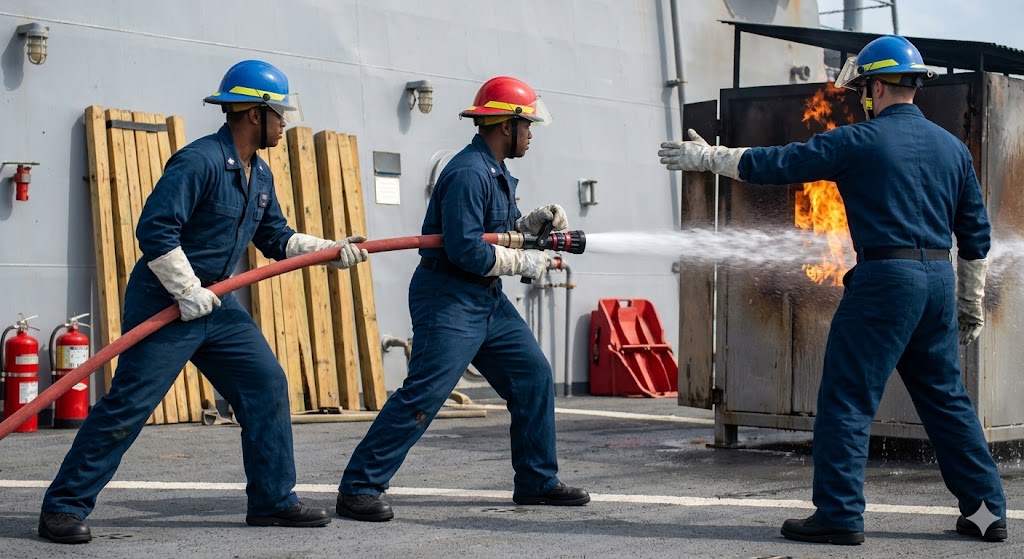
Additional Information
What the Course Entails and Exam Details
The Basic Damage Control course covers a wide spectrum of emergency response scenarios and equipment operations.
The curriculum includes, but is not limited to, the following core topics:
Chemistry of Fire: Understanding the fire tetrahedron and the different classes of fire (Alpha, Bravo, Charlie, Delta).
Firefighting Equipment: Proper operation of portable extinguishers (CO2, PKP, AFFF) and the use of fire hoses and nozzles.
Fixed Extinguishing Systems: Knowledge of shipboard systems like Halon, CO2 flooding, and AFFF.
Structural Damage Control: Techniques for plugging, patching, and shoring to control flooding and reinforce damaged structures.
CBR Defense: Proper use of the MCU-2/P gas mask, donning chemical protective overgarments (CPOG), and decontamination procedures.
Communication Systems: Utilizing the ship's interior communication circuits (e.g., 2JZ) to report casualties.
First Aid and Stretcher Bearing: Basic medical response skills for treating common shipboard injuries.
What to Expect in the Final Exam
The qualification process generally consists of two distinct parts: a written examination and practical "hands-on" assessments.
Written Examination: This portion typically features multiple-choice questions designed to test theoretical knowledge of damage control procedures, equipment functions, and safety regulations. You will be expected to identify the correct procedures for various emergency scenarios and know the specifications of standard DC equipment.
Passing Score: The required passing score can vary slightly but is generally set at 80% to ensure a high level of proficiency.
Time Limits: While usually generous, the written exam will have a designated time limit to encourage quick and accurate decision-making.
Practical Assessments: Sailors must also demonstrate their competence in a practical environment. This includes successfully bleeding a fire hose, donning a gas mask within the required time limit, and demonstrating correct plugging techniques. These are critical pass/fail components of the final qualification.
How to Study and Exam Centers
Preparation for the Basic DC exam requires a combination of self-study and practical application.
Review Official Publications: The Primary study material is the NAVEDTRA manuals, specifically the Damage Controlman Advancement Handbook and the Surface Ship Survivability manual. These publications provide the comprehensive technical knowledge required.
Utilize Online Resources: Access online learning platforms like Navy e-Learning or Joint Knowledge Online (JKO) for DC-specific courses and practice modules.
Hands-on Training: The most effective way to prepare is through actual drills and training sessions on your ship or at shore-based facilities. Practice donning your gas mask and working with DC equipment until it becomes second nature.
Practice Tests: Utilize available practice exams to familiarize yourself with the question format and identify areas where you need further review.
Testing Centers: The exam is typically administered in two ways. Sailors afloat will take the written exam on their ship under the supervision of the Educational Services Officer (ESO) or designated DC divisional personnel. Sailors ashore can take the exam at authorized training commands or specific physical testing centers designated by their command. Practical assessments are always conducted in controlled, practical environments, often on actual training simulators.
Job Opportunities from the Course
While all sailors use basic DC skills, achieving this qualification demonstrates proficiency that supports a wide range of career paths and responsibilities, primarily within the Navy, but with translatable skills for civilian life.
Damage Controlman (DC Rating)
Flying Squad Member (Primary Shipboard Emergency Response)
Scene Leader / Investigator
Repair Locker Leader
Fire Marshal
Safety Officer
Shipboard Instructor (Damage Control)
(Civilian) Firefighter / Emergency Medical Technician (EMT)
(Civilian) Industrial Safety Specialist
Frequently Asked Questions
Reviews
5.0
Based on 0 reviews
Leave a Review
No reviews yet. Be the first to review!