
Navy Communications Part 5 Practice Exam
$69.00
- Buy to unlock unlimited access to all Quiz questions and Answers in this Quiz.
- After purchase you can print a PDF of the whole quiz at any point. The PDF will contain the questions and the correct answers.
About this Exam
Embarking on the Navy Communications Part 5 Practice Exam marks a pivotal step for sailors aiming to excel in the intricate world of military communication systems.
This practice tool is meticulously designed for Information Systems Technicians (ITs) and related ratings, providing a comprehensive assessment environment.
It simulates the challenges of advanced communication evaluations, ensuring personnel are thoroughly prepared.
Mastering the material covered in this part is essential for ensuring secure, reliable, and efficient information flow across naval forces.
Whether you're gearing up for a significant advancement exam or a crucial training milestone, this practice exam offers invaluable preparation.
It validates understanding of complex technologies and operational procedures vital to fleet readiness.
Ready to test your knowledge?
Buy Now to Access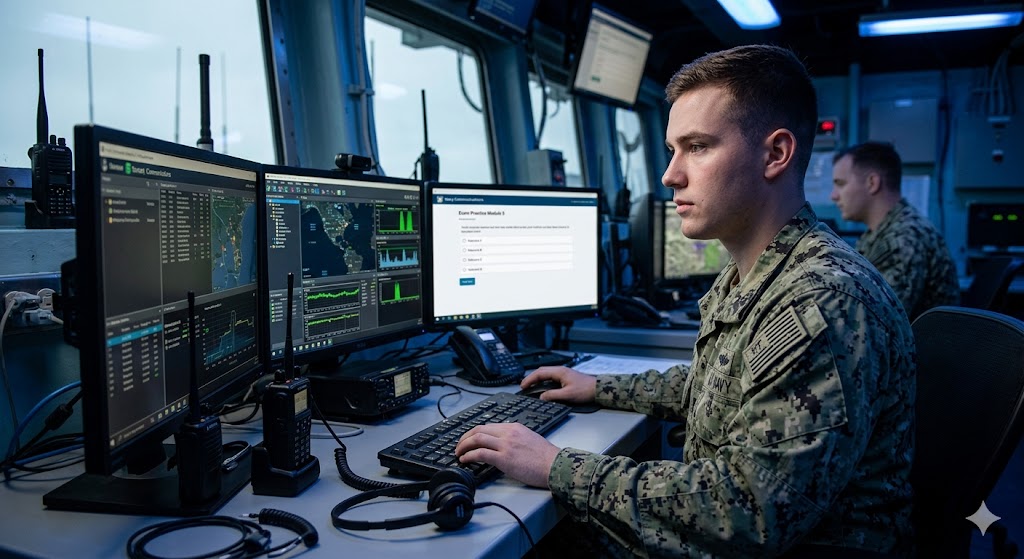
Additional Information
What the Course Entails and Exam Details
The Navy Communications Part 5 curriculum delves deeply into cutting-edge technologies and critical operational strategies.
Candidates can expect comprehensive coverage of advanced radio systems, specifically High Frequency (HF), Ultra High Frequency (UHF), and vital Satellite Communications (SATCOM).
Expect in-depth examination of crucial Digital Modular Radio (DMR) systems and powerful High Frequency Radio Group (HFRG) configurations.
Beyond specific hardware, the course extensively covers integrated Command, Control, Computers, Communications, and Intelligence (C4I) systems architecture.
Naval communication protocols, sophisticated message processing, and secure voice and data link configurations are all key pillars of study.
Understanding network fundamentals within naval enclaves and the principles of managing complex communications centers is paramount.
Troubleshooting methodologies and the expert application of specialized test equipment are also heavily emphasized to ensure operational capability.
What to Expect in the Final Exam
Prepare for a challenging, knowledge-based evaluation primarily in a multiple-choice format, often administered through secure computer systems.
This final exam is designed to rigorously assess your understanding of all the complex technical and operational topics outlined in the curriculum.
You will be required to demonstrate proficiency in various communication protocols, equipment operation principles, and troubleshooting strategies under time constraints.
The passing score required is officially determined by Navy training commands and specific rating evaluation standards, which can vary, so consult current study resources for precise targets.
It's a time-constrained examination, demanding both accuracy and efficiency in your answers to reflect real-world operational pressure.
Expect a controlled testing environment, adhering to strict rules regarding proctoring, prohibited materials, and electronic device usage to ensure the integrity of the evaluation.
How to Study and Exam Centers
Achieving success requires a dedicated and multifaceted approach to preparation, leveraging diverse study resources.
First and foremost, actively utilize practice exams like this Navy Communications Part 5 tool to familiarize yourself with question styles and time pressure.
Engage thoroughly with all official Navy training manuals, specific instruction documents, and module books related to your communication coursework.
Leverage digital resources such as Navy e-Learning and authorized online study aids, including robust flashcard sets for technical terms and procedures.
Form study groups with fellow sailors to discuss complex concepts, share insights, and test each other's knowledge effectively.
If opportunities for hands-on equipment training exist within your unit or school, maximize them to reinforce theoretical understanding with practical application.
Focus on understanding the why behind protocols and configurations, not just memorizing answers, as this deep knowledge aids critical thinking during the exam.
Simulate real exam conditions by taking full-length, timed practice tests without notes to assess your true readiness and identify weak areas.
As for testing locations, these exams are typically administered at official Navy communication schools or authorized base education/testing centers under proctored conditions.
Consult your chain of command or training pipeline coordinator for specific details on how to register and where you will take your actual evaluation.
Job Opportunities from the Course
Successfully completing the training and passing the Navy Communications Part 5 evaluation significantly enhances your qualifications for specialized and impactful roles within the fleet.
Specific career paths and functional job titles that this level of communication expertise unlocks include:
Information Systems Technician (IT) (Advanced Communications focus)
Communications Specialist
Network Administrator (for Navy Communication Networks)
C4I Systems Technician
Messaging Systems Specialist
Radio Frequency (RF) Engineer/Technician
Naval Communication Center Operator
These roles are crucial across all types of naval vessels and shore installations, from aircraft carriers to overseas communication hubs.
The skills validated by this examination are highly valued, directly contributing to mission success and unlocking diverse opportunities for career progression and specialized assignments.
Mastering these complex systems ensures you remain at the forefront of the Navy's information dominance capabilities.
Frequently Asked Questions
Reviews
5.0
Based on 0 reviews
Leave a Review
No reviews yet. Be the first to review!