
Navy Culinary Specialist (CS) Advancement Practice Test
$69.00
- Buy to unlock unlimited access to all Quiz questions and Answers in this Quiz.
- After purchase you can print a PDF of the whole quiz at any point. The PDF will contain the questions and the correct answers.
About this Exam
The Navy Culinary Specialist (CS) rating is at the heart of the Fleet's morale and well-being. This critical role involves much more than just cooking; it encompasses nutrition, sanitation, food service management, and hospitality. Advancing within this rating, especially to levels like Petty Officer Third Class through Chief Petty Officer, requires demonstrating mastery of diverse and complex skills. The Navy Culinary Specialist (CS) Various Advancement Practice Test is designed to help sailors like you, who are dedicated to feeding and fueling our Navy personnel, effectively prepare for your actual advancement exams. It's for active-duty and reserve sailors committed to career growth in the food service and hospitality sector of the Navy.
Ready to test your knowledge?
Buy Now to Access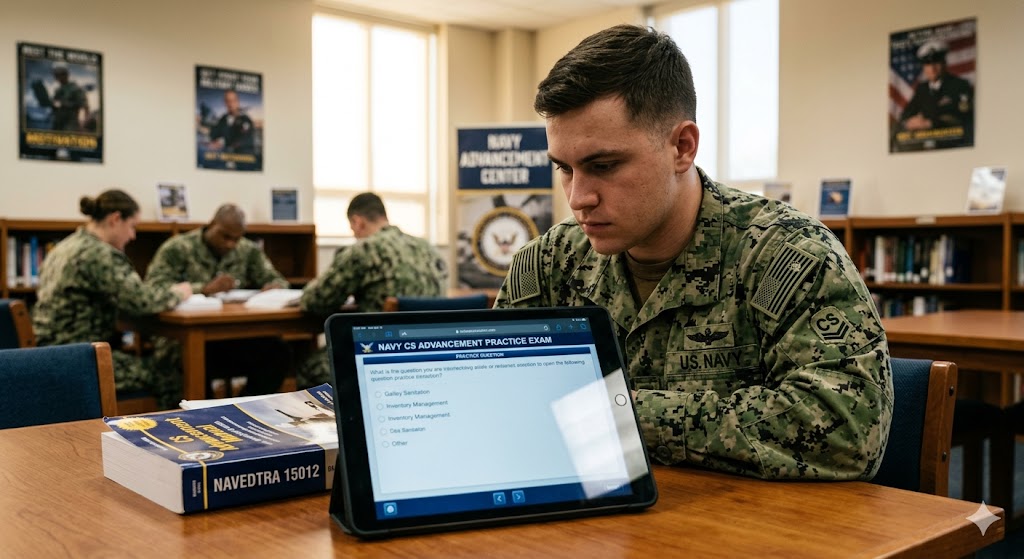
Additional Information
What the Course Entails and Exam Details
This practice test doesn't represent a specific course itself, but rather a simulation of the knowledge required for advancement in the CS rating, as detailed in Navy training manuals and instructions. Core topics covered within the practice test, mirroring the actual advancement exam syllabus, include:
Culinary Arts & Food Preparation: Comprehensive knowledge of professional food production, recipe standards, cooking techniques for large and small groups, and understanding diverse menus.
Nutrition: Fundamental principles of nutrition, menu planning for balanced diets, and meeting the specific dietary needs of personnel.
Sanitation & Safety: Strict adherence to Navy and federal health regulations (e.g., HACCP), food safety principles, sanitation of facilities and equipment, and accident prevention.
Dining Facility Management: Efficient operation of a galley, mess deck, or specialized dining facility, including personnel supervision, customer service, and inventory control.
Administration & Finance: Navy food service accounting, ordering, storage, budgeting, record-keeping, and understanding relevant NAVSUP instructions (like P-485 and P-486).
Leadership & Supervision: While the focus is technical, advancement exams also assess your ability to lead, manage, train, and mentor junior sailors under your supervision.
The practice test is built around these pillars, presenting scenarios and multiple-choice questions similar in content and complexity to those you will face in the official Navy Advancement Exam (NAE).
What to Expect in the Final Exam
While this is a practice test, the actual Navy Advancement Exam (NAE) for the Culinary Specialist (CS) rating is a highly structured, standardized written test that you must prepare for diligently. Here’s what you should expect from the official exam:
Format: The NAE is primarily composed of multiple-choice questions. It is a comprehensive assessment of your rating-specific knowledge as well as general military training and knowledge required for your rank.
Scoring: Success on the NAE is determined by a passing score or, often, by achieving a specific percentile relative to your peers who are also eligible for advancement. High scores significantly improve your chances of being selected for the next paygrade.
Time Limit: The final exam usually has a specified time limit, typically around three hours, which is sufficient to carefully consider each question, provided you have studied and are prepared for the format.
Specific Rules: The official exam is administered under strict security conditions. No personal study materials, electronics, or unauthorized items are allowed into the testing area. Your command will provide full details on these rules.
How to Study and Exam Centers
Preparation is paramount. Here are actionable study strategies and how to take the test:
Effective Study Strategies:
Use Official Navy Sources: Focus your studies on the official Culinary Specialist (CS) Nonresident Training Course (NRTCs), relevant Navy instructions (especially from NAVSUP and BUMED regarding sanitation and food ops), and the bibliography provided for your advancement cycle. These are the ultimate sources for the material on the exam.
Practice Tests: Regularly utilize this practice test and others available through official or reputable Navy education sources. Analyze your performance, especially identifying areas where you consistently struggle, and focus your study time on those weak points.
Flashcards: Create digital or physical flashcards for critical information: safety temperatures, key regulations, definitions, sanitation steps, culinary formulas, and equipment names.
Hands-on Practice: Apply your knowledge in the galley every day! The practical experience you gain is invaluable for understanding and remembering theoretical concepts. Mentorship from senior chefs and managers is also key.
Where to Take the Exam:
Practice Tests: These are available through various educational platforms, command study resources, and online portals specifically designed for military advancement training. Check with your command's educational services officer for approved options.
The Official Advancement Exam: The official Navy Advancement Exam is NOT taken at Pearson VUE or specific physical testing centers in the traditional civilian sense. It is administered directly by your command or a designated training facility under the supervision of Navy personnel and appointed command representatives. The Navy Advancement Center (NAC) coordinates and oversees this process fleet-wide.
Job Opportunities from the Course
Advancing in the Culinary Specialist (CS) rating opens up diverse and rewarding career paths within the Navy, and also equips you with highly transferable skills for the civilian hospitality industry. Key job titles and career paths this certification and your subsequent experience unlock include:
Within the Navy:
Culinary Specialist (at various rates from E-4 to E-9, e.g., CS3, CS2, CS1, CSC, CSCS, CSMC)
Food Service Division Officer (as you advance)
Galley Supervisor / Manager
Leading Petty Officer / Chief Petty Officer in a dining facility
Admirals' Steward
Fleet Culinary Manager
Instructors at Navy Culinary Schools
Positions within the Navy Supply Corps
Civilian Opportunities (Skills Transferred):
Executive Chef
Restaurant Manager
Catering Director
Hotel Food and Beverage Director
Food Service Director for corporate or institutional facilities
Possibility to pursue external certifications like Certified Executive Chef (CEC).
Frequently Asked Questions
Reviews
5.0
Based on 0 reviews
Leave a Review
No reviews yet. Be the first to review!