
Navy Culinary Specialist Records Practice Exam
$69.00
- Buy to unlock unlimited access to all Quiz questions and Answers in this Quiz.
- After purchase you can print a PDF of the whole quiz at any point. The PDF will contain the questions and the correct answers.
About this Exam
The Navy Culinary Specialist (CS) Records exam is a vital step for Navy Sailors in the CS rating who are looking to advance their careers and validate their skills in administrative and logistical operations. This exam is designed for Culinary Specialists who have completed their initial training and are seeking to demonstrate their proficiency in the meticulous record-keeping, financial management, and inventory control required to operate a Navy mess deck or galley efficiently. By passing this exam, CS Sailors showcase their readiness for increased responsibility and their commitment to maintaining the high standards of food service and financial accountability expected within the U.S. Navy.
Ready to test your knowledge?
Buy Now to Access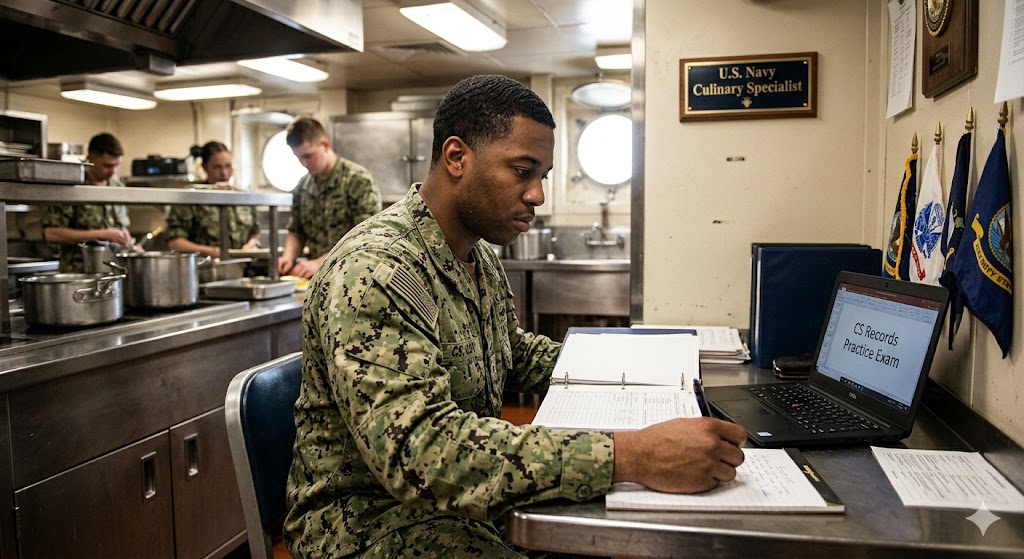
Additional Information
What the Course Entails and Exam Details
This comprehensive practice exam focuses heavily on the administrative and record-keeping aspects of the Culinary Specialist rating. While culinary skills are foundational to the CS role, this exam assesses a Sailor’s ability to manage the logistics and financial documentation that support food service operations. Core topics covered include:
Food Service Records and Forms: Mastery of Navy standard forms used for ordering, receiving, storing, and issuing food items.
Financial Management: Understanding budgeting, cost control, and financial reporting procedures for Navy messes.
Inventory Control: Procedures for conducting accurate inventories, managing stock levels, and preventing food waste.
Subsistence Ledger Management: Maintaining accurate subsistence ledgers to track the flow of food provisions.
Sanitation and Safety Regulations: While administrative, the exam ensures knowledge of record-keeping related to health inspections and safety standards.
Ration Control: Calculating ration entitlements and ensuring personnel receive appropriate food allowances.
Mess Operations and Management: Administrative tasks related to the daily operation and supervision of Navy galleys.
This practice exam serves as a crucial diagnostic tool, helping Sailors identify knowledge gaps inthese critical areas before attempting the official advancement exam.
What to Expect in the Final Exam
The actual Navy Culinary Specialist (CS) Records exam, typically a component of the Navy Wide Advancement Exam (NWAE) or a specific rating certification, will primarily consist of multiple-choice questions.
Format: Sailors can expect a rigorous multiple-choice exam administered in a computer-based format at designated Navy testing centers.
Number of Questions: While the exact number varies by exam cycle and paygrade, CS rating exams generally comprise approximately 175 to 200 questions.
Time Limit: A generous time limit, often around 3 hours, is provided to complete the exam, allowing careful consideration of each question.
Passing Score: The Navy utilizes a Final Multiple Score (FMS) system for advancement, where the exam score is a significant component, combined with performance evaluations, time in rate, and other factors. A strong exam score is critical for competitive advancement.
Content Distribution: The exam is structured to proportionally cover the key topics outlined above, ensuring a comprehensive assessment of record-keeping and administrative knowledge.
No Practical Component: This specific exam is knowledge-based and does not include a practical cooking component, as it focuses on the administrative and management skills crucial for senior Culinary Specialists.
How to Study and Exam Centers
A strategic approach to studying is essential for success on the CS Records Practice Exam and the subsequent official exam.
Review Official Navy Publications: The primary and most reliable study sources are the official Navy manuals and instructions relevant to food service and financial management, such as the NAVSUP P-485 (Naval Supply Procedures) and NAVSUP P-486 (Food Service Management General Messes).
Utilize BIBs (Bibliography for Advancement): Access the BIBs relevant to your paygrade on the MyNavy HR website. These list the specific publications from which exam questions are derived.
Engage in Focused Study: Dedicate structured time to study the specific chapters and sections outlined in the BIBs, paying close attention to forms, procedures, and calculations.
Form Study Groups: Collaborating with fellow CS Sailors can provide peer support, diverse perspectives, and a platform for discussing complex logistical scenarios.
Use Online Resources: Explore official Navy portals, Navy Knowledge Online (NKO), and reputable educational websites offering flashcards, practice quizzes, and study guides tailored to the CS rating and NWAE.
Exam Centers: The final Navy Wide Advancement Exam is administered at authorized Navy commands and physical testing centers globally, often managed by the command’s Educational Services Officer (ESO). Ensure you are aware of your command’s specific procedures for registering for and taking the exam during the designated exam cycles. Online proctoring is generally not available for the official NWAE.
Job Opportunities from the Course
Achieving proficiency in CS records management is a significant career milestone within the Navy Culinary Specialist rating. While the practice exam is a stepping stone to official advancement, mastery of these skills unlocks numerous job opportunities and career paths:
Advanced Culinary Specialist Roles: Progression to Petty Officer First Class (CS1) and Chief Petty Officer (CSC) positions, with increased leadership and supervisory responsibilities in Navy galleys afloat and ashore.
Food Service Management Officer: For high-performing Culinary Specialists, potential paths lead to commissioning programs or Limited Duty Officer (LDO) roles specializing in food service and logistics management.
Logistics and Supply Chain Management: The skills acquired in inventory control and financial management are highly transferable to Navy logistics and supply chain roles.
Culinary Instructor: Opportunities to teach records management and administrative procedures at Navy Culinary Specialist “A” and “C” schools.
Special Assignments: Placement in prestigious assignments, such as cooking for high-ranking officers, in Presidential food service, or at foreign embassies, often requiring both culinary and administrative excellence.
Civilian Career Transferability: The expertise gained in managing large-scale food operations, budgeting, and inventory control is highly sought after in the civilian hospitality industry, leading to management positions in hotels, restaurants, corporate dining, and institutional food services upon transition from military service.
Frequently Asked Questions
Reviews
5.0
Based on 0 reviews
Leave a Review
No reviews yet. Be the first to review!