
Navy Enlisted Surface Warfare Specialist Practice Exam
$69.00
- Buy to unlock unlimited access to all Quiz questions and Answers in this Quiz.
- After purchase you can print a PDF of the whole quiz at any point. The PDF will contain the questions and the correct answers.
About this Exam
The Navy Enlisted Surface Warfare Specialist (ESWS) qualification is a prestigious and rigorous program designed for all enlisted sailors serving in the United States Navy's surface warfare community. It represents a significant professional milestone, signifying that a sailor has acquired a comprehensive understanding of their ship's operations, systems, and warfighting capabilities, far beyond the scope of their specific rating. This qualification is a declaration of proficiency, proving that a sailor is a valuable asset in all aspects of a warship's mission, from combat operations to damage control. It is designed to create more well-rounded and capable warriors, ensuring the entire crew can contribute to the ship’s survivability and success in any environment.
Ready to test your knowledge?
Buy Now to Access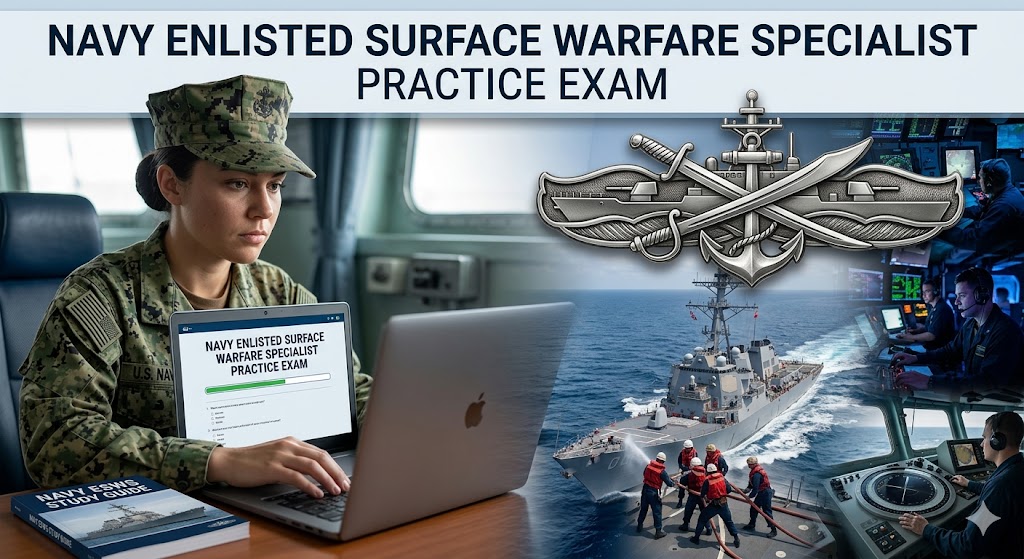
Additional Information
What the Course Entails and Exam Details
Earning the ESWS pin is a multi-stage process that combines self-study, on-the-job training, and practical qualifications. The journey is centered around the Personnel Qualification Standards (PQS), a structured manual that serves as the official curriculum. Sailors must systematically complete hundreds of line items in their PQS, which are "signed off" by qualified mentors and supervisors. The core areas of knowledge and proficiency covered in the ESWS program include:
Naval Heritage and Organization: Understanding Navy history, customs, traditions, and the overall command structure.
Shipboard Organization and Administration: Mastering the daily operations, watchstanding principles, and administrative functions of a warship.
Basic Damage Control: Acquiring the skills to fight fires, control flooding, and perform chemical, biological, and radiological (CBR) defense.
Engineering Systems: Developing a working knowledge of the ship's propulsion, electrical, and auxiliary systems.
Combat Systems and Weapons: Understanding the ship’s radar, sonar, communication, and major weapon systems.
Operations and Navigation: Mastering charts, navigation, and the function of the Combat Information Center (CIC).
Deck and Supply Fundamentals: Knowledge of seamanship, replenishment-at-sea, and logistical support.
Platform-Specific Systems: Gaining expertise in the specific systems unique to the sailor’s type of ship, whether a destroyer, cruiser, or amphibious assault ship.
The final stage of the qualification is the formal assessment, which commonly consists of two parts: a multiple-choice written examination and a rigorous oral examination board, where the candidate must defend their knowledge to a panel of ESWS-qualified senior personnel.
What to Expect in the Final Exam
The ESWS final assessment is known for its difficulty, designed to ensure that only those with a deep, command-wide understanding of surface warfare earn the designation. While the exact details can vary by individual command and ship, candidates should prepare for the following components:
Written Examination: A comprehensive multiple-choice test. This exam covers the entirety of the PQS common core and ship-specific fundamental knowledge. It is designed to verify the factual recall and understanding of a vast amount of naval information.
Oral Examination Board: This is often considered the most demanding part. The candidate sits before a board, usually composed of a mix of senior enlisted leaders and officers, all of whom are already ESWS qualified. They will be asked detailed, scenario-based questions that require them to explain complex systems, damage control procedures, and operational principles. The board is looking for not just the correct answer, but for a confident, structured response that demonstrates a thorough operational understanding of the material.
Standardized Structure: A candidate can expect a formal and structured setting, emphasizing professionalism. There is typically no single passing score that applies Navy-wide; each command establishes its own minimum required scores for both the written test and the oral board. Time limits on the written portion are common, adding a layer of pressure to the assessment.
How to Study and Exam Centers
Preparing for the ESWS qualification is a continuous process that requires dedication and a strategic approach. Sailors are encouraged to use a mix of methods to ensure a broad base of knowledge:
"Kill the Book" (PQS Progress): This is the foundation. Dedicate consistent time to studying the PQS manual. Get face-to-face line-item sign-offs, as each one is a mini-interview that reinforces your learning.
Find Mentors and Subject Matter Experts (SMEs): The best resources are fellow shipmates. Ask a qualified sailor from another rating to explain their equipment. Hands-on exposure is invaluable for internalizing the material.
Utilize Command Training and Study Groups: Participate in all available ESWS training sessions offered by your ship. Form study groups with peers to review material, quiz each other, and practice for the oral board.
Use Online and Digital Resources: Leverage the official Navy tools available on MyNavy Portal, including digital PQS access and training modules.
Practice Tests: Seek out and take numerous practice exams. The very practice test described in this guide is a critical tool for familiarizing yourself with the format of the written exam and identifying your weak areas.
Regarding Exam Centers: It is important to understand that the Navy ESWS qualification is a command-driven program and is not administered at external, civilian testing centers like Pearson VUE. The qualification process, including both the written and oral examinations, occurs entirely onboard a United States Navy surface ship or at an authorized naval training command during a ship's training cycle. The qualification is a direct reflection of a sailor's proficiency in their operational environment.
Job Opportunities from the Course
The primary benefit of earning the ESWS qualification is not a new job title, but significant career advancement within a sailor’s existing rating. Achieving this designation is a hallmark of leadership and professional dedication, unlocking numerous opportunities and advantages throughout a Navy career:
Navy Advancement Points: The ESWS pin provides valuable points that make a sailor more competitive for promotion, leading to higher rank and pay.
Improved Performance Evaluations: It is an automatic bullet point for performance evaluations (EVALs), demonstrating that a sailor goes above and beyond their assigned duties. This helps them receive higher-ranking EVALs against their peers.
Eligibility for Leadership Roles: Many commands require the ESWS qualification for a sailor to be considered for positions of increased responsibility and leadership, such as Section Leader or Command-level assignments.
Better Orders and Assignments: Sailors with the ESWS pin are seen as more professional and capable, which often gives them preference for more desirable orders and choice of duty stations.
Access to Advanced Qualifications: ESWS is often a prerequisite for more senior warfare qualifications, such as the Enlisted Expeditionary Warfare Specialist (EXW) or other higher-level professional development programs. Earning the ESWS qualification proves that a sailor is ready for the next level of challenge in the surface fleet.
Frequently Asked Questions
Reviews
5.0
Based on 0 reviews
Leave a Review
No reviews yet. Be the first to review!