
Navy Hospital Corpsman Fundamentals Practice Test
$69.00
- Buy to unlock unlimited access to all Quiz questions and Answers in this Quiz.
- After purchase you can print a PDF of the whole quiz at any point. The PDF will contain the questions and the correct answers.
About this Exam
The Navy Hospital Corpsman (HM) rating is the largest and most diverse in the U.S. Navy.
It represents the front line of medical care for Sailors, Marines, and their families.
Before achieving this prestigious rating, candidates must successfully navigate the rigorous training program at the Medical Education and Training Campus (METC).
The Navy Hospital Corpsman Fundamentals Practice Test is an essential preparatory tool designed specifically for enlisted personnel currently enrolled in HM "A" School.
It is tailored for individuals aiming to reinforce their classroom learning and ensure readiness for the official comprehensive examinations required to graduate as a basic Hospital Corpsman.
Ready to test your knowledge?
Buy Now to Access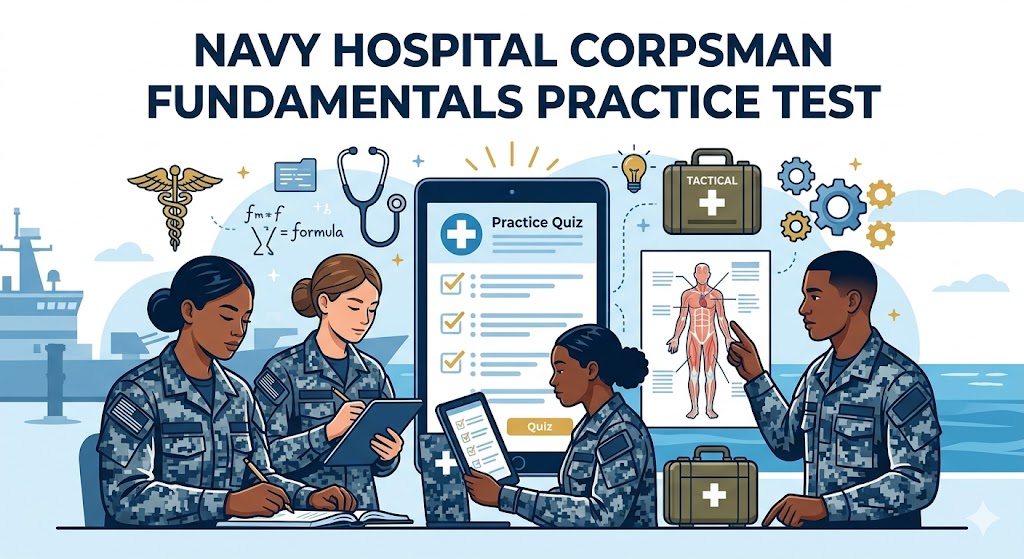
Additional Information
What the Course Entails and Exam Details
The core curriculum leading to this exam is exhaustive, blending theoretical medical knowledge with hands-on practical application.
This practice test is structured to mirror the real curriculum and evaluates competence across several critical domains.
You will encounter questions related to basic human anatomy and physiology, ensuring a foundational understanding of bodily systems.
Fundamental nursing skills, including patient assessment, hygiene, and vital signs monitoring, are heavily emphasized.
The test also covers extensive material on first aid, emergency medical treatment, and Tactical Combat Casualty Care (TCCC), which is vital for operational environments.
Additionally, candidates are assessed on their understanding of pharmacology basics, medical terminology, and basic preventive medicine protocols used in Navy health care.
What to Expect in the Final Exam
The actual Navy Hospital Corpsman Fundamentals exam is a high-stakes assessment that determines progression in the HM training pipeline.
It utilizes a multiple-choice format, designed to test both broad knowledge and specific, critical details necessary for patient safety.
While the exact number of questions and time limits can vary slightly depending on the current curriculum version, you can generally expect a time-constrained computer-based test.
Candidates must achieve a passing score—typically 70% or higher—to move on to practical applications and the next phases of training.
It is important to remember that in "A" School, exams are strictly monitored, and academic integrity is paramount.
Failure to pass can result in academic review boards and potential rolling back or separation from the training program.
How to Study and Exam Centers
Preparation is the absolute key to success in HM "A" School and on the Fundamentals exam.
The single most effective study strategy is to thoroughly master the curriculum material provided during instruction, as Navy testing is strictly derived from the approved NAVEDTRA manuals and lesson plans.
Utilizing a dedicated Navy Hospital Corpsman Fundamentals Practice Test, such as this one, is an invaluable study method.
Practice tests help you identify critical knowledge gaps, familiarize yourself with the phrasing of military medical questions, and build necessary test-taking stamina.
Active studying is required; do not just passively highlight text, but instead use flashcards for medical terminology and drug names, and form study groups to review anatomy and procedure protocols.
The official final written examinations are administered in secure, proctored computer labs directly located at the training schools, primarily at the Medical Education and Training Campus (METC) on Joint Base San Antonio-Fort Sam Houston, Texas.
Job Opportunities from the Course
Graduating from this course and becoming a Hospital Corpsman opens a vast array of challenging and rewarding career paths within the Navy and the civilian sector.
Earning your rating as an HM allows you to work immediately in various settings.
Here is a list of the specific job opportunities and career paths this certification and training unlock:
Navy Hospital Corpsman (HM 0000 - Generalist) in Navy Hospitals or Clinics.
"Green Side" Corpsman, serving directly with United States Marine Corps units.
Specialized Technician (NECs) paths, including:
Aerospace Medicine Technician.
Behavioral Health Technician.
Biomedical Equipment Technician.
Cardiovascular Technician.
Dental Hygienist.
Medical Laboratory Technician.
Nuclear Medicine Technologist.
Pharmacy Technician.
Preventive Medicine Technician.
Radiation Health Technician.
Respiratory Therapy Technician.
Surgical Technologist.
Advanced operational roles, such as Special Amphibious Reconnaissance Corpsman (SARC) or Deep Sea Diving Medical Technician.
Civilian opportunities: Transitioning Sailors are highly competitive for roles as Emergency Medical Technicians (EMTs), Medical Assistants, or continuing their education toward nursing or physician assistant programs.
Frequently Asked Questions
Reviews
5.0
Based on 0 reviews
Leave a Review
No reviews yet. Be the first to review!