
Navy OCS Navigation Practice Exam
$69.00
- Buy to unlock unlimited access to all Quiz questions and Answers in this Quiz.
- After purchase you can print a PDF of the whole quiz at any point. The PDF will contain the questions and the correct answers.
About this Exam
The Navy Officer Candidate School (OCS) is a demanding 13-week training program designed to test your mental, physical, and character limits. It is a critical path to becoming an Officer in the United States Navy, and the training is rigorous across all areas. Among the many academic hurdles you will face, the Navigation exam is one of the most significant and often cited by candidates as one of the most challenging.
This practice exam is specifically designed to help you prepare for that critical Navigation evaluation. It targets individuals who have already met the baseline requirements for OCS and are preparing to report to Newport, Rhode Island, for training. Success in the OCS Navigation exam isn't just about getting a high score; it's about demonstrating your ability to lead, make quick decisions under pressure, and safely operate a multi-billion dollar platform in any environment. If you want to arrive at OCS prepared and confident, a comprehensive Navigation Practice Exam is essential.
Ready to test your knowledge?
Buy Now to Access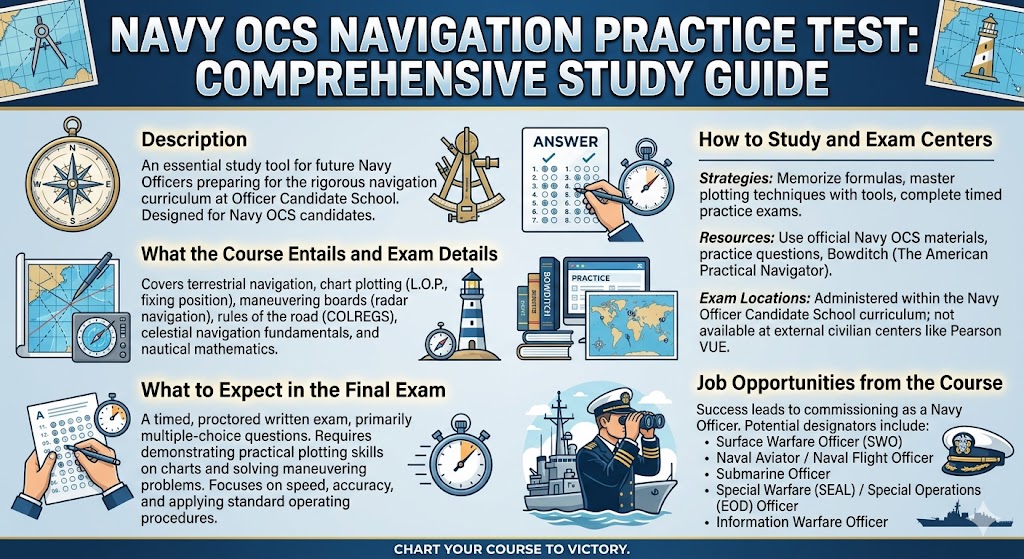
Additional Information
What the Course Entails and Exam Details
The Navigation curriculum at OCS is not a shallow overview; it is an intensive dive into professional mariner skills. The course entails understanding both traditional methods and modern applications that you will use from day one in the fleet. You will be expected to master everything from paper charts to sophisticated electronic systems.
Key skills and topics covered in the Navigation coursework and validated by the exam include:
Plotting and Chartwork: The foundation of all navigation. You must learn to correctly interpret nautical charts, apply correct terminology, and use precise plotting tools (like dividers and parallel rulers) to chart a course, determine speed over ground, and calculate your estimated time of arrival (ETA).
The Three Minute Rule and Six Minute Rule: Rapid mental math for speed and distance calculations. You must internalize these rules to solve navigation problems instantly during a real-time evolution.
Piloting: Safely guiding a ship using visual references, such as buoys, lighthouses, and electronic aids to navigation (ATONs). You will learn how to take a "fix" and a "running fix."
The Magnetic Compass: While modern tech is great, the magnetic compass is a mandatory backup. You will master compass deviation, variation, and calculating a 'True' course versus a 'Compass' course using standard corrections (e.g., 'Compass Best, Error West').
Navigation Mathematics: You must have a strong command of basic algebra and trigonometry to solve complex navigation equations.
Tides and Currents: Understanding how the environment impacts your ship’s draft, movement, and arrival windows. This includes calculating time, height, and velocity of tidal changes.
Radar Navigation: Utilizing the Surface Search Radar for collision avoidance and navigation, including plotting contacts, determining their Course, Speed, and Closest Point of Approach (CPA).
Bridge Management and Watchstanding: The Navy evaluates your ability to work as part of a team, integrate information from multiple sources (like a quartermaster or radar operator), and effectively lead the navigation team.
The exam itself is notoriously fast-paced. It usually consists of approximately 50 to 100 questions, blending multiple-choice conceptual questions with multiple "plotting scenarios" where you must generate answers by physically drawing on a nautical chart (usually provided in your exam packet) using standard naval procedure.
The content isn't just theoretical; it's a direct prerequisite for your actual ship-handling simulations and your role as a surface warrior.
What to Expect in the Final Exam
Prepare yourself for a high-intensity academic experience. The Navy OCS Navigation exam is known for being a substantial hurdle, often lasting 3 to 4 hours in a single session. This is designed to test your focus and accuracy under time pressure, simulating the real-world conditions you would encounter as an Officer of the Deck (OOD).
The exam typically has two primary sections:
Multiple Choice: This section tests your grasp of navigation concepts, definitions, rules of the road (COLREGs), and rapid mental math (like the Three Minute Rule). This section is often the first part of the test and must be completed relatively quickly.
The Plotting Problem: This is often the centerpiece of the exam. You will be given a specific, fictional, multi-step voyage (often dynamic, with course and speed changes). You will be provided a standard nautical chart, your plotting tools (dividers, parallel rules), and a sequence of "fixes" or situations (e.g., "At 1200, you are at this point. At 1230, you must be here. What course do you need to steer, and will you clear the hazard?").
Your final score is a weighted combination of these sections.
Passing Score and Time Limits:
The minimum passing score is 80%. This is a non-negotiable benchmark. While 80% is the official Navy standard, your instructors at OCS will push you toward 100%, and you should, too. In real-world navigation, an "80%" is a serious incident.
Failing to meet the 80% threshold can have serious consequences. A first failure usually triggers required remedial study sessions ("mando"), additional practice exams, and potentially mandatory re-testing (often a different version of the exam). Continuous academic struggle or a second failure on the same exam could lead to academic attrition (being rolled back to a later class) or even disenrolling you from the OCS program.
Specific exam rules include the strict prohibition of any non-issue electronic devices (including personal calculators or phones). You must solve all problems using standard Naval procedures, formulas, and approved plotting tools, exactly as taught in the curriculum. Show your work on your scratch paper—a correct answer with no work shown is sometimes a automatic failure on that problem.
How to Study and Exam Centers
Preparation for the OCS Navigation exam is the key to success. This is not a test you can cram for overnight; it requires repeated practice until the processes become muscle memory.
How to Study Effectively:
Master the Three Minute/Six Minute Rule: This is not optional. You must be able to perform these calculations (Distance = Speed x Time) effortlessly in your head or with minimal scratchpad use. Every minute saved on basic math is a minute you can use to check your chart work.
Practice the Math/Calculations: Get comfortable with the algebra of the deviation/variation corrections. Drill problems on "Compass Best, Error West; Compass Least, Error East" until you can do them without thinking.
Create Your Own Chart Problems: Find a standard Navy training chart (they are often available online in PDF form). Use a pencil, ruler, and dividers. Give yourself scenarios. "I am leaving port at 0800. My destination is X. What course will I steer? If I go at 15 knots, when will I arrive?" The key is perfecting your chart work: sharp pencil points, exact lines, correct fix symbols (circle for visual, triangle for radar).
Practice COLREGs (Rules of the Road): This will be a major part of the multiple-choice section. Don't just read them; practice scenarios. "I am in a crossing situation on a power-driven vessel. Where is the risk of collision? What is my responsibility?" Use flashcards for lights and dayshapes.
Utilize Practice Exams: Take Navy OCS Navigation Practice Exams (like this one) under simulated timed conditions. This is crucial for managing your time effectively, especially on the plotting section. The practice test will help you identify which specific topics or procedures you struggle with most.
Exam Centers and Testing Locations:
You will not take this exam at a public testing center like Pearson VUE. The Navigation Exam, as part of your comprehensive Navy OCS program, is administered internally by Navy instructors.
You will sit this exam only at Navy Officer Candidate School in Newport, Rhode Island, typically in an academic classroom setting. The exact scheduling and location are determined entirely by your class's training itinerary. Because the exam is administered within a military command, all test materials, procedures, and conditions are strictly controlled by the Navy. The final test you sit at OCS is the culminating academic evaluation of that specific module.
Job Opportunities from the Course
Successfully completing the Navigation course and passing the final exam is a crucial step that unlocks many leadership paths within the Navy. While this specific Navigation qualification is part of your baseline knowledge, it is a primary prerequisite for serving as an officer in any of the Navy's major operational communities.
Job titles and career paths available after successfully commissioning and completing the necessary follow-on training include:
Surface Warfare Officer (SWO): This is the most direct application. SWOs lead the divisions and operate the engineering and weapon systems of Navy destroyers, cruisers, and other combatant ships. You must navigate a massive ship daily, and this training is your foundation.
Naval Aviator: Even as a pilot flying advanced aircraft (jets, helicopters, maritime patrol), you must be an expert navigator. The fundamental concepts of plotting and calculating courses apply when flying from aircraft carriers or operating over ocean expanses.
Naval Flight Officer (NFO): NFOs are the highly trained specialists in the backseat of jets and non-pilot specialists on larger platforms who manage the weapon systems, radar, and navigation. This OCS groundwork is critical to their specialized training pipeline.
Submarine Officer: Submarines require exceptionally skilled navigators due to the complexity of operating underwater for extended periods. This fundamental navigation skill is essential to their extensive power school and prototype training.
Special Warfare Officer (SEAL/EOD): While not their primary task, these elite officers must be proficient navigators to plan and execute small-unit, high-stakes insertions and operations in challenging environments, often using both traditional and advanced nav systems.
Explosive Ordnance Disposal (EOD) Officer: EOD teams must often navigate safely to locate, render safe, and dispose of explosive hazards, including sea mines. Their comprehensive operational knowledge includes a solid understanding of marine navigation.
Frequently Asked Questions
Reviews
5.0
Based on 0 reviews
Leave a Review
No reviews yet. Be the first to review!