
Navy Operational Risk Management Practice Exam
$69.00
- Buy to unlock unlimited access to all Quiz questions and Answers in this Quiz.
- After purchase you can print a PDF of the whole quiz at any point. The PDF will contain the questions and the correct answers.
About this Exam
The Navy Operational Risk Management (ORM) training is a fundamental pillar of United States Navy culture, designed to instill a systematic mind-set for making sound decisions across all naval operations. This critical training is mandatory for all active duty, reserve, and civilian personnel within the Department of the Navy. Its primary goal is to provide personnel with a standardized framework to anticipate hazards, assess risks, and implement effective controls to minimize mishaps, enhance mission effectiveness, and preserve valuable resources and personnel lives. Mastering ORM is not just about compliance; it is about cultivating a proactive safety consciousness that is applied to every task, from routine maintenance to complex combat operations. This practice test is specifically designed to help naval personnel validate their understanding of ORM principles before attempting official certification or recurring training requirements.
Ready to test your knowledge?
Buy Now to Access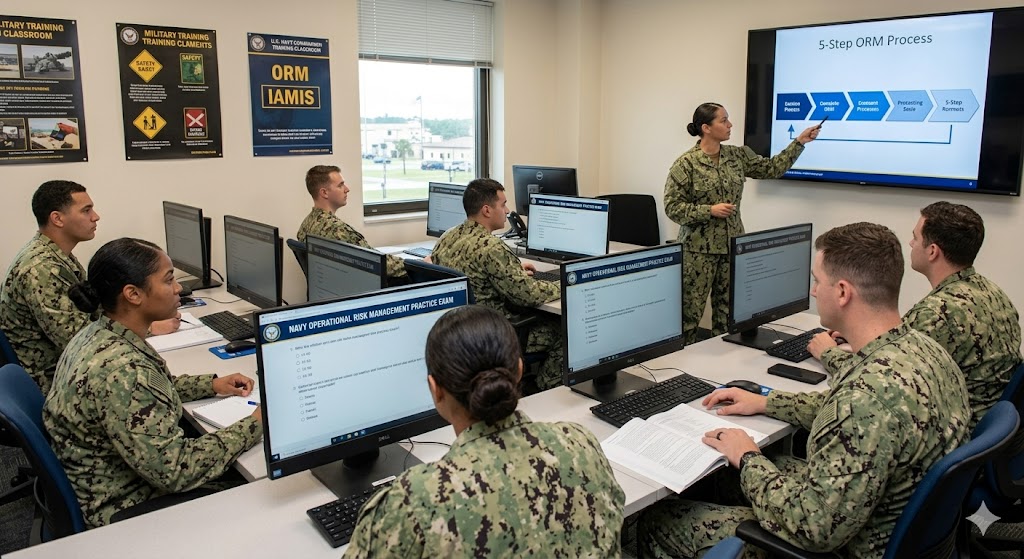
Additional Information
What the Course Entails and Exam Details
The Navy Operational Risk Management curriculum provides a deep dive into the standardized five-step process that forms the backbone of naval decision-making. The course covers crucial terminology, guiding principles, and levels of risk management application.
Key syllabus topics include:
The 5-Step ORM Process: Comprehensive understanding of the IAMIS cycle: Identify Hazards, Assess Hazards, Make Risk Decisions, Implement Controls, and Supervise.
The 3 Levels of ORM: Differentiating between Time-Critical Risk Management (TCRM), Deliberate, and In-Depth ORM applications.
The 4 Principles of ORM: Integrating ORM into operations at all levels; making risk decisions at the appropriate level; accepting risk when benefits outweigh costs; and accepting no unnecessary risk.
Risk Assessment Matrix: Learning how to utilize the standard Navy matrix to determine risk priority based on severity and probability.
Hazard Control Strategies: Understanding the hierarchy of controls (engineering, administrative, physical) and their application in various naval scenarios.
ORM Terminology: Definitions of critical terms such as hazard, risk, mishap, severity, and probability in the context of OPNAVINST 3500.39 (series).
What to Expect in the Final Exam
While the exact structure of the official Navy Operational Risk Management evaluation can vary slightly depending on the specific delivery method (e.g., Navy e-Learning, command-administered training), the assessments generally adhere to a standardized format designed to test practical application of the principles.
Here is what personnel can generally expect:
Exam Format: The assessment typically consists of a series of objective questions, primarily Multiple Choice and True/False, often presented within Navy e-Learning (NeL) modules or as part of a proctored command exam.
Scenario-Based Questions: A significant portion of the exam will likely be scenario-based. You will be presented with a naval operation (e.g., a flight deck operation, navigation detail, or maintenance task) and must correctly apply the 5-step process or principles to that specific situation.
Passing Score: A passing score is generally 80%, although command requirements or specific training pipelines may demand a higher threshold for mastery.
Time Limits and Specific Rules: Official online modules often don't have a strict timer, allowing you to review the material, though you must complete the assessment within the training window assigned by your training officer. For command-proctored paper exams, standard military testing protocols apply.
Retake Policy: Personnel who do not achieve a passing score are typically required to review the course material again before being permitted to retake the assessment, often after a 24-hour waiting period.
How to Study and Exam Centers
Successfully passing the Navy ORM assessment requires active engagement with the material and a clear understanding of how the principles apply to real-world naval environments.
Effective study strategies include:
Leverage Official References: The definitive source for ORM is OPNAVINST 3500.39 (Operational Risk Management). Study this instruction thoroughly. It contains all fundamental concepts, definitions, and application models.
Review NeL Modules: Utilize the official "Operational Risk Management (ORM)" course modules available on Navy e-Learning (NeL) through the MyNavy Portal (MNP). Pay close attention to the examples and embedded knowledge checks.
Scenario Practice: Do not just memorize definitions. Practice walking through the 5-step process for common tasks within your specific rate (e.g., a Gunner's Mate setting up a range, or an Aviation Boatswain's Mate preparing for a launch).
Use Practice Tests: Utilize practice exams (like this one) to test your recall and application skills. Focus on the questions you get wrong and review the corresponding material in the OPNAVINST.
Study the Matrix: Ensure you can navigate the Risk Assessment Matrix instantly, understanding the relationships between severity, probability, and risk level.
Exam Locations: The official ORM training and assessment are primarily conducted online via the Navy e-Learning portal, accessible from any authorized government computer or designated Navy testing center globally. Recurring or annual training may also be conducted via command-led stand-downs or training groups.
Job Opportunities from the Course
Mastery of Operational Risk Management is not simply a check-in-the-box requirement; it is a critical skill set that enhances performance and safety in every naval billet. While ORM is a required competency for all ratings, advanced knowledge or specialization in ORM-related areas can unlock specific career paths and leadership opportunities.
Key job roles and areas where advanced ORM proficiency is essential include:
Command Safety Officer: A primary role responsible for overseeing the command's safety program, ensuring compliance with ORM procedures and mishap prevention strategies.
Divisional Safety Petty Officer: Junior and senior enlisted personnel designated within their divisions to monitor operations and advise leadership on ORM application.
Quality Assurance (QA) Inspector: Positions in maintenance (Aviation, Surface, Submarine) where critical attention to detail and risk management during repairs is paramount.
Instructor Billits (CPO/Officer): Personnel responsible for teaching ORM principles at training commands, Recruit Training Command (RTC), and Officer Candidate School (OCS).
Operational Leadership Roles: Every Chief Petty Officer and Commissioned Officer is a "risk manager." Exceptional application of ORM is a hallmark of strong, mission-capable leaders and is critical for advancing in any leadership billet, including Command Master Chief and Commanding Officer.
Specialized Rates: High-risk occupational fields such as Naval Special Warfare (SEAL/SWCC), Explosive Ordnance Disposal (EOD), Navy Divers, and Naval Aviation Rates rely heavily on advanced, instinctive ORM for survival and mission success.
Civilian Transition (Safety Management): Post-military, proficiency in Navy ORM translates directly into civilian certifications (like CSP or OHST) and lucrative careers in occupational health and safety (OSHA) management, construction safety, and corporate risk management.
Frequently Asked Questions
Reviews
5.0
Based on 0 reviews
Leave a Review
No reviews yet. Be the first to review!