
Navy PMK-EE E-7 MMC Practice Exam
$69.00
- Buy to unlock unlimited access to all Quiz questions and Answers in this Quiz.
- After purchase you can print a PDF of the whole quiz at any point. The PDF will contain the questions and the correct answers.
About this Exam
Welcome to your comprehensive guide to the Navy PMK-EE E-7 MMC Practice Exam, an essential resource for ambitious U.S. Navy sailors in the E-6 paygrade striving for advancement to Chief Petty Officer.
The official Professional Military Knowledge Eligibility Exam (PMK-EE) is a critical, electronically-administered assessment that tests foundational military knowledge, ensuring sailors possess the professional acumen and leadership understanding required for higher ranks.
This guide, and the associated practice material (Navy PMK-EE E-7 MMC Practice Exam), is designed to help you confidently master the exam's content.
While the exact "MMC" designation in the title may be specific to a particular study resource, the focus of this guide and the materials it represents is entirely on the content and structure of the standard Navy PMK-EE for E-7 advancement.
Understanding this exam's nature and utilizing effective practice tools is paramount to your success, as achieving a passing score is a mandatory prerequisite for being considered by the selection board for advancement to E-7.
Prepare thoroughly with this study aid, and approach the final exam with confidence, knowing you have invested in your future leadership role as a Navy Chief Petty Officer.
Ready to test your knowledge?
Buy Now to Access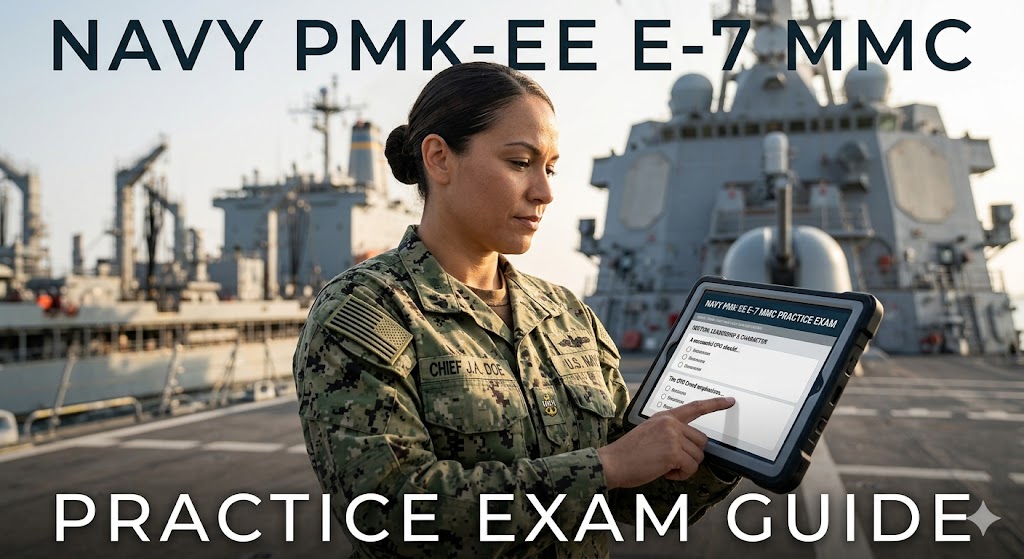
Additional Information
What the Course Entails and Exam Details
The real-world PMK-EE E-7 exam encompasses a wide range of professional military knowledge and leadership principles essential for a potential Chief Petty Officer. While specific practice resources might slightly vary in exact questions, they all mirror the official topics required for the Navy. This comprehensive guide and associated practice materials focus on the main content areas sailors must master for the PMK-EE E-7:
Career Information: This crucial area covers a vast array of Navy regulations and procedures, including advancements, career paths, time-in-rate requirements, physical readiness standards, high-year tenure, uniform regulations, and various administrative processes that influence a sailor’s career progression.
Leadership and Character: Leadership is the cornerstone of the Chief Petty Officer, and this section explores foundational leadership concepts, ethics, mentorship, professional development, and the traits expected of a leader. It delves into the importance of integrity, humility, and accountability.
Naval Heritage: Understanding the Navy’s rich history is vital, and this topic area covers historical events, significant figures, traditions, and the evolution of naval customs and courtesies. A strong grasp of heritage reinforces the sailor’s sense of purpose and pride in their service.
Professional Conduct: This section emphasizes the highest standards of behavior expected in the Navy, covering UCMJ basics, ethical decision-making, harassment and discrimination policies, substance abuse prevention, and operational security (OPSEC).
Warfighting and Readiness: This component assesses knowledge related to the Navy’s mission, operational principles, damage control, safety procedures, and the readiness required for deployment and combat. Understanding the principles of maritime strategy and the current threats is crucial.
What to Expect in the Final Exam
The actual U.S. Navy PMK-EE for E-7 is designed to thoroughly assess your military knowledge through an efficient and structured format. Knowing what to expect on the official exam can help alleviate test-day anxiety and focus your final preparation:
Exam Format: The PMK-EE E-7 is a computer-based and/or officially sanctioned mobile application exam. It typically consists of multiple-choice questions, randomly generated from a vast question bank for each unique exam session.
Total Questions: You can expect approximately 100 multiple-choice questions in total across the five main content areas mentioned in the previous section. In some implementations, the exam may be divided into 20 questions per topic.
Passing Score: To pass the PMK-EE E-7, you must achieve a score of 80% or higher on each of the five individual sections (if administered that way), as well as an overall passing score of 80% or higher. Failing to meet the required score on any section usually means you must retake that entire section.
Time Limits: A key advantage of the PMK-EE is that it is non-timed. The exam is designed for you to progress through the questions at your own pace. If you are taking the exam over multiple sessions (which is possible through official portals and apps), your progress will be bookmarked, allowing you to resume where you left off.
Retakes: You are typically allowed to retake any failed section of the exam as often as necessary to achieve the required 80% passing score. This ensures you have the opportunity to master the material in each area.
Rules: The official exam must be taken on sanctioned Navy systems or applications. Utilizing official bibliographies and resources is critical for direct alignment with the current question bank. Always consult current Navy directives for the most up-to-date rules.
Prerequisite for Advancement: Completing and passing the PMK-EE E-7 is mandatory for
Prerequisite for Advancement: Completing and passing the PMK-EE E-7 is mandatory for sailors to be eligible to have their records reviewed by the E-7 selection board. It is a critical gateway in the Navy advancement process.
How to Study and Exam Centers
Preparation for the PMK-EE E-7 is highly effective when approached systematically, and there are various avenues for study and official testing:
Official Navy Resources: Your primary source of study material must be the official PMK-EE bibliographies, which can be found on MyNavy Portal (MNP) within the Advancement & Promotion section. These bibliographies link directly to the specific Navy instructions and publications (NAVEDTRAs, BUPERSINSTs, etc.) from which exam questions are derived. Studying these documents is fundamental.
Utilize Practice Tests: Use comprehensive practice exams, such as the one referenced in the title (Navy PMK-EE E-7 MMC Practice Exam), to gauge your understanding, identify weak areas, and practice time management (even though the final exam isn't timed, familiarity helps). Look for practice resources that are current and well-regarded within the fleet.
Form Study Groups: Collaborating with other E-6 sailors can be incredibly beneficial. Discussing complex topics, quizzing each other, and sharing perspectives can enhance memory and deepen understanding. Look for study groups at your command or join reputable online forums for Navy advancement.
Create Flashcards: Making flashcards for critical terms, dates, regulations, and leaders across all topic areas is a classic and highly effective way to reinforce key information. Digital flashcard apps can make this process efficient and portable.
Practice with the Official App: The Navy provides a dedicated PMK-EE mobile application, available on both iOS and Android platforms. This app is designed not only to deliver study content but also the official exam itself. Familiarize yourself with its interface and use it for practice questions whenever possible.
Manage Your Study Time: Dedicate consistent, focused study time to each of the five exam sections. Breaking down the material into manageable parts is less overwhelming than attempting to master everything at once.
Official Exam Centers and Access:
Online Portals: The primary way to take the official PMK-EE E-7 is through sanctioned Navy online portals. These are accessible via MyNavy Portal (MNP), specifically through the Naval eLearning (NeL) or similar advancement links, requiring access to a CAC and a networked Navy computer.
Official Mobile Application: As mentioned, the PMK-EE mobile application is an authorized platform to take the exam for all paygrades (E-4 to E-7). Sailors can take the exam on their personal devices, allowing for flexibility and self-pacing.
No Physical Exam Centers: Unlike rating exams, there are typically no external physical exam centers like Pearson VUE used for the PMK-EE. The exam is solely accessible through the designated official online platforms or mobile apps. Your command training officer or educational services officer can provide specific guidance for your location and context.
Maintain Records: Always ensure that your successful completion of the PMK-EE is properly recorded in your personal data systems (like NSIPS or FLTMPS) and obtain/retain a copy of your completion certificate. The mobile app should facilitate this process by allowing you to submit your score to official systems.
5. Job Opportunities from the Course
Passing the PMK-EE E-7 is a significant milestone that does not, in itself, grant a new job title. Instead, it is the fundamental gatekeeper and prerequisite for the potential subsequent advancement to Chief Petty Officer (E-7). Successfully traversing this crucial advancement hurdle, of which the PMK-EE is the first key component, directly unlocks a vast array of significantly higher leadership roles and career-enhancing positions across the U.S. Navy:
Chief Petty Officer (CPO) – All Ratings: This is the ultimate career goal and immediate resultant position upon advancement. Becoming a "Chief" is a massive shift in responsibility and influence, positioning you as a technical expert, leader, mentor, and respected authority figure within your rate and the command.
Divisional Chief Petty Officer (CPO): Lead, manage, and mentor large groups of sailors in a specific divisional area, overseeing their work, training, well-being, and career development. You are the senior enlisted leader within that division.
Rating-Specific Leadership Billets: Advancement opens up leadership positions within your technical rate, allowing you to oversee complex technical operations, advise divisional officers, and become a key advisor to commanding officers on rating-specific matters.
Command Career Counselor (CPO level): With further training and selection, a Chief Petty Officer can serve in critical career-focused roles, managing the Command Career Team and providing high-level guidance to sailors on advancement and career decisions.
Senior Enlisted Advisor (Various Billets): Experienced Chief Petty Officers often serve as Senior Enlisted Advisors (SEAs) for smaller departments or specialized units, offering leadership and perspective directly to officers in charge or commanding officers.
Potential for Commissioning Programs: Advancement to E-7 makes you eligible to apply for various enlisted-to-officer commissioning programs, such as Chief Warrant Officer (CWO) and Limited Duty Officer (LDO), significantly expanding your long-term career path.
Increased Global Responsibility and Influence: As a Chief Petty Officer, you are expected to operate with a higher degree of autonomy and impact, shaping command culture, enforcing standards, and representing the Navy with a high level of professionalism.
Greater Command-Level Billets: CPOs often have access to billets of greater complexity, increased leadership requirements, and significant influence across larger commands or specific operational domains.
Frequently Asked Questions
Reviews
5.0
Based on 0 reviews
Leave a Review
No reviews yet. Be the first to review!