
Navy SAPR Program OPNAVINST 1752.1C Practice Exam
$69.00
- Buy to unlock unlimited access to all Quiz questions and Answers in this Quiz.
- After purchase you can print a PDF of the whole quiz at any point. The PDF will contain the questions and the correct answers.
About this Exam
The Navy Sexual Assault Prevention and Response (SAPR) Program, as mandated by OPNAVINST 1752.1C, is a foundational element of a ready and resilient force. This certification and the corresponding exam are designed for all Navy personnel, including Active Duty, Reserve, and civilian employees. Its primary mission is to prevent and respond to sexual assault, eliminating it from the ranks through comprehensive education, compassionate advocacy, and a coordinated response that supports survivors and promotes professionalism, respect, and trust across the entire Navy team.
Ready to test your knowledge?
Buy Now to Access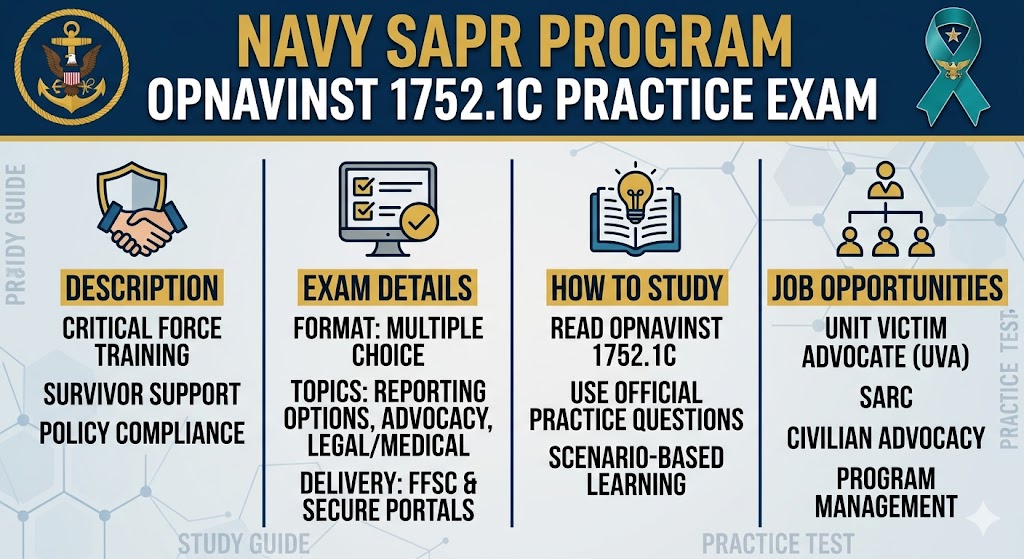
Additional Information
What the Course Entails and Exam Details
This training program equips participants with the critical knowledge and skills to understand, implement, and support the SAPR program's objectives. Key learning outcomes and syllabus topics include:
Understanding the core tenets, policies, and responsibilities outlined in OPNAVINST 1752.1C.
Mastering reporting options, including the precise distinctions between Restricted and Unrestricted Reporting, and the role of the Sexual Assault Response Coordinator (SARC) and Victim Advocates (VAs).
Learning how to provide immediate, confidential support, crisis intervention, and referrals to medical, investigative, legal, and mental health resources.
Recognizing and preventing retaliation and reprisal against victims.
Developing skills in bystander intervention and risk reduction to foster a protective command climate.
Comprehensive knowledge of the medical forensic examination process and investigative and legal procedures for adult sexual assault cases.
What to Expect in the Final Exam
The final examination to validate proficiency in the Navy SAPR Program and OPNAVINST 1752.1C knowledge typically takes the form of a formal multiple-choice assessment. Questions will rigorously cover the critical areas detailed in the course, from policy specifics to scenario-based applications. The exam is often delivered through secure military training portals, such as the Navy e-Learning system or a designated test administration platform, either on-base at authorized facilities or via secure command-authorized terminals. While specific parameters may vary by command, students should prepare for a comprehensive test, likely consisting of 30 to 50 questions, with a set time limit and a defined minimum passing score, often 80% or higher, to confirm readiness for SAPR roles.
How to Study and Exam Centers
Effective preparation is key to success on the Navy SAPR practice exam. Actionable study strategies include:
Deep-Dive into the Instruction: Create a comprehensive study guide by thoroughly reading and summarizing each chapter of OPNAVINST 1752.1C. Pay special attention to definitions, responsibilities, and the flowchart for reporting options.
Use Authorized Materials: Review all materials from the 40-hour initial training course if applicable, as well as the standard General Military Training (GMT) modules.
Practice with Purpose: Utilize available practice questions and quizzes, such as those found on official Navy knowledge portals and authorized learning systems. Focus not only on correct answers but on understanding why a specific policy applies.
Scenario-Based Study: Practice applying the policy to real-world scenarios, particularly with a study group. Discuss optimal responses for each role (VA, command, bystander).
The practice exam itself is often integrated into the end-of-course or annual training delivery. Formal testing centers are typically:
Authorized testing facilities located within Fleet and Family Support Centers (FFSC) on Navy installations worldwide.
Secure command terminals and classrooms designated for proctored testing.
Command-authorized, secure online portals for remote delivery. Check with your command's SAPR point of contact or training officer for precise scheduling and location information.
Job Opportunities from the Course
Earning proficiency and potential certification, such as the Department of Defense Sexual Assault Certification Program (D-SAACP), through this training unlocks several critical roles and career paths both within and beyond the Navy. These positions allow you to directly support the mission of care and prevention:
Command Sexual Assault Prevention and Response (SAPR) Point of Contact (POC)
Unit Victim Advocate (UVA) (a collateral duty role)
Full-time Installation Sexual Assault Response Coordinator (SARC) (military or civilian)
DoD Sexual Assault Prevention and Response (SAPR) Program Manager
Victim Advocate (civilian positions in government and non-profit organizations)
Crisis Intervention Specialist
Positions in Social Work or Victim Services with a focus on trauma and advocacy
Frequently Asked Questions
Reviews
5.0
Based on 0 reviews
Leave a Review
No reviews yet. Be the first to review!