
Navy Small Arms Practice Exam
$69.00
- Buy to unlock unlimited access to all Quiz questions and Answers in this Quiz.
- After purchase you can print a PDF of the whole quiz at any point. The PDF will contain the questions and the correct answers.
About this Exam
The Navy Small Arms Qualification is a critical certification program designed to ensure that all U.S. Navy personnel required to carry firearms possess the necessary knowledge, skill, and safety discipline. This exam is not merely about shooting proficiency; it is a comprehensive validation of a Sailor's understanding of weapon safety, mechanics, handling procedures, and legal engagement principles. The exam is mandatory for a wide range of personnel, including Master-at-Arms, Gunners Mates, security force members, VBSS (Visit, Board, Search, and Seizure) team operators, and any Sailor assigned to an armed watch or security detail. Mastering this knowledge is the prerequisite for moving to the practical, live-fire qualification phase.
Ready to test your knowledge?
Buy Now to Access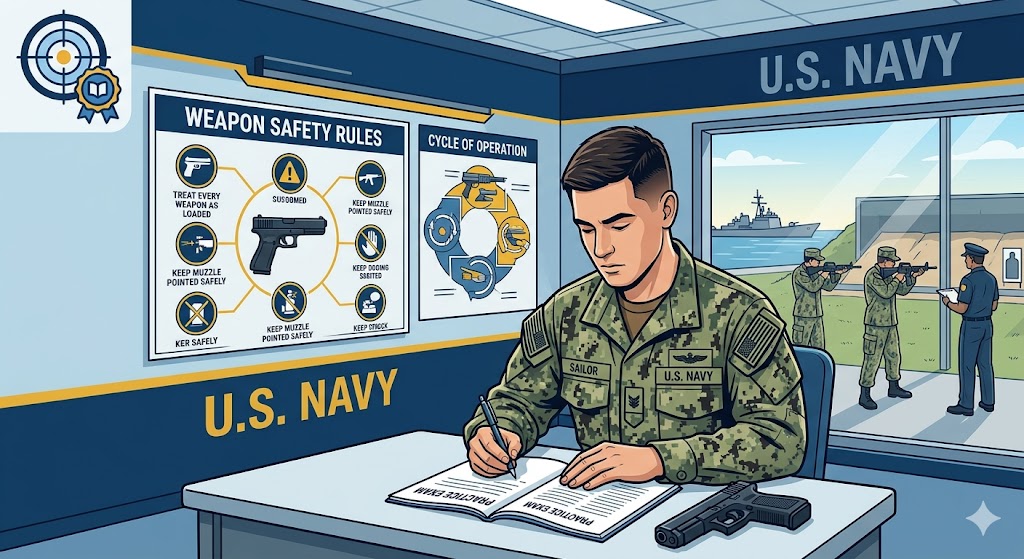
Additional Information
.
What the Course Entails and Exam Details
This examination covers the essential theoretical knowledge required to safely operate the Navy’s primary small arms, typically focusing on the M9 or M18 service pistol and the M16 or M4 rifle/carbine. The core curriculum ensures that every Sailor understands how these weapons function and how to handle them without risk to themselves or others.
Key areas covered in the course and validated by the exam include:
The Universal Weapon Safety Rules (the foundation of all naval firearms handling).
Weapon nomenclature and the identification of all major components.
The eight cycles of operation (feeding, chambering, locking, firing, unlocking, extracting, ejecting, and cocking).
Correct weapon handling procedures, including drawing, holstering, carrying, and reloading (admin, speed, and tactical reloads).
Standard range commands, procedures, and safety protocols.
Procedures for clearing stoppages and malfunctions (remedial actions).
Fundamentals of marksmanship (stance, grip, sight picture, sight alignment, trigger control, and breath control).
Proper weapon maintenance, including field stripping, cleaning, and lubrication.
Basic principles of the Use of Force and the Deadly Force Triangle.
What to Expect in the Final Exam
The Navy Small Arms written examination is the final checkpoint before the practical qualification. It is designed to be rigorous, ensuring a deep internalization of safety protocols, as errors in this environment have real-world consequences.
Sailors can expect the following during the final exam:
Format: The test is usually a standardized, multiple-choice exam. Some versions may include true/false or diagram labeling questions (e.g., identifying weapon parts).
Method: The exam is typically administered either in a traditional paper-and-pencil format within a training classroom or, increasingly, as a computer-based test through official Navy portals.
Time Limit: The exam is timed, typically giving candidates 30 to 60 minutes to complete all questions, which is generally ample time if well-prepared.
Passing Score: The Navy maintains high standards for weapon safety. While exact requirements may fluctuate slightly by command or weapon system, the standard passing score is typically 80% or higher. Some commands require a higher score, especially on safety-critical sections.
Rules: Cheating or compromising test integrity results in immediate failure and potential disciplinary action. The use of study guides, personal electronic devices, or external notes is strictly prohibited during the examination. A failure generally requires a mandatory waiting period and retraining before a retest can be attempted.
How to Study and Exam Centers
Preparing for the Navy Small Arms Exam requires diligent study of official materials and practical reinforcement of safety concepts. Since this is an internal Navy requirement, you cannot "sign up" for this test at a public testing facility like Pearson VUE.
Here are actionable strategies for success:
Master the OPNAVIST/Manuals: The ultimate authority is the Navy's official instruction series (OPNAVIST 3591.1 series for Small Arms Training and Qualification) and the specific Naval Sea Systems Command (NAVSEA) technical manuals for each weapon system (e.g., the M9 or M4 technical manuals). Study these manuals relentlessly.
Internalize the Four Safety Rules: You must know these word-for-word and, more importantly, understand their application. Every failure on the practical range often stems from a violation of one of these written rules.
Use Visual Aids: Study diagrams of the weapon systems. You must be able to visually identify the receiver, sear, slide stop, magazine release, and safety mechanisms.
Attend the Full Classroom Training: Never skip or tune out during the mandatory "ground school" or classroom training provided by Navy Small Arms Instructors (SAIs). These instructors are experts and will emphasize the critical points that often appear on the exam.
Practice with Inert Weapons: When available, practice handling inert (blue gun or dummy-rounded) weapons to reinforce the mechanical knowledge (e.g., practice the cycle of operation) alongside your reading.
Exam Centers: This exam is exclusively administered within Navy command structures. This includes:
Command training departments aboard ships or at shore stations.
Navy Gun Mount or Range facilities.
Authorized Navy schools (such as MA "A" school or specialized security academies).
Through official Navy eLearning (NeL) portals for the classroom portion.
Job Opportunities from the Course
Successfully passing the Navy Small Arms Practice Test—and subsequently the written and live-fire qualifications—is a prerequisite for many career paths and specialized roles within the Navy. Mastering small arms is not just a requirement; it is a fundamental skill that unlocks significant operational responsibilities.
Specific job titles and career paths enabled by small arms qualification include:
Master-at-Arms (MA) (The Navy’s dedicated law enforcement and security specialists).
Gunner's Mate (GM) (Responsible for the operation and maintenance of all Navy weapons).
Special Warfare Operator (SEAL) (Highly advanced tactical weapons usage).
Special Warfare Boat Operator (SWCC) (Crew-served weapons and small arms).
Armed Watchstander (Including Petty Officer of the Watch and Officer of the Deck).
Security Force Member (NSF) (Personnel assigned to base or asset protection).
Auxiliary Security Force (ASF) (Non-MA Sailors assigned to security augmentation duties).
VBSS (Visit, Board, Search, and Seizure) Team Member (Tactical boarding and inspection).
Mobile Security Force (MSF) Detachment Member.
Landing Force/Ground Combat Element personnel within specific units.
Civil Engineer Corps (Seabees) (Defensive weapons operation).
Frequently Asked Questions
Reviews
5.0
Based on 0 reviews
Leave a Review
No reviews yet. Be the first to review!