
Navy TCCC Practice Exam
$69.00
- Buy to unlock unlimited access to all Quiz questions and Answers in this Quiz.
- After purchase you can print a PDF of the whole quiz at any point. The PDF will contain the questions and the correct answers.
About this Exam
The Navy Tactical Combat Casualty Care (TCCC) certification is a mission-critical program designed to provide all Navy service members, particularly Hospital Corpsmen and those in combat or specialized roles, with the life-saving skills needed to care for casualties in dynamic and high-threat environments. This course shifts focus from traditional civilian first aid to a phased approach, ensuring that medical care does not interfere with tactical objectives. Whether you are on land with a Marine unit, aboard a ship, or part of a special operations team, this certification validates your ability to stabilize casualties, prevent additional injuries, and complete the mission, ultimately reducing preventable deaths on the battlefield.
Ready to test your knowledge?
Buy Now to Access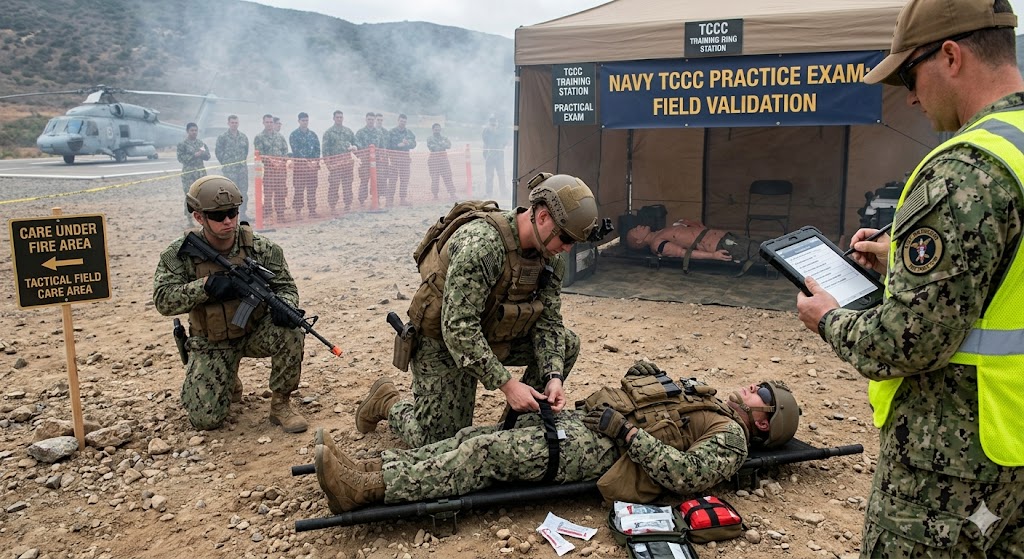
Additional Information
What the Course Entails and Exam Details
The TCCC curriculum is based on the most current, evidence-based guidelines from the Committee on Tactical Combat Casualty Care (CoTCCC). It revolves around three primary phases:
Care Under Fire (CUF): Focusing on immediate life-saving actions while under effective hostile fire, primarily hemorrhage control with limb tourniquets.
Tactical Field Care (TFC): Extending care once the unit is no longer under effective fire. This phase includes a detailed assessment and wider range of treatments using the MARCH-PAWS sequence (Massive Hemorrhage, Airway, Respiration, Circulation, Hypothermia/Head, Pain, Antibiotics, Wounds, Splinting).
Tactical Evacuation Care (TACEVAC): Continuing care during transport to a higher level of medical facility.
The core skills and topics you must master include:
Hemorrhage Control: Proper application of extremity, junctional, and hemostatic tourniquets and wound packing.
Airway Management: Head-tilt/chin-lift, recovery position, nasopharyngeal airways, and surgical cricothyroidotomy.
Breathing and Respiration: Recognizing and treating tension pneumothorax with chest seals and needle decompression.
Circulation: Gaining intravenous (IV) or intraosseous (IO) access, fluid resuscitation strategies, shock management, and administering Tranexamic Acid (TXA).
Hypothermia Prevention: Using specialized kits and ensuring proper casualty insulation.
Analgesia and Antibiotics: Following strict protocols for pain management and early infection prevention.
Splinting and Burns: Managing fractures and varied burn injuries.
Casualty Movement and Documentation: Safe extraction and clear TCCC Casualty Card completion.
Communication: Formulating and transmitting a 9-line MEDEVAC request.
What to Expect in the Final Exam
The final Navy TCCC assessment is a comprehensive, two-part evaluation designed to test your knowledge and, most importantly, your ability to perform under stress.
Part 1: The Written Knowledge Test
This section is often administered online or in a standard testing format.
Format: Typically 30-50 multiple-choice questions.
Content: Tests your theoretical understanding of the TCCC guidelines, specific protocols (e.g., analgesia dosages, fluid types), and the logic behind each phase of care.
Passing Score: You must achieve a minimum of 80% to proceed.
Part 2: The Practical Skills Validation
This is the core of the exam and is a direct simulation of a real-world tactical situation.
Format: A dynamic scenario where you must care for multiple, simulated casualties.
Environment: The setting can be unpredictable and high-stress, potentially involving a mock firefight, loud noise, smoke, and varying levels of light. You will be in full tactical gear.
Assessment: Instructors will evaluate you on your ability to: execute all MARCH-PAWS steps correctly and in sequence, make rapid and sound tactical decisions, maintain situational awareness, communicate effectively with your team, and properly prepare the casualty for evacuation.
Scoring: The practical portion is typically pass/fail, and you must pass all critical performance steps. Failure in the practical portion often requires full retraining.
How to Study and Exam Centers
Study Strategies and Actionable Methods:
Master the Official Guidelines: Your single best resource is Deployedmedicine.com, the home of the official CoTCCC guidelines, curriculum, videos, and standard forms. This is where all written test questions originate. Also, review the Joint Trauma System Clinical Practice Guidelines (CPGs).
Use Practice Tests: Leverage available Navy TCCC practice exams to familiarize yourself with the written question format and identify your knowledge gaps. Focus on the core MARCH sequence and the different phases of care.
Physical Practice, Every Day: TCCC is a skill, not just a subject. Obtain a training kit and practice applying tourniquets to yourself and others under time pressure. Run through the entire MARCH sequence with a partner or on a training manikin until it becomes muscle memory. Practice needle decompression and IV/IO insertion.
Simulate Stress: Once you know the steps, practice with added stress. Have your partner yell, use loud background noise, or do it in low-light. This will prepare you for the chaos of the practical exam.
Exam Centers and Where to Take the Exam:
Navy TCCC certification is unique to the military training system. You cannot take the final certification exam at a civilian center like Pearson VUE.
Physical Testing: For actual certification, all training and testing (written and practical) occur at designated Navy and Marine Corps training commands, specific physical testing centers, such as Field Medical Training Battalions (FMTB), on-base Naval Medical Readiness and Training Commands (NMRTCs), the Naval Medical Leader and Professional Development Command (NMLPDC), or via authorized special operations medical schools.
Mobile Training Teams (MTT): TCCC instructors frequently travel as mobile training teams to units at sea or in austere environments to conduct training and certification on-site.
Online Portals: Military learning portals, like Deployedmedicine.com and Naval Knowledge Online (NKO), may be used for written pre-tests, didactic modules, or to access study material, but the comprehensive practical validation must be done in person.
Job Opportunities from the Course
A Navy TCCC certification is not just a requirement; it is a foundational skill that unlocks and enhances numerous career paths within and outside the military.
Hospital Corpsman (HM) (all enclaves, especially FMF and specialized)
Special Warfare Operator (SEAL, SWCC)
Medical Officer (Physician, Physician Assistant, Nurse Practitioner, Dentist)
Flight Paramedic
Aeromedical Evacuation Technician
Search and Rescue (SAR) Medical Technician
Combat Lifesaver (CLS) Trainer/Evaluator
(Civilian) SWAT/Tactical Medic (T-PHTLS)
(Civilian) Austere Medicine Provider
(Civilian) Wilderness Emergency Medical Services
(Civilian) Flight Paramedic/Flight Nurse
(Civilian) Medical Lead for Overseas Contracting or NGOs
Frequently Asked Questions
Reviews
5.0
Based on 0 reviews
Leave a Review
No reviews yet. Be the first to review!