
NBEO Biochemistry Practice Exam
$69.00
- Buy to unlock unlimited access to all Quiz questions and Answers in this Quiz.
- After purchase you can print a PDF of the whole quiz at any point. The PDF will contain the questions and the correct answers.
About this Exam
The National Board of Examiners in Optometry (NBEO) Part I is a critical milestone for all aspiring optometrists.
Within this rigorous assessment, the biochemistry section plays a vital role in testing your foundational medical knowledge.
This specific practice exam preparation is designed to help optometry students master the chemical processes that govern the human body and the eye.
By deeply understanding these biological concepts, candidates ensure they are fully prepared to provide exceptional clinical care and accurately diagnose complex ocular conditions
Ready to test your knowledge?
Buy Now to Access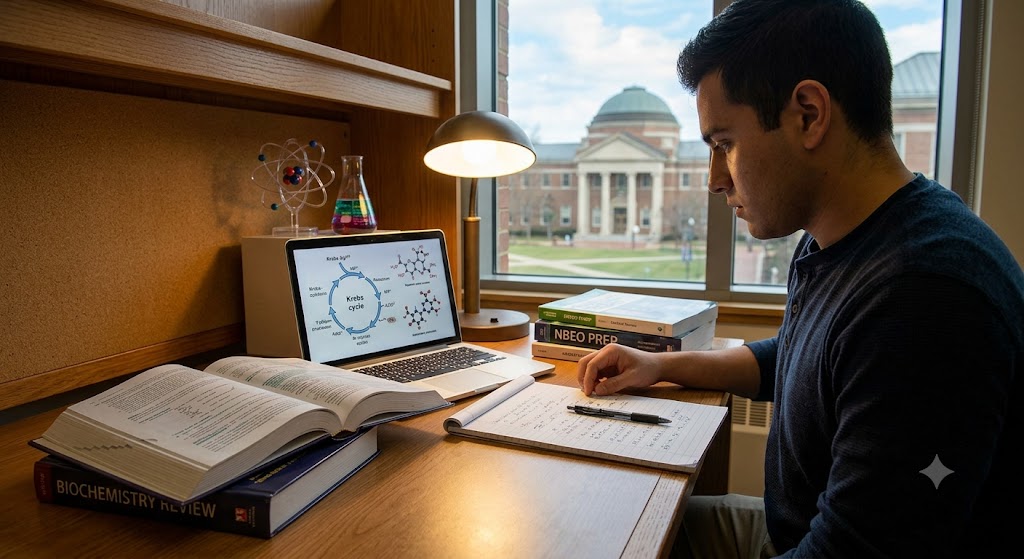
Additional Information
What the Course Entails and Exam Details
Preparing for the biochemistry portion of the NBEO involves
a deep dive into both general and ocular-specific chemical pathways.
Students must master fundamental cellular metabolism,
including glycolysis, the Krebs cycle, and oxidative phosphorylation.
The syllabus heavily emphasizes ocular biochemistry,
requiring a thorough understanding of tear film composition, lens proteins, and
the intricate biochemical cascade of phototransduction.
Additionally, core topics such as molecular biology,
genetics, enzyme kinetics, and systemic nutritional pathways are thoroughly
covered to ensure a comprehensive medical foundation.
What to Expect in
the Final Exam
The NBEO Part I Applied Basic Science exam is a
comprehensive, multiple-choice test that seamlessly integrates biochemistry
with other basic sciences like anatomy and physiology.
You should expect clinical vignette-style questions where
biochemical knowledge must be directly applied to patient scenarios and ocular
pathology.
The overall exam is typically divided into two intense
sessions, featuring hundreds of challenging multiple-choice items.
Scores are calculated on a scaled system from 100 to 999,
with the standard passing score firmly set at 300.
Strict time limits are rigorously enforced for each testing
block, meaning rapid recall and highly efficient time management are absolutely
essential for success.
How to Study and Exam Centers
An highly effective study strategy begins with active recall
and extensive, timed practice testing.
Students should map out complex metabolic pathways visually
on whiteboards and use spaced repetition flashcards for the rapid memorization
of enzymes and molecular structures.
Taking a high-quality practice exam under realistic,
distraction-free conditions is the best way to build mental endurance and
identify specific weak areas.
When it is time to take the official exam, you will complete
your registration entirely through the official NBEO online portal.
The actual examination is securely administered via computer
at authorized Pearson VUE physical testing centers located nationwide.
Job Opportunities from the Course
Successfully passing the NBEO Part I, including mastering
the complex biochemistry material, is a mandatory step toward obtaining your
professional optometry license.
This achievement ultimately unlocks the prestigious and
rewarding career path of becoming a Licensed Optometrist.
Beyond general practice, this robust foundational knowledge
opens doors to specialized leadership roles such as Clinical Director in a
private or corporate eye care practice.
For those uniquely interested in academia and product
development, exciting career opportunities include becoming an Ophthalmic
Researcher or an Optometric Educator.
Additionally, medical professionals with strong biochemical
expertise are highly sought after as Medical Science Liaisons within the
pharmaceutical and vision science industries.
Frequently Asked Questions
Reviews
5.0
Based on 0 reviews
Leave a Review
No reviews yet. Be the first to review!