
NBEO Ocular Anatomy Posterior Segment (Post Seg) and Cranial Nerves Practice Test
$69.00
- Buy to unlock unlimited access to all Quiz questions and Answers in this Quiz.
- After purchase you can print a PDF of the whole quiz at any point. The PDF will contain the questions and the correct answers.
About this Exam
Mastering the intricate details of ocular anatomy is a foundational requirement for any aspiring optometry professional.
This specialized practice test is expertly designed for optometry students and candidates preparing for high-stakes licensure examinations, specifically focusing on the complex anatomy of the posterior segment (Post Seg) of the eye and the intricate network of cranial nerves that govern vision and ocular motor function.
By providing a targeted, focused review, this practice test serves as an essential diagnostic tool, allowing students to gauge their understanding of critical structures, refine their knowledge, and build the confidence necessary to excel on the actual NBEO board exams.
It is an indispensable resource for anyone committed to achieving deep proficiency in ocular anatomy and securing their future as a licensed optometrist.
Ready to test your knowledge?
Buy Now to Access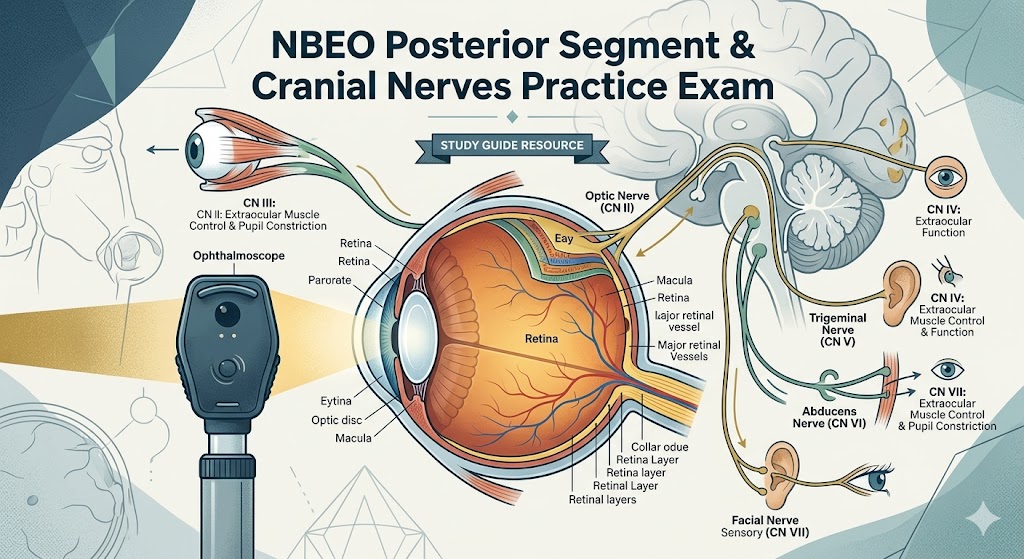
Additional Information
What the Course Entails and Exam Details
This comprehensive practice test dives deep into two of the
most demanding and heavily weighted topics in ocular anatomy.
The first major section focuses on the Posterior Segment
(Post Seg), exploring the structure and function of essential elements,
including the detailed layers of the retina, the retinal pigment epithelium,
the macula, the choroid, the vitreous humor, the optic nerve head, and the
major retinal blood supply.
The second core area is the Cranial Nerves relevant
to the vision and ocular motor control systems.
Candidates must demonstrate thorough knowledge of the
origin, pathway, and innervation targets of several key nerves, including the
Optic Nerve (CN II), Oculomotor Nerve (CN III), Trochlear Nerve (CN IV),
Trigeminal Nerve (CN V - specifically its ophthalmic division), Abducens Nerve
(CN VI), and Facial Nerve (CN VII).
This entails understanding sensory input, motor control for
extraocular muscles, pupillary responses, and the relevant brainstem structures
associated with these nerves.
What to Expect in
the Final Exam
While this is a practice test, it is modeled to simulate the
structure and rigor candidates will face in official licensing examinations,
such as the NBEO Part I Applied Basic Science.
You can typically expect a series of multiple-choice
questions that require not only recall of anatomical facts but also the
application of that knowledge to clinical scenarios and differential diagnoses.
Timed sections are common in these types of standardized
tests to ensure pacing proficiency.
A passing score on this practice test is often set around
70-75%, serving as a strong indicator of readiness, but candidates should
strive for higher proficiency for optimal exam performance.
Questions are designed to test detailed knowledge of
structure, function, nerve pathways, and the clinical implications of
anatomical relationships and lesions, requiring precise identification and
analytical thinking.
How to Study and Exam Centers
Effective preparation requires a multi-faceted approach.
We recommend combining the use of high-quality anatomy
textbooks and atlases, which provide detailed diagrams, with active study
methods like utilizing flashcards (especially for nerve pathways and retinal
layers) and participating in peer study groups.
Clinical correlation is crucial; always ask, "How does
understanding this anatomical structure relate to a clinical condition,
diagnostic test, or treatment plan?"
Incorporate extensive practice by taking targeted quizzes
and full practice exams, such as this one, and focus significant energy on
reviewing detailed explanations for both correct and incorrect answers to
address any underlying knowledge gaps.
To access this practice test, candidates typically register
and complete it through an approved educational portal, an online learning
management system provided by their optometry school, or a dedicated test-bank
platform specializing in NBEO preparation, rather than a physical testing
center like Pearson VUE.
Job Opportunities from the Course
Mastering the critical concepts covered in this practice
test is a crucial step toward successfully passing the official NBEO board
examinations.
Achieving passing scores on all parts of the NBEO is a
mandatory prerequisite for obtaining licensure to practice as an optometrist in
most jurisdictions.
A deep understanding of Posterior Segment and Cranial Nerve
anatomy directly unlocks the gateway to a successful and rewarding career in
various sectors of the optometric profession.
While the practice test itself doesn’t provide a job, this
mastery is required for roles such as:
- Licensed
Optometrist in Private Practice
- Licensed
Optometrist in an Integrated Ophthalmology Practice
- Licensed
Optometrist at a Community Health Center or VA Hospital
- Clinical
Research Optometrist specializing in Ocular Anatomy/Disease
- Optometry
School Faculty Member or Clinical Instructor
- Ocular
anatomy educational content developer
Frequently Asked Questions
Reviews
5.0
Based on 0 reviews
Leave a Review
No reviews yet. Be the first to review!