
NBEO Ocular Physiology Practice Exam
$69.00
- Buy to unlock unlimited access to all Quiz questions and Answers in this Quiz.
- After purchase you can print a PDF of the whole quiz at any point. The PDF will contain the questions and the correct answers.
About this Exam
The National Board of Examiners in Optometry (NBEO) Ocular Physiology Practice Exam is an essential tool for optometry students preparing for licensure. This exam specifically focuses on the fundamental biological and physical functions of the human eye. It is designed to evaluate a candidate's understanding of how the various components of the ocular system work together to facilitate vision, maintain eye health, and respond to external stimuli.
This practice exam serves as a direct preparatory resource for the actual NBEO Part I: Applied Basic Science (ABS) examination, where ocular physiology is a key component. By simulating the actual test experience, it helps students gauge their knowledge, identify areas of weakness, and build confidence before taking the high-stakes official exam.
Ready to test your knowledge?
Buy Now to Access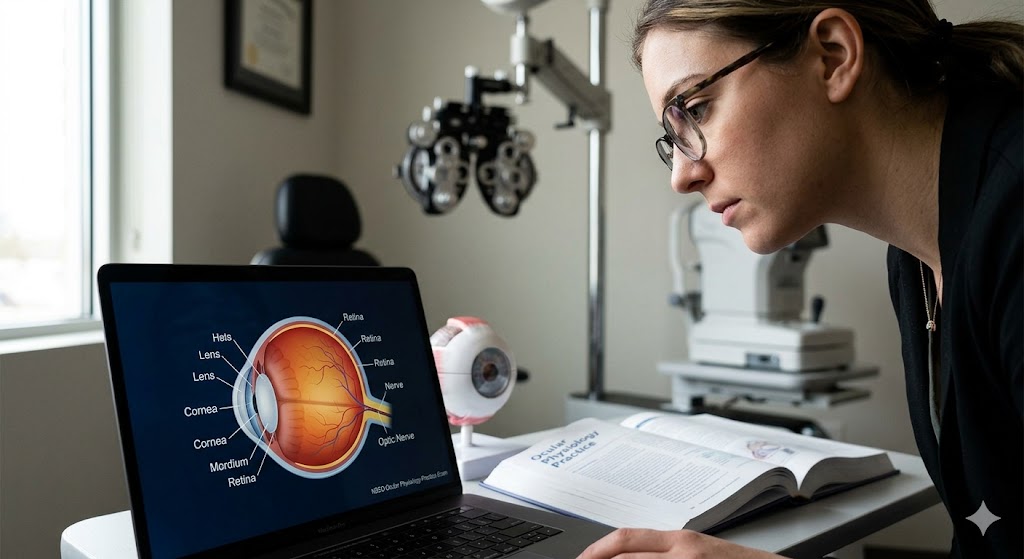
Additional Information
What the Course
Entails and Exam Details
The NBEO Ocular Physiology practice content is a
comprehensive review of advanced ocular science. It covers the intricate
physiological processes of the eye from the molecular level up to full system
integration. The practice content ensures a deep grasp of how the normal eye
functions.
The core topics and syllabus areas typical in this practice
material include:
- Corneal
Physiology: Metabolism, hydration control, and wound healing
processes.
- Aqueous
Humor Dynamics: Production, flow, and drainage mechanisms crucial for
intraocular pressure regulation.
- Lens
Physiology: Accommodation mechanisms, transparency, metabolism, and
cataract formation.
- Retinal
Physiology: Phototransduction cascade, dark adaptation, color vision,
and the roles of photoreceptors and retinal pigment epithelium (RPE).
- Vitreous
Humor: Composition, function, and aging changes.
- Ocular
Circulation: Blood flow regulation to the retina, choroid, and optic
nerve.
- Tear
Film and Lacrimal Apparatus: Composition, function, and regulation of
the tear film.
- Extraocular
Muscle Physiology: Control of eye movements and binocular
coordination.
- Pupillary
Physiology: Light and near reflex pathways.
What to Expect in
the Final Exam
While this is a practice exam, it is modeled closely
on the structure and delivery of the official NBEO standard. Students should
expect a rigorous, computer-based testing experience.
- Format:
The primary format is Multiple Choice Questions (MCQs). These often
feature scenario-based clinical vignettes where physiological principles
must be applied to reach the correct answer, rather than simple recall.
- Passing
Score Requirements: NBEO exams use scaled scoring. The exact raw score
needed to pass can vary slightly between different test administrations,
reflecting the statistical difficulty of the specific question set. The
practice exam may provide score reporting to help you estimate your
readiness.
- Time
Limits: The full Part I ABS exam is divided into multiple sessions,
often totaling several hours. The practice exam should be used to simulate
this time pressure, training you to maintain focus and manage your pace
efficiently.
- Specific
Rules: On exam day, strict security protocols are in place. No outside
materials, devices, or communication are permitted. When using this
practice exam, it is highly beneficial to enforce similar conditions—quiet
room, no textbooks—to truly test your knowledge.
How to Study and
Exam Centers
Effective study for ocular physiology demands a conceptual
understanding, not just memorization. Here are actionable strategies:
- Integrate
Resources: Do not rely solely on the practice exam. Use it in
conjunction with standard textbooks like "Adler's Physiology of the
Eye" or Remington's "Clinical Anatomy and Physiology of the
Visual System."
- Active
Recall: When taking the practice exam, don't just check the right
answer. Explain to yourself why the other options are wrong and the
underlying physiological mechanism.
- Spaced
Repetition: Spread your studying over weeks or months. Ocular
physiology is dense, and consistent review is key to retention.
- Simulate
Exam Conditions: Dedicate specific blocks of time to take segments of
the practice exam under timed, uninterrupted conditions. This builds
mental stamina.
Where to Take the Exam (NBEO Part I ABS):
While the practice exam may be available through
online portals, the official NBEO Part I examination must be taken at
designated testing centers. The primary administrator for NBEO computer-based
examinations is Pearson VUE. You will need to locate an authorized
Pearson VUE testing center near you and register for a specific exam date and
time through the NBEO website or your academic institution. These centers
enforce rigorous security and standard environmental conditions.
Job Opportunities from the Course
Passing the NBEO Ocular Physiology section is a
non-negotiable step toward earning your optometric license. Once you have
successfully completed all parts of the NBEO (including Parts I, II, and III),
a wide array of professional opportunities in eye care becomes available.
Unlocking these job opportunities is the direct result of
completing this comprehensive licensing pathway:
- Licensed
Optometric Physician (Private Practice)
- Optometrist
in a Multidisciplinary Medical Group (e.g., working alongside
Ophthalmologists)
- Academic
Faculty Member in Optometry Schools
- Clinical
Researcher in Vision Science and Ocular Physiology
- Optometrist
within Veteran Affairs (VA) Hospitals and Medical Centers
- Industry
Consultant for Pharmaceutical or Ophthalmic Device Companies
- Public
Health Optometrist
Frequently Asked Questions
Reviews
5.0
Based on 0 reviews
Leave a Review
No reviews yet. Be the first to review!