
NBEO Part III Patient Encounters and Performance Skills (PEPS) Practice Test
$69.00
- Buy to unlock unlimited access to all Quiz questions and Answers in this Quiz.
- After purchase you can print a PDF of the whole quiz at any point. The PDF will contain the questions and the correct answers.
About this Exam
The NBEO Part III Patient Encounters and Performance Skills (PEPS) exam is a high-stakes clinical assessment designed by the National Board of Examiners in Optometry.
It is specifically tailored for optometry students and recent graduates who are seeking full licensure to practice optometry in the United States.
This rigorous, hands-on examination serves as the ultimate benchmark of a candidate’s clinical competence, evaluating not just theoretical knowledge, but the practical ability to interact with patients, perform essential procedures, and make accurate clinical decisions in real time.
Taking a practice test for this exam is an absolute necessity for candidates to build confidence and familiarize themselves with the high-pressure clinical environment.
Ready to test your knowledge?
Buy Now to Access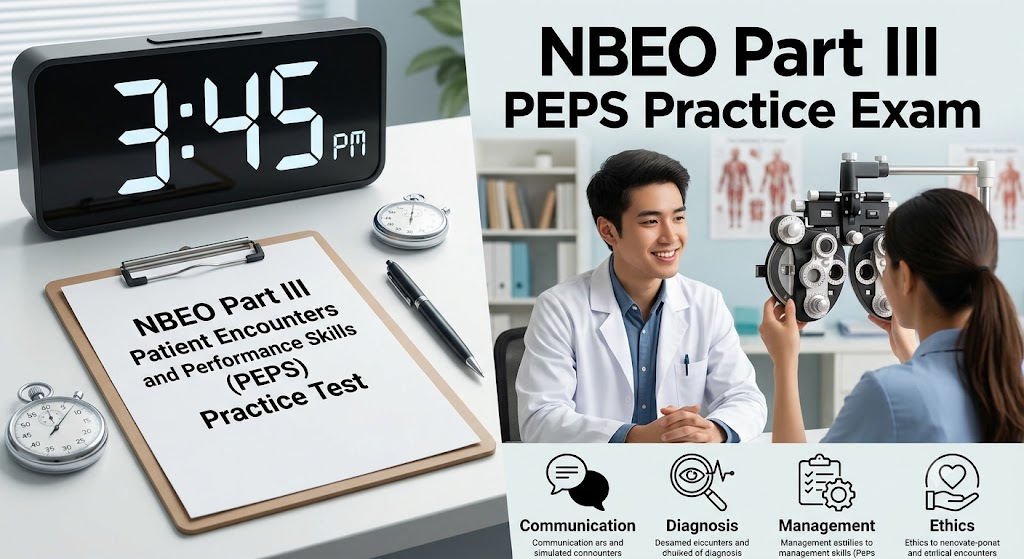
Additional Information
What the Course
Entails and Exam Details
The PEPS examination assesses a comprehensive syllabus of
clinical capabilities through simulated patient interactions and technical
skills demonstrations.
Candidates are evaluated heavily on their communication
skills, including taking thorough patient histories, delivering diagnoses
clearly, and demonstrating empathy and professionalism.
The core topics covered include comprehensive eye
examinations, contact lens evaluations, ocular disease management, and systemic
health considerations as they relate thorough preparation course or practice
exam will simulate these exact competencies, ensuring that candidates can
seamlessly bridge the gap between textbook theory and physical clinical
execution.
What to Expect in
the Final Exam
The final NBEO Part III exam operates as an Objective
Structured Clinical Examination (OSCE), meaning you will rotate through
multiple standardized stations.
Each station features a "standardized patient" (an
actor trained to present specific symptoms) or a specialized performance task.
Candidates face strict time limits, typically having around
15 to 30 minutes per station to complete their assessment, formulate a
diagnosis, and communicate a treatment plan.
The passing requirement is determined using a scaled scoring
system, which aggregates your performance across all stations based on
standardized rubrics measuring accuracy, efficiency, and patient rapport.
Test-takers must adhere to a strict professional dress code,
usually requiring business professional attire and a clean, unbranded white
clinical coat, and follow rigorous rules regarding conduct and equipment
handling.
How to Study and
Exam Centers
Studying for the NBEO Part III requires a highly active and
practical approach rather than passive reading.
The most effective strategy is to engage in continuous
role-playing with peers, treating them as standardized patients while setting a
strict timer to mimic real exam conditions.
Recording yourself during these mock encounters allows you
to review your body language, eye contact, and the clarity of your
communication.
Familiarize yourself intimately with your clinical equipment
so that mechanical adjustments become second nature, saving you precious time
during the actual test.
Unlike written exams that can be taken at various local
testing centers, the NBEO Part III is exclusively administered at the National
Center of Clinical Testing in Optometry (NCCTO) located in Charlotte, North
Carolina. Candidates must travel to this specific state-of-the-art facility to
complete the assessment.
Job Opportunities
from the Course
Successfully passing the NBEO Part III PEPS exam is the
final hurdle to becoming a fully licensed optometrist, unlocking a wide array
of prestigious and lucrative career paths.
The primary role attained is a Licensed Clinical
Optometrist, allowing you to examine, diagnose, and treat visual system
disorders in patients of all ages.
Many graduates go on to become Private Practice Owners,
running their own successful eye care clinics and managing both patient care
and business operations.
Others pursue careers as Medical Optometrists working
alongside ophthalmologists in hospitals or specialized eye surgery centers to
provide pre- and post-operative care.
Additional roles include Ophthalmic Consultants for
healthcare technology companies, Academic Optometrists teaching the next
generation of students in university settings, and Public Health Optometrists
focusing on community vision care programs.
Frequently Asked Questions
Reviews
5.0
Based on 0 reviews
Leave a Review
No reviews yet. Be the first to review!