
NBEO Visual Perception Practice Exam
$69.00
- Buy to unlock unlimited access to all Quiz questions and Answers in this Quiz.
- After purchase you can print a PDF of the whole quiz at any point. The PDF will contain the questions and the correct answers.
About this Exam
The NBEO Visual Perception exam section is a crucial milestone for optometry students striving to become licensed practitioners.
This specialized test evaluates your fundamental understanding of how the human brain and eyes process visual information.
It is designed specifically for aspiring optometrists who need to demonstrate clinical competence in visual processing and binocular vision.
Mastering this material is absolutely essential for diagnosing and managing complex visual anomalies in your future patients.
Ready to test your knowledge?
Buy Now to Access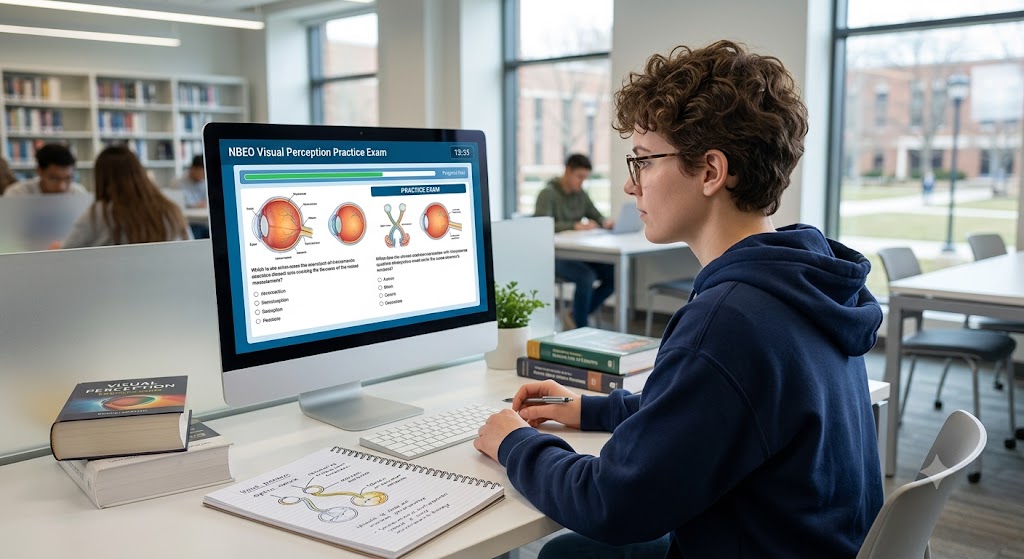
Additional Information
What the Course Entails and Exam Details
Preparing for this section of the boards requires a deep
dive into the physiological and psychological aspects of human vision.
You will explore core topics such as color vision, spatial
vision, temporal processing, and depth perception.
The syllabus heavily emphasizes binocular vision anomalies,
ocular motility, and the neural pathways responsible for translating light into
recognizable images.
Additionally, candidates must understand contrast
sensitivity, motion perception, and how various neurological conditions affect
visual processing.
By mastering these complex concepts, you will build a solid
foundation for assessing pediatric vision development and adult perceptual
disorders.
What to Expect in
the Final Exam
The visual perception component is typically integrated into
the broader multiple-choice framework of the National Board of Examiners in
Optometry (NBEO) Part I exam.
You can expect a series of rigorous, multiple-choice
questions that test both theoretical knowledge and direct clinical application.
The test utilizes a strict computerized format where you
must carefully analyze physiological data and patient scenarios.
Time management is critical, as you will have a set time
limit to complete the overarching exam block, which is divided into multiple
sessions over a multi-day period.
While specific passing thresholds can vary slightly by year
based on statistical scaling, you generally need a scaled score of 300 to pass
the entire board part.
Strict security protocols are enforced, meaning no personal
electronics, bags, or unapproved reference materials are allowed in the testing
room.
How to Study and
Exam Centers
Success on the visual perception section requires active
recall, spatial understanding, and strategic practice.
Start by utilizing high-yield study guides and completing as
many NBEO Visual Perception practice exams as possible to familiarize yourself
with the distinct question style.
Form study groups to discuss complex neurological pathways
and teach difficult concepts to your peers, which profoundly solidifies your
own understanding.
Flashcards are highly effective for memorizing specific
contrast sensitivity parameters, color vision tests, and visual pathway
lesions.
The official NBEO exams are administered exclusively at
authorized Pearson VUE testing centers.
You must register through the official NBEO online portal,
select your preferred test date, and secure a spot at a local physical Pearson
VUE facility well in advance of your desired testing window.
Job Opportunities from the Course
Earning your optometry license by passing the NBEO exams
opens the door to a highly rewarding healthcare career. A strong background in
visual perception specifically prepares you for several specialized and
impactful roles. Here are the prominent career paths this certification
unlocks:
- Licensed
Optometrist
- Pediatric
Optometrist
- Vision
Therapy and Rehabilitation Specialist
- Neuro-Optometrist
- Clinical
Researcher in Vision Science
- Academic
Professor of Optometry
- Sports
Vision Consultant
- Low
Vision Specialist
Frequently Asked Questions
Reviews
5.0
Based on 0 reviews
Leave a Review
No reviews yet. Be the first to review!