
NBME Form 15 Practice Test
$69.00
- Buy to unlock unlimited access to all Quiz questions and Answers in this Quiz.
- After purchase you can print a PDF of the whole quiz at any point. The PDF will contain the questions and the correct answers.
About this Exam
The NBME Form 15 practice exam is a crucial self-assessment tool designed specifically for medical students preparing for the USMLE Step 1 examination. This practice test mimics the actual Step 1 environment, providing realistic questions that gauge a student's readiness and understanding of core medical sciences. It helps identify strengths and weaknesses across the entire spectrum of preclinical knowledge, offering invaluable feedback before sitting for the high-stakes official exam. This approach allows students to refine their study plan and build confidence.
Ready to test your knowledge?
Buy Now to Access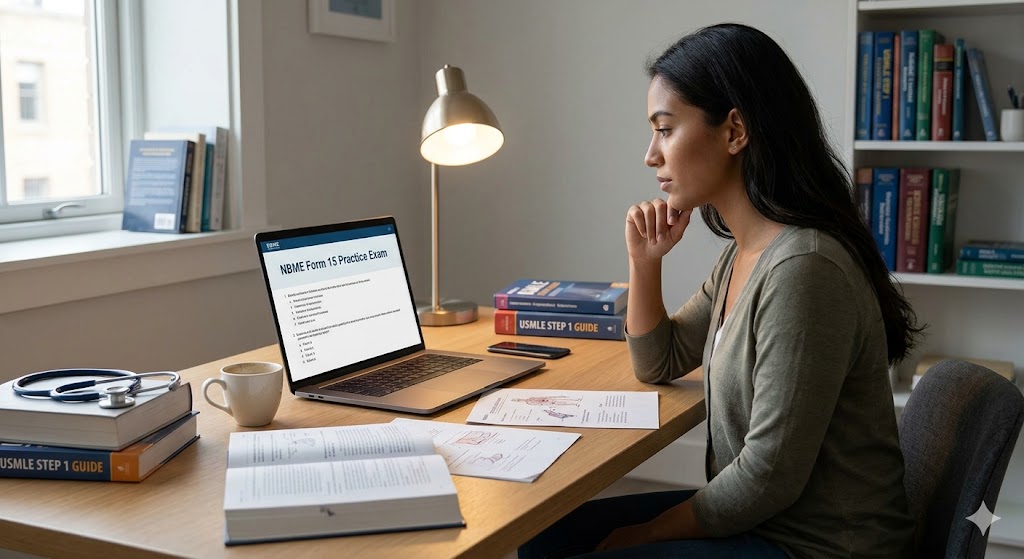
Additional Information
What the Course
Entails and Exam Details
While not a course with a syllabus, the NBME Form 15
practice exam comprehensively covers the diverse disciplines tested in the
USMLE Step 1. The questions are structured as clinically relevant vignettes
that demand integration of multiple concepts rather than simple recall. Core
topics reflected in the question bank include anatomy, behavioral sciences,
biochemistry, biostatistics and epidemiology, microbiology, immunology,
pathology, pharmacology, and physiology. Additionally, questions encompass foundational
knowledge about the various organ systems and general principles. The practice
test consists of 4 blocks, each typically containing 50 multiple-choice
questions, totaling approximately 200 items. Students are given roughly 1 hour
and 15 minutes per block to complete the assessment under timed conditions,
simulating the pressure of the real exam. This structure effectively evaluates
critical thinking and decision-making skills required for medical practice.
What to Expect in
the Practice Exam Format
When taking the NBME Form 15 practice exam, students can
expect a realistic simulation of the USMLE Step 1 experience. The entire
assessment is multiple-choice and is typically broken down into 4 distinct
blocks of around 50 questions each. You will need to manage your time
effectively, as each block is allotted approximately 75 minutes. The questions
are integrated, often presenting a patient scenario or complex data, and
requiring synthesis of knowledge from different preclinical subjects. After
completing the exam, you will receive a comprehensive score report rather than
a simple pass/fail result. This report provides a prediction of your potential
Step 1 performance based on your scores in each subject area, helping you
prioritize future study efforts. It's essential to understand that there is no
official passing score for this self-assessment itself, but rather it is
designed as a tool for personal evaluation and readiness check.
How to Study and
Exam Centers
Studying for and taking the NBME Form 15 requires strategic
planning.
To maximize its effectiveness, first simulate test-day
conditions by setting aside an uninterrupted 4-5 hour period in a quiet
environment. Treat it as a real exam to get a genuine sense of pacing and
stamina.
After finishing, dedicate significant time to review not
only the questions you got wrong but also those you guessed on or were unsure
about. For each incorrect answer, understand why your choice was wrong
and why the correct answer is right; don't just memorize the correct
answer.
Use your results to identify weak areas and focus your
remaining study time on those subjects using comprehensive review resources
like First Aid and UWorld. Consistently working through practice questions and
thoroughly reviewing explanations is paramount.
Regarding where to take the exam, it's important to note
that NBME Form 15, like other NBME self-assessments, is an online practice
test. You do not go to physical testing centers like Pearson VUE for
this specific assessment.
Instead, you purchase and access it directly through the
NBME Services Portal website. Once purchased, you can take the exam from any
computer with a stable internet connection that meets the system requirements.
This flexibility allows you to conveniently integrate important practice into
your existing study schedule.
Job Opportunities
from the Course
Successful completion of the USMLE Step 1 is a
non-negotiable requirement for medical students in the United States and
international graduates seeking medical licensure and residency in the US.
While NBME Form 15 is only a practice assessment and not the final
qualification itself, performs on it are strong predictors of Step 1 success.
Achieving a high score on the actual USMLE Step 1 opens doors to competitive
residency programs across all medical specialties.
Subsequently completing residency and subsequent USMLE steps
(Step 2 and Step 3) leads to fulfilling careers as licensed physicians.
Therefore, performing well on prep tools like this directly supports your path
toward numerous medical career opportunities, including:
- Anesthesiologist
- Cardiologist
- Dermatologist
- Emergency
Medicine Physician
- Family
Medicine Physician
- Internal
Medicine Physician
- Neurologist
- Obstetrician
and Gynecologist
- Ophthalmologist
- Pediatrician
- Psychiatrist
- Radiologist
- General
Surgeon
- Orthopedic
Surgeon
Frequently Asked Questions
Reviews
5.0
Based on 0 reviews
Leave a Review
No reviews yet. Be the first to review!