
NBME Form 30 Practice Test
$69.00
- Buy to unlock unlimited access to all Quiz questions and Answers in this Quiz.
- After purchase you can print a PDF of the whole quiz at any point. The PDF will contain the questions and the correct answers.
About this Exam
The National Board of Medical Examiners (NBME) Form 30 is a critical resource within the extensive landscape of self-assessment tools for medical students. Specifically, this practice exam, also known as the Comprehensive Basic Science Self-Assessment (CBSSA), is designed for individuals preparing for the formidable United State Medical Licensing Examination (USMLE) Step 1. It is primarily taken by medical students during their preclinical years, offering a simulated, timed environment to gauge their knowledge and readiness. The assessment aims to identify strengths and weaknesses across the preclinical disciplines, providing valuable insight into one's performance before the actual high-stakes licensing exam.
Ready to test your knowledge?
Buy Now to Access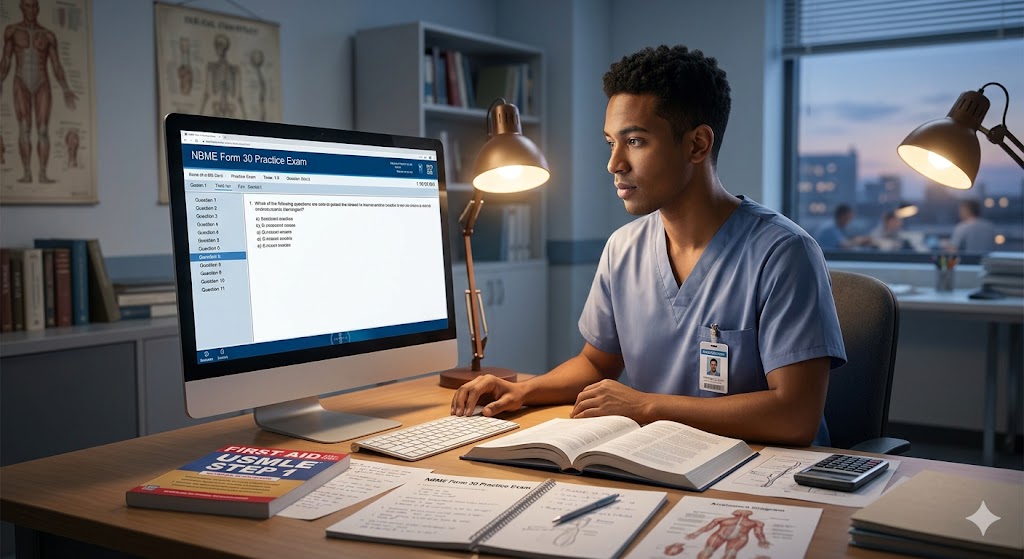
Additional Information
What the Course
Entails and Exam Details
It is important to clarify that NBME Form 30 is a practice
test, not a standalone course with a curriculum or syllabus. However, the
material it covers is exhaustive and directly reflective of the standard
preclinical medical sciences curriculum tested on the USMLE Step 1. Core
disciplines encompassed within the exam questions include Anatomy, Behavioral
Science, Biochemistry, Genetics, Immunology, Microbiology, Pathology,
Pharmacology, and Physiology. The exam details for Form 30 typically include:
- Format:
A simulated examination consisting of multiple-choice questions (MCQs),
heavily focused on clinical reasoning and data interpretation within basic
science scenarios.
- Length:
Form 30 is structured in timed blocks, similar to the actual USMLE Step 1,
typically featuring 4 blocks of 50 questions each, for a total of 200
items. [Note: Specific numbers of questions can vary slightly between
forms, but this is a standard structure].
- Timing:
Each block is timed, simulating the pace and pressure of the actual
7-block USMLE Step 1 test day.
- Accessibility:
Candidates can purchase and access the form online through the official
NBME website.
What to Expect in
the Final Exam
While the actual "final exam" is the USMLE Step 1,
the experience of taking NBME Form 30 is itself designed as a complete,
simulated high-stakes test. Here is what you can expect during the practice
examination:
- Format:
You will face continuous blocks of multiple-choice questions, just as you
would on test day, requiring intense concentration and time management.
The simulated interface mimics the look and feel of the USMLE testing
software.
- Passing
Requirements (Practice Test Context): It is crucial to understand that
you do not "pass" or "fail" the NBME Form 30
practice test in the way you do the actual USMLE. Instead, you will
receive a performance profile and a predictive report (e.g., a 3-digit
score equivalent, percentile, and feedback on your performance across
different subjects/organ systems). The goal is to analyze this data to
understand your readiness and where to focus your remaining study efforts,
aiming to improve your predicted actual USMLE score.
- Time
Limits: The blocks are strictly timed, forcing you to develop and
practice effective pacing strategies and deal with exam-day stress.
Missing questions or rushing due to poor time management are issues you
can identify and correct during this practice.
- Rules:
While taken at your chosen location, you are encouraged to simulate test
conditions: sitting in a quiet room, taking it in one sitting, and
adhering to timing to get an accurate representation of your performance.
Unauthorized resource use during the timed blocks is strongly discouraged
as it defeats the purpose of the self-assessment.
How to Study and Exam Centers
Successfully navigating the NBME Form 30 practice test, and
ultimately USMLE Step 1, requires a multifaceted study approach. Strategies and
test-taking methods include:
- Simulate
Exam Conditions: Treat Form 30 as if it were the real USMLE Step 1.
Dedicate a substantial block of uninterrupted time, take it in a quiet
environment, and use only allowed materials (like your
calculator/scratchpad). Taking multiple forms in this manner helps build
stamina.
- Review
Thoroughly: Perhaps the most critical step. After completion, dedicate
significant time (often days) to meticulously reviewing every question –
those you answered correctly and those you missed. Understand why
the correct answer is right and, equally importantly, why the other
options are wrong. Many forms include detailed explanations.
- Identify
and Address Weaknesses: Use the performance report to pinpoint areas
where you struggled. Integrate focused review of these topics using
high-yield resources.
- Use
Complementary Resources: Do not rely solely on practice tests. Form 30
is a benchmark; use it alongside core resources like comprehensive
textbooks (e.g., First Aid for the USMLE Step 1), question banks (e.g.,
UWorld), flashcards, and online lecture series.
- Practice
Active Learning: Engage in active recall and spaced repetition for key
facts and concepts identified during your reviews.
- Time
Management Practice: If timing was an issue, practice working quickly
but accurately with smaller, timed blocks of questions during regular
study.
Exam Centers: NBME Form 30 is an online
self-assessment and is not taken at a physical testing center like
Pearson VUE (which is where the actual USMLE Step 1 is taken). Instead,
you purchase and launch the test directly through the MyNBME Examinee Portal
on the NBME website, allowing you to take it from the comfort and quiet of your
own chosen location, provided you have a reliable internet connection.
Job Opportunities
from the Course
While completing NBME Form 30 practice test does not
directly unlock job titles, successful performance and subsequent mastery of
the core concepts tested (leading to successful USMLE Step 1 completion) are
essential, non-negotiable milestones on the path to a diverse and rewarding
medical career in the United States and globally. Successful navigation of this
process (aided by diligent practice like this exam) unlocks opportunities
including:
- Progression
to Clinical Rotations: Passing USMLE Step 1 is the universal
prerequisite for medical students to advance into the clinical phase of
their education.
- Completion
of Medical School: Successful USMLE performance is typically required
to graduate with a medical degree.
- Residency
Application & Match: A passing score and increasingly important
competitive score percentile are key components of a residency
application. Match Day success unlocks residency positions in various
medical specialties.
- Specialized
Medical Careers: Following residency, you can pursue a career as a
licensed physician in countless specialties, including, but not limited
to:
- Anesthesiologist
- Cardiologist
- Dermatologist
- Emergency
Medicine Physician
- Family
Medicine Physician
- General
Surgeon
- Hospitalist
- Internist
(Internal Medicine Physician)
- Neurologist
- Obstetrician/Gynecologist
(OB/GYN)
- Orthopedic
Surgeon
- Pathologist
- Pediatrician
- Psychiatrist
- Radiologist
- Fellowship
Opportunities: Further specialization through fellowships after
residency (e.g., Cardiology, Oncology, Neonatology).
- Medical
Licensure: Meeting all USMLE and residency requirements is necessary
for medical licensure and independent practice as a doctor.
- Medical
Education & Academic Medicine: Career paths in teaching, mentoring
future doctors, and medical school leadership.
- Medical
Research: Roles in pharmaceutical, academic, or institutional clinical
research.
- Medical
Writing & Editing: Opportunities in medical publishing, scientific
communication, and education.
- Public
Health & Policy: Careers focused on community health, global
health, and healthcare policy development.
- Telemedicine:
Specialized practice and consultations through online platforms
Frequently Asked Questions
Reviews
5.0
Based on 0 reviews
Leave a Review
No reviews yet. Be the first to review!