
NBME Form 31 Practice Test
$69.00
- Buy to unlock unlimited access to all Quiz questions and Answers in this Quiz.
- After purchase you can print a PDF of the whole quiz at any point. The PDF will contain the questions and the correct answers.
About this Exam
The NBME Form 31 Practice Test is one of the premier Comprehensive Basic Science Self-Assessments (CBSSA) offered by the National Board of Medical Examiners.
This assessment is specifically designed for medical students who are actively preparing for the United States Medical Licensing Examination (USMLE) Step 1.
It serves as a crucial benchmarking tool, allowing students to gauge their readiness for the actual licensure exam and determine their proximity to achieving a passing score.
Form 31 uses retired USMLE Step 1 questions, providing a highly realistic approximation of the actual testing environment and content difficulty.
It is intended for use after the completion of core basic science coursework, usually taken during the dedicated study period before Step 1.
Ready to test your knowledge?
Buy Now to Access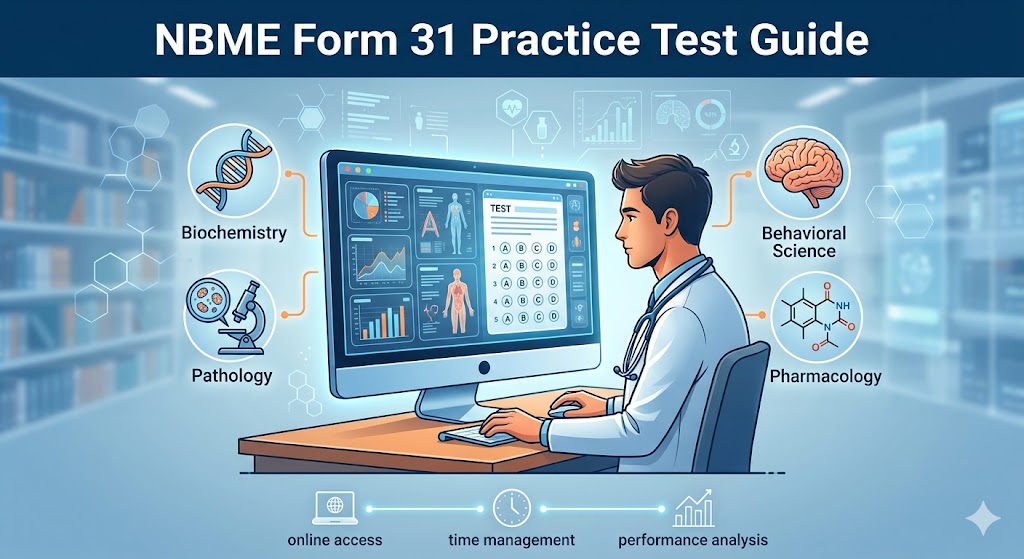
Additional Information
What the Course Entails and Exam Details
This self-assessment does not include a syllabus or course
material; rather, it is a diagnostic tool that covers the vast scope of the
USMLE Step 1 content.
The core disciplines assessed across the exam include, but
are not limited to, anatomy, behavioral sciences, biochemistry, microbiology,
immunology, pathology, pharmacology, and physiology.
Furthermore, the questions integrate interdisciplinary
themes such as genetics, nutrition, aging, and molecular and cell biology.
Form 31 evaluates a student's foundational knowledge of
health, disease, and modes of therapy, placing a heavy emphasis on
understanding mechanisms rather than rote memorization.
By taking this practice form, students gain immediate
insight into their relative strengths and weaknesses across these comprehensive
basic science systems and categories.
What to Expect in the Final Exam
When sitting for the NBME Form 31, students should expect a
testing experience that closely mimics the real USMLE Step 1 regarding
interface, pacing, and question style.
The practice exam consists of four blocks, with each block
containing 50 multiple-choice questions, totaling 200 questions for the entire
assessment.
Each question is presented in a clinical vignette style,
requiring the application of basic science knowledge to solve complex
patient-oriented scenarios.
Unlike the real 8-hour Step 1 exam, this self-assessment is
designed to be completed in approximately four hours of testing time, with an
optional tutorial and flexible breaks between blocks.
Upon completion, students receive a score report that
includes a standardized three-digit score and a probability of passing the
actual USMLE Step 1 if taken within a week.
While the "passing score" criteria are generally
aligned with the current USMLE standards, the primary purpose of this form is
to provide a predictive snapshot of the student's current standing.
How to Study and Exam Centers
The best strategy for taking NBME Form 31 is to simulate
real exam conditions as closely as possible, ensuring a quiet, uninterrupted
environment for the full testing duration.
Effective study methods prior to taking the form include
reviewing comprehensive high-yield resources such as 'First Aid for the USMLE
Step 1' and utilizing Question Banks like UWorld for repetitive practice.
After completing the self-assessment, the most vital step in
the process is performing a deep-dive review of the provided answer
explanations for both correct and incorrect answers.
Because this exam is a web-based self-assessment, it is not
administered at physical testing centers or Pearson VUE locations.
The exam is purchased directly through the NBME website (via
the MyNBME Services Portal) and can be taken anywhere with a stable internet
connection and a compatible browser.
Students may choose to take the exam in either a standard
timed format or a self-paced format, though the standard timed format is
recommended for an accurate assessment of readiness.
Frequently Asked Questions
Reviews
5.0
Based on 0 reviews
Leave a Review
No reviews yet. Be the first to review!