
NBRC Pharmacology Practice Exam
$69.00
- Buy to unlock unlimited access to all Quiz questions and Answers in this Quiz.
- After purchase you can print a PDF of the whole quiz at any point. The PDF will contain the questions and the correct answers.
About this Exam
Welcome to your comprehensive guide for mastering the NBRC Pharmacology requirements. While the National Board for Respiratory Care (NBRC) does not offer a standalone "Pharmacology Exam," proficiency in respiratory pharmacology is a mandatory and heavily weighted component of its primary credentialing examinations. This study guide and practice exam framework is specifically designed for student respiratory therapists and graduate respiratory therapists preparing for the Therapist Multiple-Choice (TMC) Examination (to earn the CRT and RRT credentials) and the Clinical Simulation Examination (CSE). It focuses exclusively on the essential medication knowledge required to safely and effectively practice respiratory care, ensuring you are fully prepared for the pharmacology questions you will encounter on your journey to becoming a Registered Respiratory Therapist (RRT) or obtaining specialty credentials like the Adult Critical Care Specialist (ACCS).
Ready to test your knowledge?
Buy Now to Access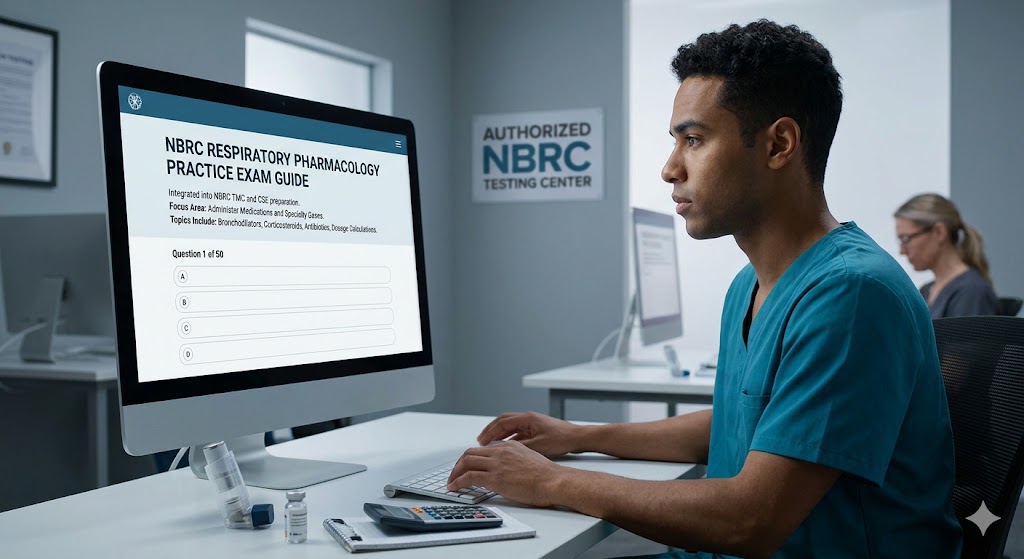
Additional Information
What the Course Entails and Exam Details
To succeed on the NBRC exams, you must possess a deep
understanding of the drugs used to treat cardiopulmonary diseases. This guide
covers the entire spectrum of respiratory pharmacology outlined in the NBRC's
detailed content specifications. Key areas include the indications,
contraindications, mechanisms of action, dosages, routes of administration,
adverse effects, and drug interactions for the following drug classes:
- Bronchodilators:
Beta-2 agonists (SABA, LABA), anticholinergics (SAMA, LAMA), and
methylxanthines.
- Anti-inflammatory
Agents: Inhaled and systemic corticosteroids, leukotriene modifiers,
and mast cell stabilizers.
- Mucokinetic
and Mucoactive Agents: Mucolytics, expectorants, and surface-active
agents (surfactants).
- Anti-infective
Agents: Antibiotics, antivirals, antifungals, and antiprotozoals
delivered via aerosol or systemically for respiratory infections.
- Neuromuscular
Blocking Agents: Depolarizing and non-depolarizing paralytics used in
rapid sequence intubation and mechanical ventilation.
- Sedatives,
Analgesics, and Anesthetics: Agents for conscious sedation and patient
comfort during mechanical ventilation.
- Cardiovascular
Agents affecting the Pulmonary System: Vasodilators (e.g., nitric
oxide), vasopressors, and antiarrhythmics.
- Specialty
Gases: Medical air, oxygen, heliox, and carbon dioxide/oxygen
mixtures.
- Dosage
Calculations: Critical calculations for adult and pediatric patients,
including intravenous drip rates and aerosol dilutions.
What to Expect in
the Final Exam
On the NBRC Therapist Multiple-Choice (TMC) Examination,
pharmacology content is integrated into broader clinical scenarios. You will
not find a separate "pharmacology section." Instead, you will face
multiple-choice questions that require you to apply your drug knowledge to make
sound clinical decisions. Out of the 160 questions on the TMC (140 scored),
approximately 4% to 8% are directly classified under "Administer
Medications and Specialty Gases," but pharmacology knowledge is also
essential for answering many questions in the "Initiation and Modification
of Interventions" section. Questions are distributed at different
cognitive levels, testing recall, application, and analysis. In the Clinical
Simulation Examination (CSE), pharmacology is critical for determining the
correct pathway for patient care, where choosing the wrong medication can lead
to a simulation failure. The TMC has a three-hour time limit, and passing
scores vary for the CRT and RRT levels, but both require a strong performance
in pharmacology-related questions.
How to Study and Exam Centers
Effective preparation requires a multi-faceted approach.
First, download and intimately familiarize yourself with the latest NBRC
Detailed Content Outline for the TMC and CSE to know exactly what is testable.
Utilize reputable respiratory care pharmacology textbooks and online resources.
Create comprehensive drug charts or flashcards for every drug class, noting
prefixes and suffixes for easy identification. Master dosage calculations
through relentless practice until you can perform them accurately under pressure.
Join or form a study group to discuss clinical scenarios involving medication
administration. Take multiple "NBRC Pharmacology Practice Exams"
available from commercial preparation sources; these provide realistic question
formats and rationales for correct answers, helping you identify weak areas. To
take the actual NBRC credentialing exams, you must apply through the official
NBRC website. Once approved, you will schedule your appointment at a
computer-based testing center, primarily through PSI testing centers located
across the United States. International candidates and those with specific
needs may have options for live remote proctoring.
Job Opportunities
from the Course
Mastering respiratory pharmacology is not just an academic
requirement; it is a fundamental pillar of respiratory care practice.
Successfully navigating the pharmacology questions on the NBRC exams is
essential to obtaining the credentials required for licensure and employment.
Holding NBRC credentials opens doors to diverse and rewarding career paths,
including:
- Certified
Respiratory Therapist (CRT)
- Registered
Respiratory Therapist (RRT)
- Adult
Critical Care Specialist (RRT-ACCS)
- Neonatal/Pediatric
Specialist (RRT-NPS)
- Sleep
Disorders Specialist (RRT-SDS)
- Pulmonary
Function Technologist (CPFT/RPFT)
- Asthma
Educator (AE-C)
- Home
Care Respiratory Therapist
- Pulmonary
Rehabilitation Specialist
- Transport
Respiratory Therapist (Ground and Air)
- Clinical
Educator in Respiratory Care
- Respiratory
Care Department Manager or Director
Frequently Asked Questions
Reviews
5.0
Based on 0 reviews
Leave a Review
No reviews yet. Be the first to review!