
NC BLET 2026 State Practice Exam
$69.00
- Buy to unlock unlimited access to all Quiz questions and Answers in this Quiz.
- After purchase you can print a PDF of the whole quiz at any point. The PDF will contain the questions and the correct answers.
About this Exam
The North Carolina Basic Law Enforcement Training (BLET) program is the state’s foundational certification course for aspiring law enforcement officers. It is designed to equip candidates with the essential skills, knowledge, and physical capabilities required for entry-level employment in municipal police departments, county sheriffs’ offices, state agencies, and private company police.
Administered by the North Carolina Criminal Justice Education and Training Standards Commission and the North Carolina Sheriffs’ Education and Training Standards Commission, BLET is not merely a test; it is an intensive, multi-month, para-military academy that combines rigorous physical training with theoretical classroom learning. Successfully completing BLET is the prerequisite for taking the State Comprehensive Examination, which is the final hurdle to becoming a certified, sworn law enforcement officer in North Carolina.
Ready to test your knowledge?
Buy Now to Access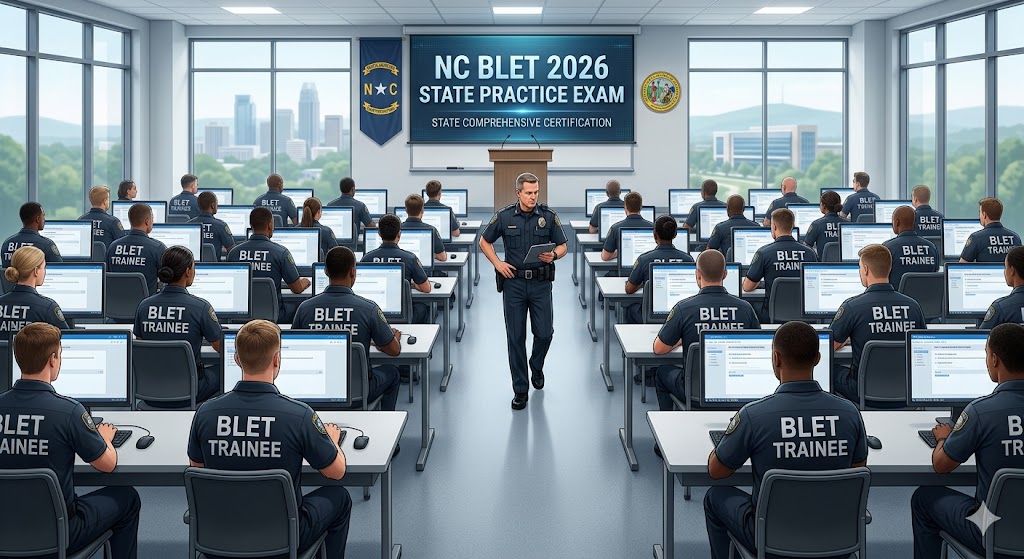
Additional Information
What the Course Entails and Exam Details
The BLET course is a comprehensive, state-mandated
curriculum totaling over 640 hours of instruction. The material is divided into
dozens of specific topical areas, or "modules," which must be
successfully mastered.
The Core Topics and Syllabus include:
- Legal:
Criminal Law, Juvenile Laws, Civil Process, ABC Laws, Motor Vehicle Laws,
Laws of Arrest, Search and Seizure.
- Tactical
and Physical: Firearms Qualification (Handgun and Shotgun), Law
Enforcement Driver Training (LEDT), Subject Control and Compliance
Techniques (SCCT), Rapid Deployment, Physical Fitness (culminating in the
POPAT—Police Officer’s Physical Ability Test).
- Operational
and Investigative: Patrol Techniques, Crime Prevention, Ethics and
Community Relations, Crisis Intervention, Domestic Violence Response,
Anti-Terrorism, Criminal Investigation, Interview and Interrogation.
- Administrative
and Communications: Report Writing, Court Procedures, DCI (Division of
Criminal Information), and Emergency Responses (First Aid/CPR).
Exam Details (The State Comprehensive Exam):
The State Comprehensive Examination is a cumulative test
administered only after a student has successfully passed all course
modules, physical skill tests, and the POPAT. In 2026, the state will use the
standard comprehensive test structure or the newly introduced scenario-based
"pilot program" state exam format.
What to Expect in the Final Exam
Format: The primary State Comprehensive Examination
is typically a multiple-choice, computer-based exam. It consists of several
hundred questions, rigorously testing all theoretical knowledge. A recent
"pilot program" for the state exam has introduced scenario-based
questioning, which has fewer questions and focuses on decision-making and
critical thinking within basic law enforcement situations. Students should be
prepared for either format, as both test the full scope of the BLET curriculum.
Passing Score Requirements: To pass the State
Comprehensive Examination, students must achieve a minimum score of 70 percent.
It is crucial to note that individual module tests during the BLET
academy often have their own 70 or 80 percent passing standard, and excessive
failures or failure to remediate individual tests will result in dismissal from
the program before the final state exam can be attempted.
Time Limits: The State Comprehensive Examination is a
timed test, generally spanning several hours, often with a break. The exact
time allotted depends on the specific exam version and total number of
questions for that cycle.
Specific Rules: Only students who have been certified
by their School Director as successfully completing all BLET coursework, skill
requirements, and the POPAT are eligible to sit for the state exam. The test
must be taken within a specified window after course completion, usually
arranged through the BLET delivery academy.
How to Study and
Exam Centers
Actionable Study Strategies:
- Prioritize
Understanding Over Memorization: Law enforcement is often about
applying the law to a set of circumstances. Focus on the elements
of crimes, the why behind tactical decisions, and the practical
application of civil rights. For scenario-based questions, practice
identifying the best answer out of several correct-looking options.
- Form
Active Study Groups: Your classmates are your best resource. Group
discussion, especially working through practical scenarios and legal
precedents, reinforces a conceptual understanding. Use the 640+ page State
Comprehensive Study Guide as your anchor text.
- Take
Continuous Practice Quizzes: Throughout the academy, utilize practice
tests on specific modules. Actively review every question you get wrong to
understand the concept you missed. Use available digital download
resources for mock State Exams.
- Maintain
Physical and Mental Wellness: BLET is a marathon. A disciplined
physical routine will help you pass the POPAT and improve cognitive
function, making classroom study more effective.
Where and How to Take the Exam:
You will take the State Comprehensive Examination at your
BLET delivery institution (typically a North Carolina community college or an
authorized law enforcement training facility) upon graduation. It is
administered in a secure, proctored computer lab environment.
Unlike general standardized tests, you do not register for
this through a global portal like Pearson VUE; your academy's School Director
and the North Carolina Justice Academy manage the testing process
Job Opportunities from the Course
Upon passing the BLET program and the State Comprehensive
Exam, you earn your certification from the North Carolina Department of
Justice, making you eligible for sworn law enforcement positions across the
state. This certification is a minimum requirement and a significant
achievement in unlocking the following career paths:
- Police
Officer Recruit/Cadet (for municipal police departments like
Charlotte-Mecklenburg, Raleigh, Greensboro)
- Deputy
Sheriff Trainee (for county sheriffs’ offices)
- State
Highway Patrol Trooper Cadet
- NC
State Bureau of Investigation (SBI) Agent
- Wildlife
Enforcement Officer
- Alcohol
Law Enforcement (ALE) Agent
- Campus
Police Officer (at NC universities and community colleges)
- Company
Police Officer (private police authorized by the state)
- Hospital
Police Officer
- DMV
License and Theft Bureau Inspector
Frequently Asked Questions
Reviews
5.0
Based on 0 reviews
Leave a Review
No reviews yet. Be the first to review!