
NC BLET Civil Process Practice Exam*
$69.00
- Buy to unlock unlimited access to all Quiz questions and Answers in this Quiz.
- After purchase you can print a PDF of the whole quiz at any point. The PDF will contain the questions and the correct answers.
About this Exam
The North Carolina Basic Law Enforcement Training (BLET) Civil Process course and its final exam are critical steps for individuals aspiring to specialized roles within law enforcement, primarily within North Carolina Sheriff's offices. This certification prepares officers to handle the complex, non-criminal procedures required by the courts, such as serving legal documents, executing court orders, and managing civil matters with precision and legal compliance. It is designed for both new recruits and experienced officers seeking to move into a civil division, providing the foundational knowledge required for effective and responsible performance in these essential duties.
Ready to test your knowledge?
Buy Now to Access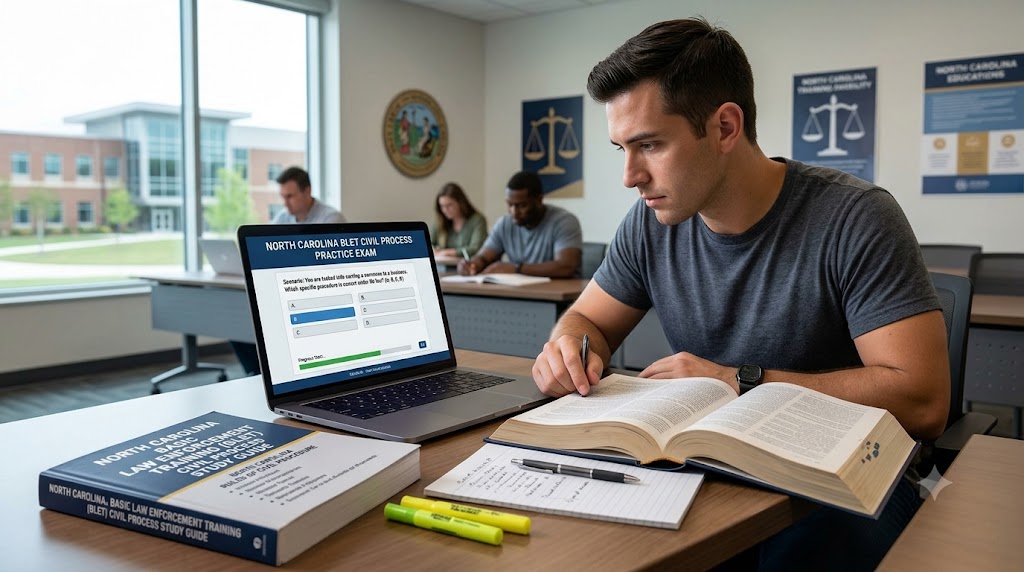
Additional Information
What the Course Entails and Exam Details
The NC BLET Civil Process course is an intensive program covering a wide array of topics crucial to civil court operations. Students will delve into:
The North Carolina Rules of Civil Procedure and related laws.
The types and classifications of civil processes (summons, complaints, subpoenas, etc.).
Detailed protocols for the proper service of process to individuals, businesses, and government entities.
The execution of court orders, including writs of execution for money or property, attachment, and claim and delivery.
Handling diverse civil cases, from domestic violence protective orders to child support enforcement and mental health processes.
Understanding and navigating the role of the Sheriff and deputy sheriffs in civil matters, including limitations of authority and potential liabilities.
The accurate and detailed documentation of service, including proper return of process to the courts.
The exact length and delivery of the course can vary depending on the authorised BLET training academy (often community colleges or specific agency schools) in North Carolina.
What to Expect in the Final Exam
The final exam for the NC BLET Civil Process certification is typically a proctored, written examination. It is designed to rigorously test your understanding of the course material and its application to real-world scenarios. Here is what you can generally expect:
Format: Primarily multiple-choice questions, with some true/false or scenario-based problem-solving. This requires strong recall of specific procedures and legal principles.
Time Limit: There is a defined time limit, compelling candidates to manage their time effectively across the questions. The exact duration will be communicated at the exam.
Passing Score: Students must achieve a minimum percentage to pass, often around 70-80%, reflecting the need for comprehensive understanding in this critical area.
Content Focus: Expect a heavy emphasis on North Carolina-specific civil laws, required service protocols, official return requirements, and critical scenario-based applications of civil procedure. This isn't just about theory; it's about practical, legal execution of duties.
Rules: The exam is typically closed-book and strictly monitored. No external resources or assistance are allowed, simulating a high-pressure environment similar to practical service situations.
How to Study and Exam Centers
Preparation is paramount to success in the NC BLET Civil Process exam. Here are actionable strategies:
Master the Course Material: Dedicate significant time to studying all textbooks, manuals, handbooks, and classroom notes. Go beyond just reading – understand the 'why' and 'how' behind every procedure.
Utilize Practice Resources: Seek out practice tests and quizzes that mirror the exam format and cover NC-specific civil process. Identify key terms, legal requirements, and typical scenarios. Focus on specific areas you find challenging. (Note: While not an interactive tool here, the prompt specifically mentions practice tests as a key resource).
Create Key Definitions & Flows: Make flashcards for legal terms (e.g., summons, subpoena, writ of execution, replevin), and chart the step-by-step process for different service types and returns.
Scenario Practice: Review case studies and practice scenarios to apply principles of service and execution to complex situations, considering officer safety, proper documentation, and potential legal pitfalls.
Attend Review Sessions: Participate in any available academy-led review sessions, and form study groups with classmates.
Stay Updated: Ensure your knowledge reflects the most current North Carolina rules and regulations for civil procedure.
Exam Centers:
The final official exam for the NC BLET Civil Process certification is not taken via general online portals like Pearson VUE or third-party test centers. It is typically administered as the culmination of the official BLET program, proctored in a controlled classroom setting at the specific authorized NC training academy where the course was completed, such as a local community college or a sheriff's office training facility. You must check with your BLET director or training coordinator for the exact schedule and location.
Job Opportunities from the Course
Successful completion of the NC BLET Civil Process course and exam opens specific career paths, primarily within North Carolina law enforcement, specifically focused on the administration and execution of court matters:
Sheriff's Deputy (Civil Process Division/Unit): The most common position, where deputies are tasked with serving civil papers, executing writs, and handling varied civil matters daily.
Civil Process Server: Specialized officers within a sheriff's office or other entities dedicated exclusively to the legal service of civil process documents.
Courthouse Deputy/Security (with related duties): Officers in the courthouse may have elements of civil process or court order enforcement within their roles.
Deputy Marshal (conceptually related roles): While 'Marshal' is less common at the county level in NC compared to other states, related specialized warrant/process positions might exist within larger or specialized agencies, heavily drawing on civil process knowledge.
Supervisory/Administrative Roles in Civil Divisions: As experience grows, this certification forms a strong foundation for advancement into leadership within civil processing teams.
Frequently Asked Questions
Reviews
5.0
Based on 0 reviews
Leave a Review
No reviews yet. Be the first to review!