
NC EMT-B Practice Exam
$69.00
- Buy to unlock unlimited access to all Quiz questions and Answers in this Quiz.
- After purchase you can print a PDF of the whole quiz at any point. The PDF will contain the questions and the correct answers.
About this Exam
Unlock your potential as a lifesaver in North Carolina with our essential guide to the EMT-Basic certification process and NC EMT-B Practice Exam strategies. This comprehensive guide is designed specifically for aspiring Emergency Medical Technicians looking to embark on a fulfilling healthcare career within North Carolina. Whether you’re a recent high school graduate, a career-changer, or someone passionate about community service, obtaining your EMT-Basic certification is the critical first step. The exam evaluates your knowledge and practical skills, ensuring you are prepared to provide crucial, pre-hospital care in emergency situations. Preparing effectively with a dedicated North Carolina EMT-Basic (EMT-B) State Practice Exam strategy will build your confidence and knowledge. Our goal is to equip you with the insights and resources needed to successfully navigate this challenging yet rewarding certification journey and make a real difference in people's lives.
Ready to test your knowledge?
Buy Now to Access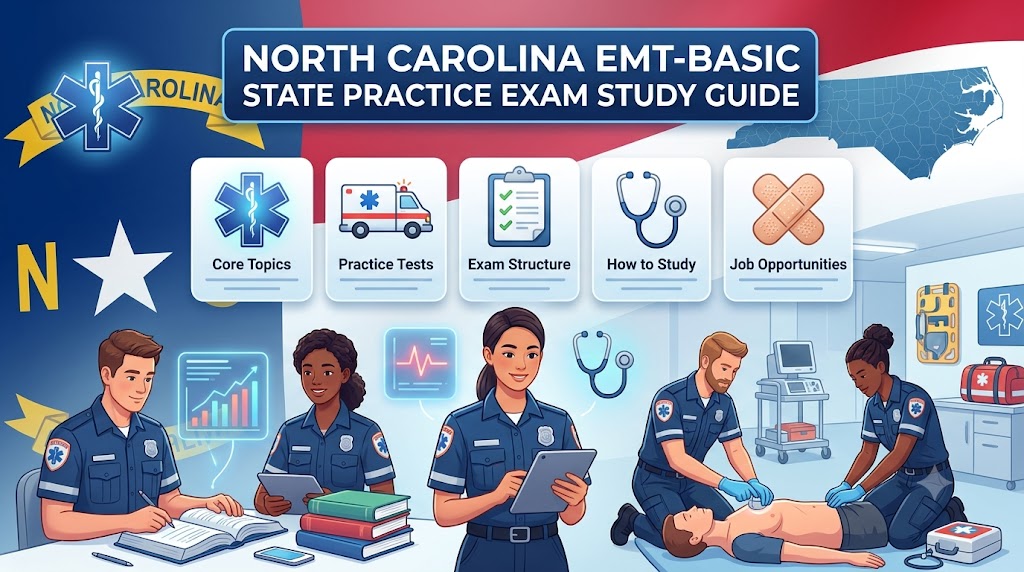
Additional Information
What the Course Entails and Exam Details
Before sitting for the exams, candidates must successfully complete an state-approved North Carolina EMT-Basic training course. This intensive program provides foundational knowledge across critical emergency medical topics. Students delve into airway management, ventilation, oxygen therapy, patient assessment (medical and trauma), medical emergencies (cardiac, respiratory, diabetic, etc.), trauma care, obstetrics/gynecology, and EMS operations. You will learn life-saving skills such as administering certain medications, using automated external defibrillators (AEDs), controlling bleeding, splinting fractures, and managing spinal injuries. The course combines classroom lectures with hands-on practical skills labs, ensuring you are proficient in both theory and application. The certification process itself consists of two primary components: a cognitive exam and a psychomotor (practical) exam. While there isn't one single official state practice exam, numerous reputable online EMT practice questions and simulated exams are available to help you prepare effectively for both parts by reinforcing course material and simulating test conditions.
What to Expect in the Final Exam
The primary cognitive evaluation for NC EMT-B certification is generally the National Registry of Emergency Medical Technicians (NREMT) EMT exam. This is a computer adaptive test (CAT), meaning the difficulty of questions adjusts based on your previous answers. You can expect between 70 and 120 questions covering the core knowledge areas mentioned in your coursework. The time limit for the NREMT cognitive exam is usually up to 2 hours. A scaled passing score of 700 or higher is required to succeed. You will typically receive your results relatively quickly after completing the test. The practical, or psychomotor, exam is administered by the North Carolina Office of Emergency Medical Services (OEMS) or state-approved training programs. This hands-on exam requires you to demonstrate proficiency across several skill stations, such as patient assessment (both medical and trauma), airway management, oxygen administration, BVM ventilation, cardiac arrest management/AED use, bleeding control, and immobilization skills. Each station is evaluated on a pass/fail basis by trained examiners. Consistent practice with skill sheets and scenario-based training is crucial for mastering this portion.
How to Study and Exam Centers
Effective preparation is key to conquering both exams. Consistent study habits are essential. Thoroughly review your course textbook, notes, and all training materials daily. Utilize flashcards for key terms, acronyms (like SAMPLE, OPQRST), dosages, and protocols. Form study groups to discuss concepts and practice skills together. The most impactful strategy, however, is incorporating reputable NC EMT study guide materials and full-length practice exams into your routine. Take multiple practice tests to familiarize yourself with the question formats, identify weak areas, and build test-taking stamina. Review the rationale for every practice question, ensuring you understand not just the correct answer but why other options were incorrect. To take the cognitive NREMT exam, you must schedule it through an authorized testing center, most commonly Pearson VUE. Pearson VUE has numerous testing centers across North Carolina and nationwide. The psychomotor (practical) exam is typically coordinated directly through your EMT training program or scheduled at designated state testing sites; consult your instructor or the NC OEMS website for upcoming dates and locations.
Job Opportunities from the Course
Successfully gaining your North Carolina EMT-Basic certification opens doors to a diverse range of rewarding EMT jobs in North Carolina and beyond.
Emergency Medical Technician (Ambulance - Private & Public)
Firefighter/EMT (Many fire departments require both certifications)
Hospital Emergency Department Technician
Event Medical Staff (Concerts, sports events, festivals)
Interfacility Transport EMT
Industrial or Occupational EMT
Search and Rescue Team Member
Clinic or Urgent Care Technician
Wilderness EMT (With additional specialized training)
Medical Equipment Sales or Training
Frequently Asked Questions
Reviews
5.0
Based on 0 reviews
Leave a Review
No reviews yet. Be the first to review!