
NC Nail Technology State Board Practice Exam
$69.00
- Buy to unlock unlimited access to all Quiz questions and Answers in this Quiz.
- After purchase you can print a PDF of the whole quiz at any point. The PDF will contain the questions and the correct answers.
About this Exam
The North Carolina Nail Technology State Board Exam is the essential final stepping stone required to become a licensed nail technician in the state. This comprehensive exam is designed exclusively for individuals who have successfully completed the required hours of training at an approved North Carolina cosmetic art school. The certification process validates that you possess the necessary knowledge and practical skills to perform nail services safely and effectively on the public. This exam is administered under the oversight of the North Carolina Board of Cosmetic Art Examiners to ensure all practicing technicians meet state safety and sanitation standards.
Ready to test your knowledge?
Buy Now to Access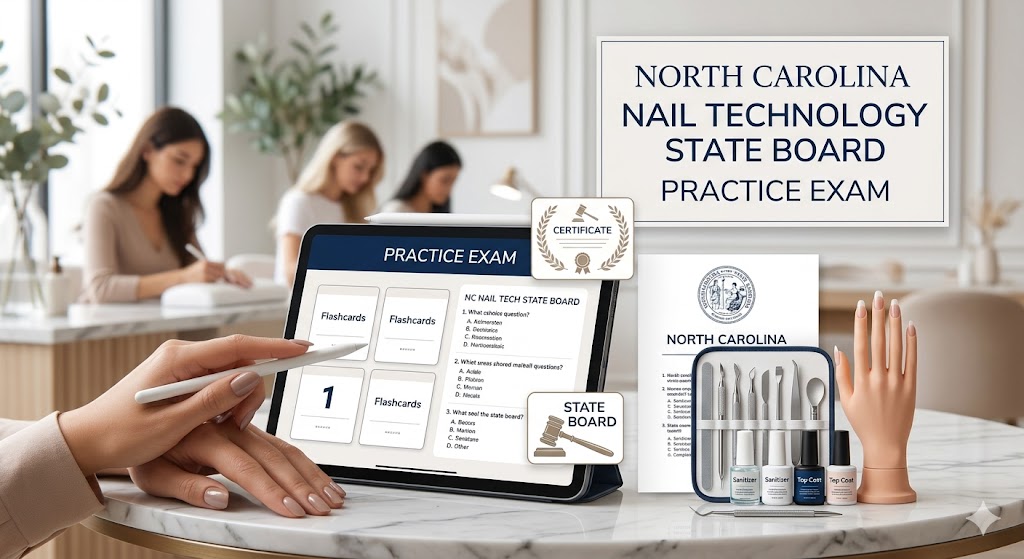
Additional Information
What the Course Entails and Exam Details
Preparing for the state board exam involves a deep dive into both the theoretical foundations and the hands-on techniques of nail technology. The prerequisite training curriculum and the subsequent exam focus heavily on critical safety and sanitation protocols to protect client health. You will study nail anatomy, physiology, and the identification of nail diseases and disorders that require medical referral. The core technical skills covered include proper procedures for manicuring, pedicuring, nail tips, acrylic application, and specialized gel services. You will also be tested on North Carolina state laws and regulations governing cosmetic art shops and individual licensees.
What to Expect in the Final Exam
The North Carolina Nail Technology State Board Exam generally consists of two distinct components that must be passed independently. The first component is the Theory examination, which is a written test composed of multiple-choice questions administered via computer. The Theory section covers scientific concepts, client consultation, and the specific rules and regulations established by the North Carolina Board. The second component is the Practical examination, where you must demonstrate your technical skills in a hands-on setting. During the practical, you are required to perform a series of specific nail services on either a mannequin hand or a live model, depending on current board guidelines. You will be meticulously evaluated on your ability to perform these services while maintaining a sterile environment and following precise, step-by-step procedures. A passing score of at least 75% is typically required on both the theory and practical portions to qualify for licensure. Time limits are strictly enforced for both sections: the written exam generally allows about 90 minutes, and the practical exam segments are individually timed.
How to Study and Exam Centers
Effective preparation requires a structured study plan that balances theoretical knowledge with repetitive practical application. Utilizing a high-quality North Carolina Nail Technology State Board Practice Exam is one of the most effective strategies for success. Practice exams help familiarize you with the specific wording of the questions, identify your knowledge gaps, and improve your test-taking speed. Create detailed flashcards for key terms, anatomical diagrams, sanitation procedures, and state regulations. For the practical exam, schedule regular, timed practice sessions to build your muscle memory and refine your procedural efficiency. Ensure your kits for the practical exam are packed correctly and that all products are properly labeled according to state requirements. The official exams are typically administered through a third-party testing agency authorized by the North Carolina Board of Cosmetic Art Examiners, such as PSI Services LLC. Once you have completed your required hours and your school has certified your eligibility, you will register for the exams through the testing provider's online portal. Testing centers are located in various major cities across North Carolina to provide convenient access for candidates state-wide.
Job Opportunities from the Course
Obtaining your North Carolina Nail Technician License opens the door to a wide range of professional opportunities within the thriving beauty industry. Here are some of the career paths this certification unlocks:
Licensed Nail Technician: Work in a salon or spa providing manicures, pedicures, and advanced nail enhancements.
Mobile Nail Technician: Offer professional nail services directly to clients in their homes or office locations.
Salon or Spa Manager: Oversee the daily operations, inventory, and staff management for a beauty establishment.
Nail Art Specialist: Build a clientele focused on intricate designs, custom nail painting, and artistic applications.
Beauty Educator: Teach future generations of technicians at a cosmetic art school after gaining necessary experience.
Salon Owner: Establish and operate your own unique nail boutique or salon business.
Brand Ambassador: Represent nail product manufacturers, demonstrating techniques and promoting product lines at industry events.
Frequently Asked Questions
Reviews
5.0
Based on 0 reviews
Leave a Review
No reviews yet. Be the first to review!