
NC Pathology Funeral Service Practice Exam Guide
$69.00
- Buy to unlock unlimited access to all Quiz questions and Answers in this Quiz.
- After purchase you can print a PDF of the whole quiz at any point. The PDF will contain the questions and the correct answers.
About this Exam
This comprehensive study guide is designed to help you prepare for and succeed in the North Carolina Pathology Funeral Service Exam. This specific examination is a mandatory requirement for individuals seeking full licensure as a Funeral Director in the state of North Carolina. Its primary purpose is to ensure that all aspiring funeral professionals possess a fundamental understanding of pathology—the study of disease. This knowledge is crucial not only for the respectful and ethical care of the deceased but also for the health and safety of the funeral director, the embalming staff, and the public. It is designed for students enrolled in mortuary science programs and registered apprentices pursuing their professional path.
Ready to test your knowledge?
Buy Now to Access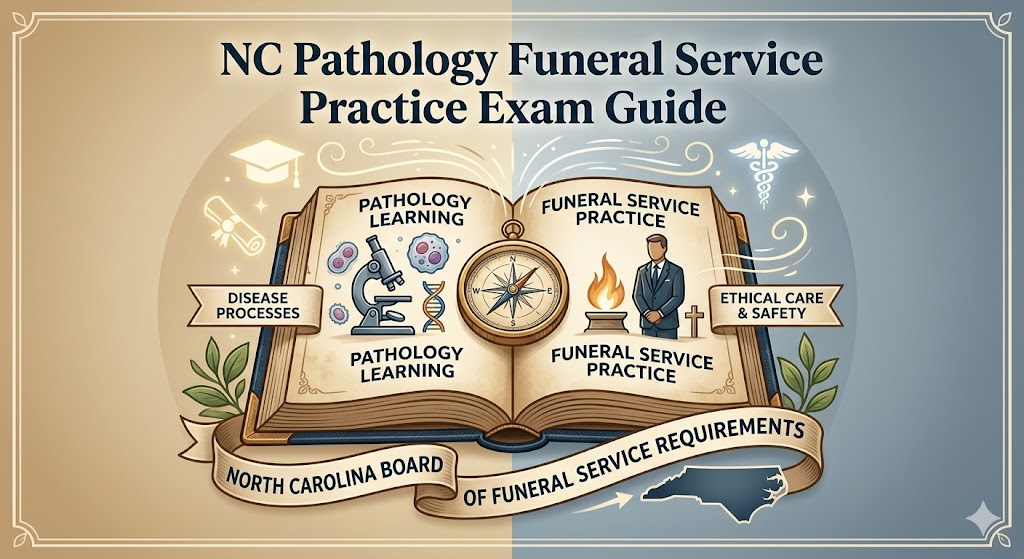
Additional Information
What the Course Entails and Exam Details
A comprehensive funeral service pathology course provides the foundation for this exam. It covers both general and systemic pathology, focusing on the concepts and conditions relevant to the funeral service professional. The core topics and skills include:
General Pathology: Introduction to the nature and causes of disease (etiology), methods of study, and fundamental concepts such as cellular adaptation, injury, inflammation, repair, regeneration, and cell death (necrosis, including gangrene).
Systemic Pathology: Examination of common diseases and their post-mortem manifestations in specific body systems, such as the cardiovascular (e.g., arteriosclerosis, myocardial infarction), respiratory (e.g., pneumonia, tuberculosis), digestive, and central nervous systems.
Pathology of Infectious Diseases: Understanding the characteristics and transmission modes of various infectious agents, including bacteria, viruses, and fungi, and the safety protocols necessary to manage remains.
Neoplasia: Knowledge of the characteristics, classification, and naming of benign and malignant tumors (e.g., melanoma, carcinoma, sarcoma).
Vascular and Circulatory Disturbances: Study of conditions affecting blood flow, such as edema, thrombosis, embolism, hemorrhage, and shock.
Terminology: Mastery of the extensive vocabulary specific to medical and pathological conditions essential for accurate documentation and communication.
Post-Mortem Conditions: Practical application of pathological knowledge to anticipate changes and conditions relevant to the embalming and preparation process.
What to Expect in the Final Exam
The final North Carolina Pathology Funeral Service Exam is typically administered in a computer-based format. Candidates should be prepared for a series of objective questions, most often presented as multiple-choice questions (MCQs). These questions are designed to test your comprehension and ability to apply pathology principles.
The specific details regarding the total number of questions, the exact time limit, and the required passing score are set by the North Carolina Board of Funeral Service. However, a common structure involves a test of around 50 to 100 questions, with a time limit of 60 to 120 minutes. Candidates are usually required to achieve a scaled score of 75% or higher to pass. You should check the official NC Board of Funeral Service website or your examination notification for the most current and precise details. Your score report will typically provide a pass/fail status immediately.
How to Study and Exam Centers
Effective preparation is key to your success. Here are actionable study strategies:
Review Your Textbooks: Revisit the textbooks and materials from your funeral service pathology and microbiology courses. These are your foundational resources.
Utilize Practice Questions: Solve as many practice questions as possible. This helps familiarize you with the types of questions and the overall test format. Websites and resources from mortuary science programs and professional organizations are excellent sources.
Create Flashcards: Create flashcards for key terms, disease characteristics, and definitions. This is a powerful tool for memorization.
Form a Study Group: Collaborating with fellow students can provide different perspectives, explanations, and emotional support.
Focus on Application: Instead of just memorizing facts, try to understand how a specific disease or condition would manifest and why it is significant for embalming, restorative art, or public health in a funeral service context.
Exam Centers:
To take the exam, you must first become eligible and register through the North Carolina Board of Funeral Service. The Board typically coordinates testing through a national testing service, such as Pearson VUE, which operates numerous secure testing facilities across North Carolina and the United States. When you receive your Authorization to Test (ATT) letter, you will follow the instructions to schedule your exam at a convenient location. It is important to confirm the current process with the NC Board of Funeral Service.
Job Opportunities from the Course
Successfully passing this exam and obtaining your North Carolina Funeral Director license unlocks various fulfilling career paths within the funeral service profession. Here are some specific job titles this certification can lead to:
Funeral Director
Embalmer
Funeral Service Manager
Funeral Home Consultant
Funeral Service Educator
Morgue Attendant/Technician
Bereavement Counselor
Frequently Asked Questions
Reviews
5.0
Based on 0 reviews
Leave a Review
No reviews yet. Be the first to review!