
NC Permit Practice Exam
$69.00
- Buy to unlock unlimited access to all Quiz questions and Answers in this Quiz.
- After purchase you can print a PDF of the whole quiz at any point. The PDF will contain the questions and the correct answers.
About this Exam
Prepare for your journey behind the wheel with our comprehensive North Carolina (NC) Permit Practice Test guide. This study resource is expertly designed for first-time drivers, new residents, and anyone looking to confidently pass the written knowledge test required by the NCDMV to obtain their learner's permit.
Getting your driver's permit is a significant milestone, and this practice test is your essential companion. We have crafted a range of questions that mirror the official examination, helping you build familiarization with NC traffic regulations, safe driving principles, and essential road signs. Whether you are a high school student eager to start driving or an adult navigating the licensing process, this guide offers the practice and reassurance you need.
Ready to test your knowledge?
Buy Now to Access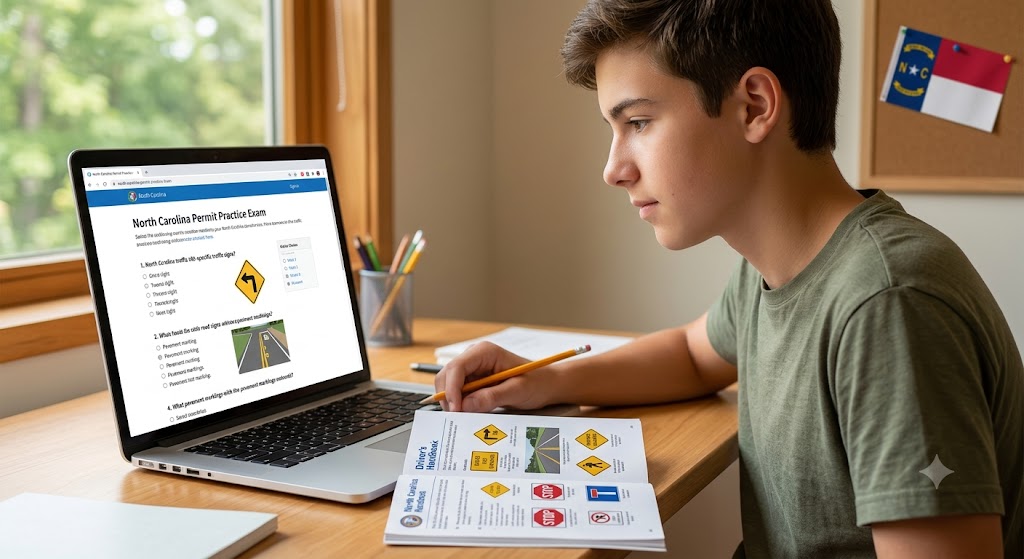
Additional Information
What the Course Entails and Exam Details
This online practice resource focuses on ensuring you are fully prepared for the NCDMV learner’s permit test. It meticulously covers key categories outlined in the official North Carolina Driver's Handbook.
NC Traffic Laws: Understand rules of the road specific to North Carolina, including speeding laws, right-of-way protocols, and laws regarding cell phone use and seatbelts.
Safe Driving Practices: Test your knowledge on safe following distances, defensive driving techniques, and the legal implications of driving while impaired (DWI).
Road Signs and Pavement Markings: Learn to identify and understand the meanings of various regulatory, warning, and informational signs, as well as complex pavement markings and dynamic driving scenarios.
Intersections and Turns: Master the rules for navigating intersections, four-way stops, and executing turns correctly and safely.
3. What to Expect in the Final Exam
While our practice test helps you prepare, the actual NC DMV written permit test is the final hurdle. Knowing what to expect can alleviate test anxiety and improve your performance.
The official NCDMV written knowledge test is typically a multiple-choice examination. In North Carolina, you are required to answer 25 questions covering driving laws and safe practices. To pass, you must achieve a score of at least 80%, which means answering 20 out of 25 questions correctly. There is generally no strict time limit, but you must complete the test within the operating hours of your local DMV office. The test is administered in an environment designed for integrity, and you must not use books or seek assistance during the exam.
How to Study and Exam Centers
Effective study and knowing your exam center locations are crucial steps for success.
Study Strategies for Success:
Use official resources: The North Carolina Driver’s Handbook is the primary resource for the DMV test. We recommend reading it thoroughly multiple times.
Take our practice tests: Actively engage with multiple versions of our NC Permit Practice Test. These replicate the official format and content, building familiarity and confidence.
Analyze missed questions: After each practice test, review the questions you missed. Understand why the correct answer is right and the incorrect ones are wrong.
Create flashcards: Make flashcards for North Carolina road signs, traffic laws, and safe driving definitions.
Simulate exam conditions: Dedicate time to take practice tests in a quiet, distraction-free environment to simulate the pressure of the actual exam day.
Taking the Exam and Exam Centers:
Unlike the online practice test, the final NCDMV written knowledge test must be taken in person at a designated North Carolina DMV office. You can find a complete list of North Carolina driver license office locations and hours on the NCDMV official website. We highly recommend scheduling an appointment online in advance to reduce wait times.
Preparing for Your Visit:
Confirm the location and operating hours of your chosen NCDMV office.
Ensure you bring all required documentation, such as proof of age, identity, social security number, North Carolina residency, and, for minors, proof of successful completion of driver education.
Complete any necessary applications before your visit if possible.
Job Opportunities from the Course
While a driver’s permit itself is not a job qualification, it is the fundamental first step towards obtaining a full driver’s license, which unlocks numerous employment opportunities and career paths across various industries.
Successfully passing the NC DMV permit test and earning your permit opens the door to jobs that require full licensure once you complete the necessary driving experience. Consider these roles that depend on having a driver's license:
Delivery Driver: Jobs in food delivery, parcel services, or medical courier roles often require an active driver's license.
Ride-Share Driver: Services like Uber and Lyft require drivers to hold a full, valid driver’s license.
Field Service Technician: Technical roles that involve travel to client sites, such as HVAC, plumbing, or telecom, rely on mobility-driven careers.
Sales Representative: Many outside sales positions require driving to meet with clients and manage territories.
Commercial Drivers (with further training): A standard license is a prerequisite to pursue commercial driver's licenses (CDL), leading to high-demand careers in trucking and public transit.
Frequently Asked Questions
Reviews
5.0
Based on 0 reviews
Leave a Review
No reviews yet. Be the first to review!