
NC Public Utilities License Practice Exam: A Comprehensive Study Guide
$69.00
- Buy to unlock unlimited access to all Quiz questions and Answers in this Quiz.
- After purchase you can print a PDF of the whole quiz at any point. The PDF will contain the questions and the correct answers.
About this Exam
The North Carolina Public Utilities License, administered by the North Carolina Licensing Board for General Contractors, is designed for individuals wishing to work as contractors on public utility projects. This license covers the installation, maintenance, and repair of various public infrastructure systems, including but not limited to, water distribution lines, sanitary sewer systems, storm drainage, gas mains, communication lines (pole and underground), and electrical distribution systems. It is intended for ambitious tradespeople, project managers, and business owners seeking to take single-prime contracts or subcontracts for these critical infrastructure developments. Securing this license demonstrates regulatory compliance and technical competency in a demanding field.
Ready to test your knowledge?
Buy Now to Access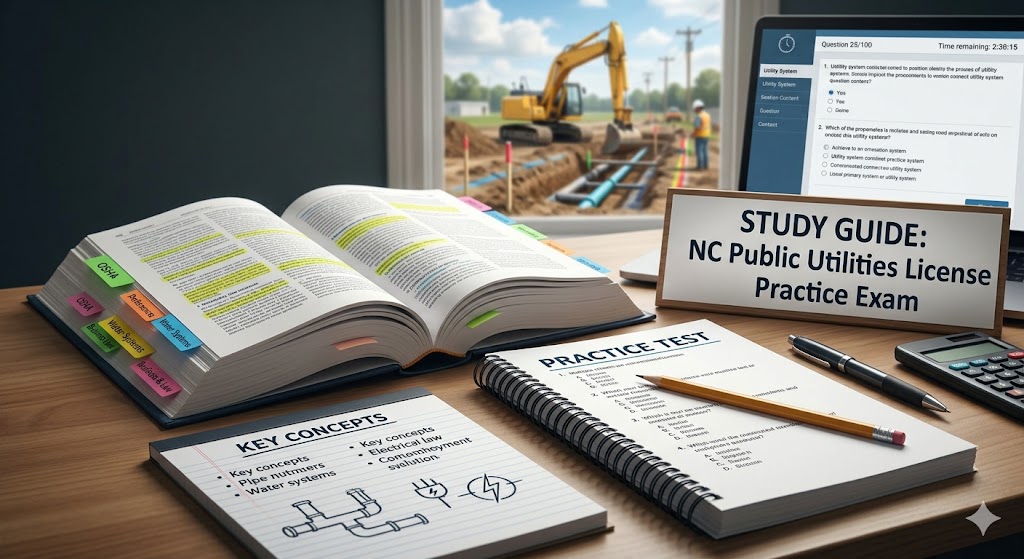
Additional Information
What the Course Entails and Exam Details
Preparing for the NC Public Utilities License exam typically involves studying a specific, diverse set of topics that reflect the broad scope of utility work. While there isn't one single mandated course, numerous trade schools, private training providers, and online platforms offer comprehensive prep programs, study guides, and, crucially, realistic practice exams. These study materials and practice tests are crucial for exam preparation.
The topics you need to master, and which practice exams should cover, include:
NC Licensing Board Laws and Rules: Understanding the specific regulations and requirements for general contractors in North Carolina.
Business Practices and Financial Responsibility: General principles of managing a contracting business, project estimating, and meeting financial criteria.
Safety Standards (OSHA 1926): Critical knowledge of safety regulations for construction industry work, particularly related to trenching, excavation, and heavy equipment.
Blueprint Reading and Specifications: Interpreting construction drawings and technical specifications accurately.
Utility Systems Knowledge: In-depth technical understanding of:
Water lines, mains, and external distribution infrastructure.
Sanitary sewer lines, mains, and manholes.
Storm drainage systems.
Gas and petroleum pipelines and systems.
Communication lines (cable TV, telephone, fiber optics) including pole line construction and underground conduit.
Electrical systems, typically focusing on underground distribution, but sometimes covering overhead elements, depending on the specific scope of the PU classification.
General Contracting Principles: Relevant aspects of project management, contract law, and material usage in utilities.
What to Expect in the Final Exam
The actual licensing exam, administered by PSI Services, is designed to thoroughly assess your readiness. Here’s a breakdown of what to expect:
Format: The exam consists of 100 multiple-choice questions.
Passing Score: You must achieve a score of 70% or higher (answer at least 70 questions correctly) to pass.
Time Limit: Candidates are typically given 4 hours to complete the full exam.
Type: The exam is typically open book, but you are only permitted to bring specific, approved reference materials (certain code books, safety manuals, etc.) into the testing center. These materials must be highlited, tabbed, and verified according to PSI rules. You cannot bring notes, scratch paper, or non-approved references. Be sure to obtain the latest candidate bulletin from the NC Licensing Board or PSI for the exact list of allowed references and specific rules for tabbing and highlighting. No external materials beyond the approved references are permitted during the timed test.
How to Study and Exam Centers
Effective study and knowing the exam logistics are vital for success.
Actionable Study Strategies:
Understand the Content Outline: Review the official exam content outline in the candidate information bulletin to know exactly what topics are covered.
Obtain and Utilize Required References: Source all the approved reference books for the current exam year. Familiarize yourself with their contents extensively. Don't just read; learn where information is located.
Develop Tab and Highlight Systems: Strategically highlight key sections and use specific colored tabs for main chapters or important tables within your reference materials (ensuring you follow PSI guidelines on allowed notes/tabs). This will drastically improve speed when looking up information during the timed test.
Utilize High-Quality Practice Tests: Consistently taking realistic, timed NC Public Utilities License Practice Exams is arguably the single most effective study method. This builds test-taking stamina, identifies weak areas, and helps you learn to navigate your references under time pressure. Review every answer – both correct and incorrect – to truly understand the underlying concepts. Practice tests are highly recommended.
Consider Prep Courses: Enroll in a specialized NC Public Utilities exam prep course, which can provide structured learning, highlighting guides, and expert instruction.
Form a Study Group: Collaborate with other aspiring licensees to discuss concepts and test each other.
Time Management Practice: Practice taking full-length practice tests within the four-hour time limit to ensure you can adequately address all questions.
Exam Centers & Registration: The North Carolina Public Utilities License exam is computer-based and administered at dedicated PSI testing centers across the state. Once your application for licensure is approved by the North Carolina Licensing Board for General Contractors, you will receive an eligibility letter. This letter will contain instructions on how to schedule your exam appointment through PSI's website or phone system. PSI operates testing centers in several locations, including, as of recent information, Asheville, Charlotte, Winston-Salem, Raleigh, Fayetteville, Greenville, and Wilmington, making them reasonably accessible for candidates statewide. You cannot typically take this final exam online; you must travel to a physical, proctored testing facility. Ensure you arrive early on your scheduled test day and bring required identification and your approved reference materials.
Job Opportunities from the Course
A North Carolina Public Utilities License opens doors to various rewarding career paths. With a dedicated effort in preparation, including utilizing comprehensive study guides and practice exams, you can unlock opportunities for the specific job titles this certification can unlock:
Licensed Public Utilities Contractor (Own/operate a business, bid on public projects)
Utility Construction Project Manager
Utility Foreman/Supervisor
Utility Pipe Layer/Skilled Laborer (Managing/leading specific tasks)
Estimator (Utilities Construction)
Locate Technician (Utilities specialized)
Pipeline Construction Specialist
Water/Sewer System Technician
Communications Line Installer (Pole & Underground)
Underground Electrical Distribution Foreman
Frequently Asked Questions
Reviews
5.0
Based on 0 reviews
Leave a Review
No reviews yet. Be the first to review!