
NCA Canadian Constitutional Law Practice Exam
$69.00
- Buy to unlock unlimited access to all Quiz questions and Answers in this Quiz.
- After purchase you can print a PDF of the whole quiz at any point. The PDF will contain the questions and the correct answers.
About this Exam
The National Committee on Accreditation (NCA) Canadian Constitutional Law exam is a critical stepping stone for internationally trained lawyers and Canadian civil law graduates.
This assessment is designed to ensure that candidates possess a fundamental understanding of Canada's unique legal framework before they are licensed to practice common law in the country.
If you are an overseas law graduate looking to integrate into the Canadian legal market, this certification is a mandatory and highly rewarding part of your journey.
Successfully passing this exam demonstrates your competency in the supreme law of the land, proving you are ready to navigate the complexities of the Canadian legal system.
Ready to test your knowledge?
Buy Now to Access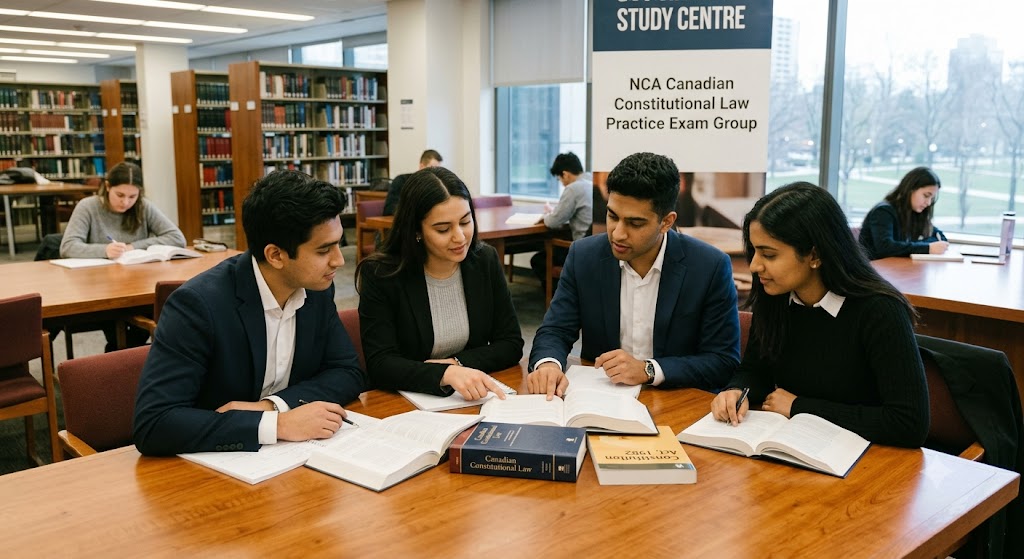
Additional Information
What the Course Entails and Exam Details
The syllabus for this subject provides a deep dive into the
foundational architecture of the Canadian state.
At its core, the course covers the division of legislative
powers between the federal and provincial governments as outlined in the
Constitution Act, 1867.
Candidates will thoroughly explore the Canadian Charter of
Rights and Freedoms, learning how to analyze Charter infringements and the
application of Section 1 (the Oakes test).
The curriculum also places a strong emphasis on Section 35
of the Constitution Act, 1982, detailing Aboriginal rights and title.
Additionally, you will study unwritten constitutional
principles, judicial independence, and the role of the courts in constitutional
interpretation.
What to Expect in
the Final Exam
The final NCA Canadian Constitutional Law exam is rigorous
and designed to test your practical application of the law, not just your
memorization skills.
It is an open-book exam, meaning you are allowed to bring
your syllabus materials, textbooks, and personal notes.
The format traditionally consists of complex, fact-based
essay questions, and occasionally includes short-answer questions.
Candidates are given exactly three hours to complete the
test.
To achieve certification, you must secure a passing score of
at least 50%, which is evaluated on a strict Pass/Fail basis.
You must manage your time flawlessly, allocating the
appropriate amount of time to each question based on its assigned marks.
How to Study and
Exam Centers
Mastering this subject requires active engagement with the
official NCA syllabus and the required readings, such as Peter Hogg's
Constitutional Law of Canada.
One of the most effective study strategies is to write out
your own detailed summaries and indexes, which will serve as a quick-reference
guide during the open-book test.
Practice applying the IRAC (Issue, Rule, Analysis,
Conclusion) method to past exam questions to build your legal reasoning speed.
When it comes to exam logistics, the NCA has transitioned to
a highly accessible digital format.
You do not need to travel to a physical testing center; the
exams are conducted fully online through a secure, remote proctoring portal
like MonitorEDU.
This allows you to take the exam from the comfort of your
own home, provided you have a reliable internet connection, a webcam, and a
quiet, private workspace.
Job Opportunities
from the Course
Successfully completing your NCA exams unlocks a wealth of
career opportunities within the Canadian legal sector. By satisfying your NCA
requirements, you become eligible to enter the provincial bar admissions
process. Here are the specific career paths and job titles this opens up for
you:
- Articling
Student or Law Clerk
- Associate
Lawyer (upon bar call)
- In-House
Legal Counsel
- Legal
Policy Analyst or Advisor
- Constitutional
Law Researcher
- Government
Relations Consultant
- Legal
Consultant for NGOs and Advocacy Grou
Frequently Asked Questions
Reviews
5.0
Based on 0 reviews
Leave a Review
No reviews yet. Be the first to review!