
NCAA Basketball Practice Test
$69.00
- Buy to unlock unlimited access to all Quiz questions and Answers in this Quiz.
- After purchase you can print a PDF of the whole quiz at any point. The PDF will contain the questions and the correct answers.
About this Exam
Prepare effectively for your future in collegiate athletics with this comprehensive NCAA Basketball Practice Exam study guide. This essential resource is designed for a wide range of individuals aiming to advance their careers within the NCAA basketball structure.
Whether you are an aspiring coach, an existing coach looking for rules updates, a prospective referee, or a dedicated athletics compliance professional, mastering the complex landscape of NCAA rules and regulations is crucial. The actual, final exams for these roles are challenging and require a deep, up-to-date understanding of vast regulatory bodies.
A strong practice test, and the dedicated study approach described here, allows you to familiarize yourself with the question styles, timing, and extensive content areas that you will encounter on the required official certification tests. It’s the perfect tool to boost your confidence and identify areas for focused study.
Ready to test your knowledge?
Buy Now to Access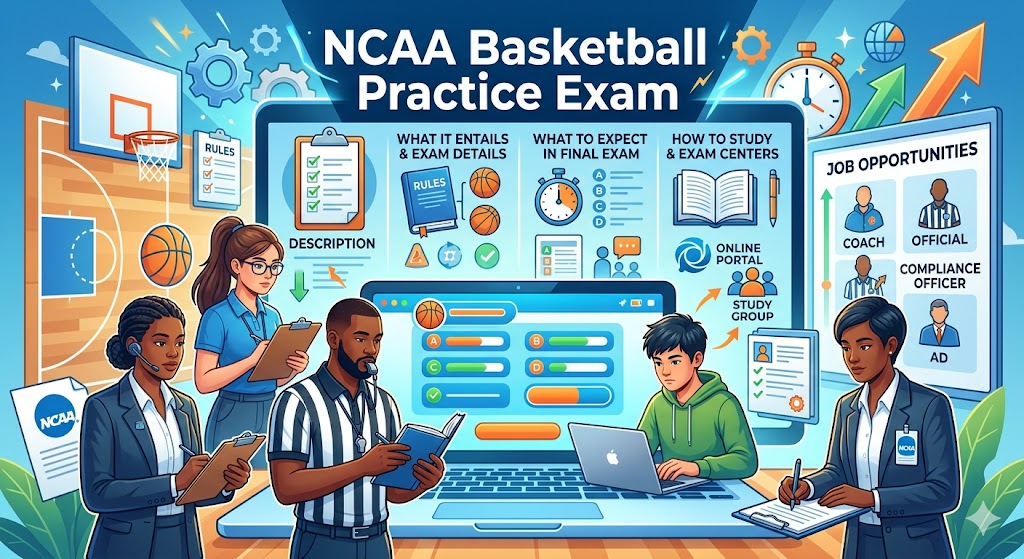
Additional Information
What the Course Entails and Exam Details
This guide covers the key domains of knowledge essential for
different professional paths, as reflected in various NCAA-administered tests.
The structure of these requirements is not a single "course" but a
defined body of knowledge and specific certification exams. Key areas of focus
include:
NCAA Playing Rules: A fundamental understanding of court
dimensions, game timing, specific violations (e.g., traveling, shot clock),
foul categories, and scoring across all divisions.
Coaching Compliance and Recruiting Regulations: Extensive
knowledge of NCAA Division I, II, and III bylaws regarding recruiting periods,
communication rules with prospective student-athletes, and illegal benefits.
Athletic Eligibility and Amateurism: Critical requirements
for student-athlete core courses, GPA benchmarks, amateurism certification, and
seasons of competition rules.
Officiating Mechanics and Scenario Judgement: Detailed
knowledge of the official’s positioning, signals, rules interpretations, and
instantaneous decision-making in complex game situations for those aiming to be
a basketball official.
Recent Legislation (e.g., NIL): A comprehensive
understanding of the evolving rules surrounding student-athlete Name, Image,
and Likeness (NIL) opportunities and related compliance duties.
The final certification exams (which this guide prepares you
for) generally require passing specific, official rules tests, often
administered online.
What to Expect in
the Final Exam
While this is a practice test, it simulates the
experience of the actual final, required NCAA certification exams. You
should be prepared for:
Comprehensive Formats: The required exams often feature
extensive multiple-choice, true/false, and scenario-based questions that test
both direct recall and, more crucially, the ability to apply complex rules to
real-world situations.
High Passing Scores: To earn your certification, you will
typically need to achieve a high passing score, often 80% or greater. The
pressure is on for accuracy and thorough knowledge.
Time Constraints: Official exams are almost always timed.
You must develop the ability to think quickly and accurately under time
pressure, and a practice test is perfect for mastering this skill.
Specific Rules and Manuals: Many compliance and rules tests
are "open-book," allowing you to use current NCAA manuals and bylaws
during the test. However, the questions are designed to be challenging, making
strong navigation skills and deep knowledge of the structure essential. Other
exams, such as certain components of officiating, may be from memory.
How to Study and
Exam Centers
Effective preparation requires more than just passive
reading. Here are actionable study strategies:
Utilize Official NCAA Resources: Read and reread the current
NCAA Division I, II, and III manuals, official rules publications, and
compliance documentation. These are your primary study materials and the source
of all exam content. Be sure to check for regular updates.
Engage in Scenario-Based Practice: Work through hypothetical
recruiting, game-time, or eligibility situations. The hardest exam questions
involve complex rules application, not simple recall. Discuss scenarios with
colleagues or mentors.
Take Multiple Practice Tests: If an official practice test
is available through the NCAA or reliable educational platforms, utilize it
repeatedly. Treat each attempt as a timed mock exam to build your pacing and
endurance.
Join Clinics and Study Groups: Attending official clinics
for coaches or officials is highly recommended. These often feature expert
rules interpretations, video review, and discussions that are invaluable for
understanding how rules are applied. Collaborating in a study group can expose
you to different perspectives and challenging scenarios.
Taking the Actual Exam: The final certification exams for
roles like coaches, officials, or compliance personnel are generally not taken
at general physical centers like Pearson VUE. Instead, they are typically
administered through secure, official online portals specifically designated by
the NCAA (e.g., individual coaching dashboards, official officiating software
like Arbiter), and often require authorization from a member institution or
conference office.
Job Opportunities from the Course
Successfully mastering the required knowledge and passing
the relevant official NCAA rules and certification exams unlocks numerous vital
career paths within collegiate basketball and athletics administration:
NCAA Head Coach (All Divisions): The top leadership role for
a team, responsible for strategy, management, and ultimate rules compliance.
NCAA Assistant Coach (All Divisions): Plays a crucial role
in player development, recruiting, and supportive compliance and game
preparation duties.
NCAA Basketball Official / Referee: Officiates competitive
college games, from Division I to III, applying playing rules on the court.
Athletics Director: Overarching leadership for an entire
athletic department, involving strategic planning, budgeting, and establishing
a culture of compliance across all sports.
Compliance Officer: Specializes in ensuring an athletic
department, coaches, and student-athletes adhere to all NCAA and conference
regulations.
Sports Information Director (SID): Manages communications,
statistics, media relations, and brand strategy for an athletic department or
specific teams.
Frequently Asked Questions
Reviews
5.0
Based on 0 reviews
Leave a Review
No reviews yet. Be the first to review!