
NCAA Recruiting Practice Exam
$69.00
- Buy to unlock unlimited access to all Quiz questions and Answers in this Quiz.
- After purchase you can print a PDF of the whole quiz at any point. The PDF will contain the questions and the correct answers.
About this Exam
The NCAA Recruiting Practice Exam is an essential preparatory tool designed for professionals aspiring to work in collegiate athletics. This resource simulates the official exam that validates a fundamental understanding of the complex National Collegiate Athletic Association (NCAA) recruiting rules and regulations. This knowledge is crucial for a variety of roles within university athletic departments and regulatory bodies. The actual certification exam is designed for athletic directors, compliance officers, coaches, and any staff involved in the prospective student-athlete recruitment process. This practice exam allows individuals to assess their current knowledge, identify areas for further study, and build confidence before taking the formal test. By successfully navigating this practice test and the subsequent official exam, candidates demonstrate their commitment to athletic compliance and ethical recruitment practices.
Ready to test your knowledge?
Buy Now to Access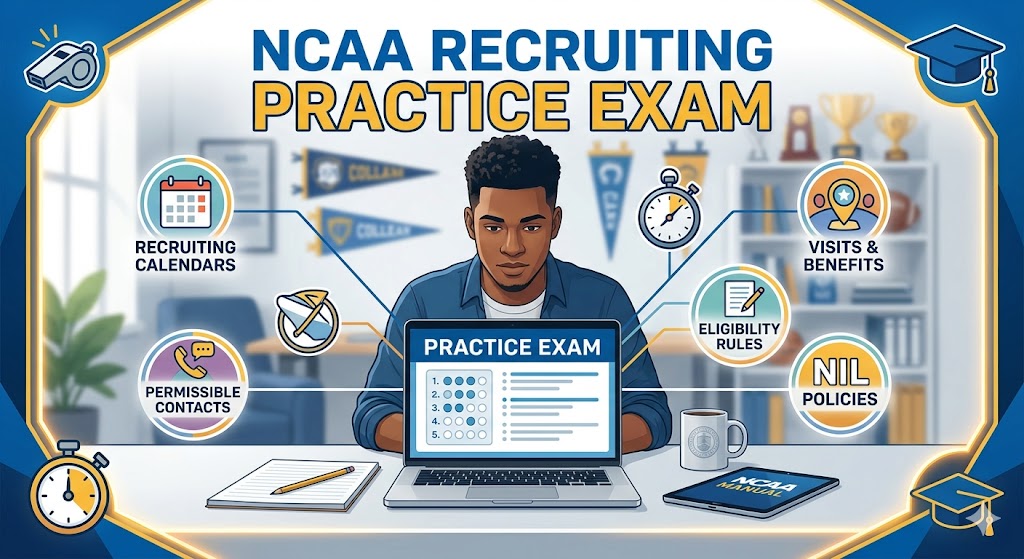
Additional Information
What the Course Entails and Exam Details
This "course" and its practice exam focus entirely
on the comprehensive NCAA Division I and II (and sometimes III, depending on
institutional needs) recruiting rulebooks. It does not teach general recruiting
techniques, but rather the legalities and limitations set by the NCAA. The core
topics and skills covered in both the practice and official exams include:
- Understanding
the NCAA Recruiting Calendars: Detailed knowledge of dead, quiet,
contact, and evaluation periods for different sports and divisions.
- Permissible
Contacts: Specific rules on when and how (phone, in-person, social
media, email) athletic staff can contact prospective student-athletes.
- Recruiting
Visits: The regulations governing both official (institution-funded)
and unofficial (prospect-funded) campus visits, including duration,
expenses, and activities.
- Initial
and Transfer Eligibility: Basic understanding of academic standards
and transfer rules that affect a prospect's eligibility to compete.
- Permissible
Benefits and Activities: Knowing what gifts, expenses, or experiences
are permissible or prohibited for prospective student-athletes, their
families, and coaches.
- Name,
Image, Likeness (NIL): Current NCAA policies and state laws regarding
a prospect's ability to monetize their NIL, especially as it interacts
with recruiting activities.
- The
National Letter of Intent (NLI) Program: Understanding the binding
agreement between a prospect and an institution.
The practice exam serves to familiarize you with the
structure and scope of these rules, ensuring you can navigate common scenarios
and specific data points.
What to Expect in the Final Exam
While the exact parameters of the NCAA Recruiting Practice
Exam will vary depending on the platform or institution offering it, it is
designed to mimic the conditions and content of the formal NCAA certification
test.
Key considerations for the final certification exam
include:
- Format:
The official NCAA exam is typically a multiple-choice test taken online.
Questions may present hypothetical scenarios, requiring candidates to
apply specific rules correctly.
- Adminstration:
The test is usually administered through an online portal designated by
the NCAA or a candidate's employing institution or conference office. It
is often overseen by a designated test administrator within the athletic
department (e.g., a Compliance Officer).
- Resources:
Unlike many traditional tests, the official NCAA Recruiting Exam is
frequently "open manual." This means candidates are allowed to
use the relevant NCAA Manuals (or digital ePub versions) during the exam.
This reflects the reality that in professional settings, staff will always
consult the rulebook. However, candidates must still be highly familiar
with the rules to find the information efficiently and accurately.
- Time
Limits: A specific time limit (e.g., 60-90 minutes) is usually applied
to mirror professional time management.
- Passing
Score Requirements: A passing score is mandatory for certification.
This score is often quite high (e.g., 80% or 90%) to ensure a strong grasp
of compliance issues.
- Re-take
Rules: Institutional and conference policies dictate how soon a
candidate can re-take the exam if they do not pass initially.
The practice exam will often follow these general parameters
to provide the most realistic experience.
How to Study and
Exam Centers
Preparation is paramount for success on the NCAA Recruiting
Exam and, consequently, your future in collegiate athletics. Effective study
strategies include:
Obtain and Master the NCAA
Manual: The definitive source for all rules. Understand how the manual is
organized and how to quickly look up specific rules and definitions. Pay close
attention to the indices, divisional differences, and recent bylaws.
Utilize Official NCAA
Educational Resources: The NCAA Eligibility Center and conference offices
often provide study guides, rule interpretation documents, recent rules changes
summaries, and even official practice questions. These are highly credible
resources.
Take Multiple Practice Exams:
Repeat this practice exam and seek out other reputable sources. Analyze not
only which questions you get wrong but why you got them wrong and how to
find the correct answer in the manual.
Review Real-World Scenarios
and Bylaw Interpretations: Study "Case Studies" or official
interpretations often found alongside bylaw text. These clarify how the rules
are applied in nuanced situations.
Form a Study Group:
Discussing rules with peers or seeking guidance from experienced compliance
professionals can offer different perspectives and help solidify your
understanding.
Simulate Exam Conditions:
When taking your practice tests, use the time limit and resources permissible
in the actual exam. If the actual exam is open manual, practice finding the
information under pressure.
Exam Center and Taking the Test:
The official NCAA certification exam is taken online
and usually administered within an institutional or conference-designated
environment, not public testing centers like Pearson VUE. Candidates will gain
access to the testing portal through their college or conference athletic
compliance department, which verifies their professional role. A designated
administrator (often from the institutional compliance staff) usually serves as
the proctor, even for an online test taken remotely. The system ensures only
authorized individuals take the exam. Your employing or prospective institution
will guide you on the specific platform and process for taking the final exam.
Job Opportunities from the Course
A strong performance on the NCAA Recruiting Practice Exam is
a crucial step towards passing the actual certification, which is mandatory for
many specific career paths in college athletics and compliance. While the
practice exam itself doesn't offer job placement, successful certification
unlocks these opportunities:
- Assistant
Coach (in all NCAA-governed sports)
- Head
Coach (in all NCAA-governed sports)
- Recruiting
Coordinator
- Athletic
Director / Associate Athletic Director
- External
Athletic Compliance Consultant
- Student-Athlete
Advisory Committee (SAAC) Advisor (for relevant roles)
- Director
of Hockey/Football/etc. Operations (often includes recruiting support)
- NCAA
Compliance Officer / Compliance Director
- Athletic
Department Rules Analyst
- Conference
Office Compliance Staff
Frequently Asked Questions
Reviews
5.0
Based on 0 reviews
Leave a Review
No reviews yet. Be the first to review!