
NCAA Soccer Rules Practice Test
$69.00
- Buy to unlock unlimited access to all Quiz questions and Answers in this Quiz.
- After purchase you can print a PDF of the whole quiz at any point. The PDF will contain the questions and the correct answers.
About this Exam
The NCAA Soccer Rules Practice Exam is an essential preparatory tool for anyone aiming to officiate or deeply understand the complexities of collegiate soccer in the United States. While primarily designed for aspiring and current NCAA soccer referees to gain or maintain their certification, it is an invaluable resource for coaches, players, and athletic administrators who must ensure compliance with specific NCAA modifications to the standard FIFA Laws of the Game. This practice test helps individuals master the nuanced rules that differentiate the fast-paced college game from other levels, ensuring fairness, safety, and consistent match management across all three NCAA divisions. It serves as a benchmark of knowledge for those serious about participating in, or contributing to, the collegiate game.
Ready to test your knowledge?
Buy Now to Access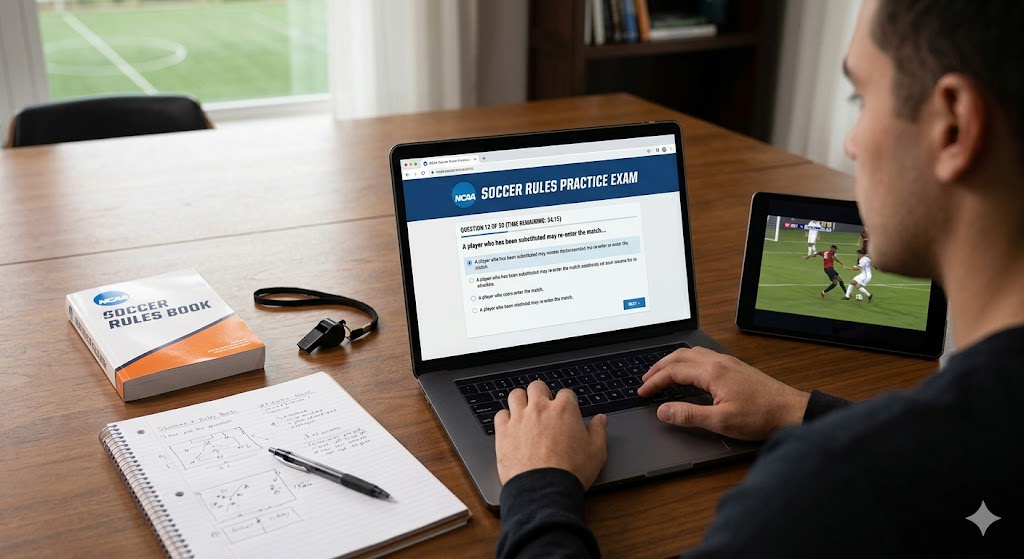
Additional Information
What the Course Entails and Exam Details
This practice exam covers the entirety of the official NCAA
Soccer Rules and Interpretations, focusing heavily on the critical distinctions
between NCAA regulations and the International Football Association Board
(IFAB)/FIFA Laws of the Game. It details the administrative, technical, and
on-field rules that govern an NCAA match. Key topics include, but are not
limited to, unique collegiate rules for substitutions (such as the re-entry
rule), regular and overtime timekeeping protocols, specific interpretations of
offside, handling the ball, and misconduct (specifically, cautionable and
sending-off offenses and related suspensions). Furthermore, the course
encompasses rules regarding field specifications, player equipment, pre-game
and post-game responsibilities, the referee's authority, and approved mechanics
for both the dual and diagonal systems of control.
What to Expect in the Final Exam
The actual official NCAA Soccer Rules Exam, for which this
practice test prepares you, is typically administered online through a
designated platform (such as RefQuest for referees) or an internal
institutional portal (for coaches). It is generally a comprehensive,
multiple-choice examination. Referees must pass this test annually to be
eligible for assignments. While specific numbers of questions, time limits, and
passing scores can vary slightly by year and division, the test is timed to
simulate the pressure of match-day decisions and is demanding. For referees, a
high passing score (often 80% or 90%) is required. Coach-specific rules exams,
though also critical, may have different administrative structures and purposes
depending on the division (e.g., focusing more on recruiting or eligibility
compliance and potentially being an "open-book" educational tool in
some divisions).
How to Study and Exam Centers
Effective preparation requires a multi-faceted approach.
First, obtain the most current copy of the official NCAA Soccer Rules and
Interpretations book and the NCAA "Points of Emphasis" document. Use
a comparative "Soccer Guide" that highlights rule differences between
FIFA, NFHS (High School), and NCAA to target your learning. Create flashcards
for critical differences, especially regarding substitution rules, overtime,
and misconduct handling. Leverage this NCAA Soccer Rules Practice Exam and
others to take repeated, timed tests to improve your accuracy and speed.
Regarding "exam centers," the official exam is now taken online. For
referees, after registering with the official officiating service platform
(like RefQuest/RQ+), you will receive a secure link to take the test. For
collegiate staff, including coaches, the test is typically accessed via the
NCAA Learning Portal after logging into their institution's NCAA MyApps
account.
Job Opportunities from the Course
Mastering the NCAA soccer rules is the primary knowledge
base required for several career paths in collegiate athletics. This knowledge,
confirmed by passing the associated certification exam, can lead to the
following professional roles:
- NCAA
Soccer Referee (Head Referee)
- NCAA
Soccer Assistant Referee (AR)
- NCAA
Fourth Official
- NCAA
Video Match Official (VMO) (in experimental or select settings)
- NCAA
Soccer Assignor (typically requires significant officiating
experience)
- NCAA
Soccer Match Observer / Evaluator
- Head
Soccer Coach (NCAA Division I, II, or III)
- Assistant
Soccer Coach (NCAA Division I, II, or III)
- Athletic
Rules Compliance Officer / Administrator
- NCAA
Conference Officiating Coordinator
Frequently Asked Questions
Reviews
5.0
Based on 0 reviews
Leave a Review
No reviews yet. Be the first to review!