
NCAA Softball Practice Test
$69.00
- Buy to unlock unlimited access to all Quiz questions and Answers in this Quiz.
- After purchase you can print a PDF of the whole quiz at any point. The PDF will contain the questions and the correct answers.
About this Exam
Are you ready to make the right call or lead your team to victory with a perfect understanding of the game’s official regulations? The NCAA Softball Rules knowledge base is essential for anyone aspiring to officiate, coach, or administer at the collegiate level. This study guide and practice exam are designed specifically for prospective umpires, current and future coaches, and athletic administrators who must possess a comprehensive, precise understanding of the official NCAA Softball Rules. By mastering this material, you demonstrate your commitment to the integrity, safety, and fairness of collegiate competition, ensuring you are prepared for the high-pressure environment of NCAA sports.
Ready to test your knowledge?
Buy Now to Access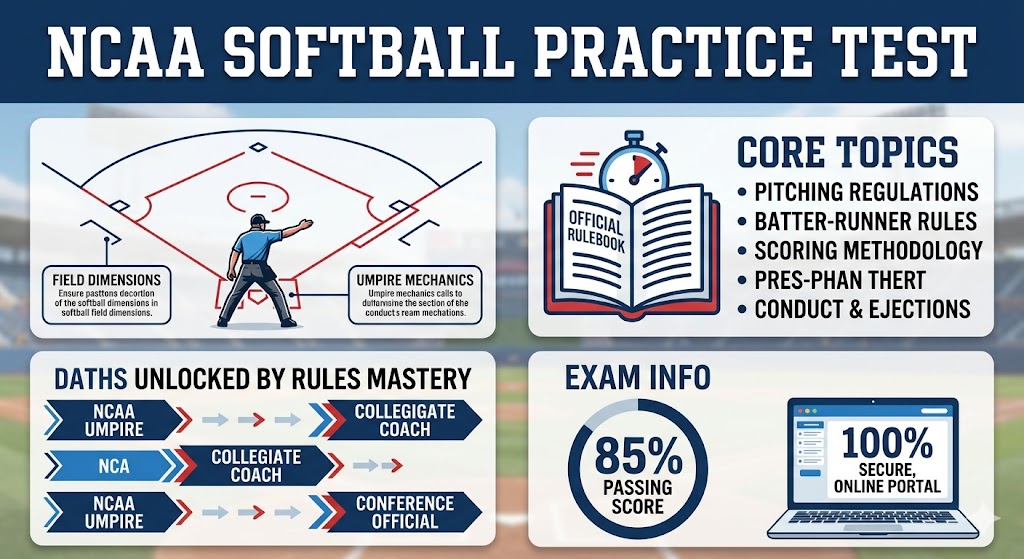
Additional Information
What the Course Entails and Exam Details
This comprehensive study guide mirrors the official NCAA
Softball Rulebook, which serves as the complete syllabus for your preparation.
The course of study is not just about memorizing rules, but understanding their
application in complex game situations. Key areas covered include:
- Field
of Play and Equipment: Specifications for the diamond, equipment, and
required safety gear.
- Participants:
Rules regarding players, substitutes, and coaches, including lineup
management.
- The
Game: Defining a regulation game, scoring, and non-regulation
scenarios.
- Pitching:
The legal pitching motion, illegal pitches, and requirements for the
pitcher.
- Batting:
The strike zone, batter's box infractions, and designated player (DP)/flex
rules.
- Base
Running: Batter-runner and runner rules, включая stealing,
interference, and obstruction.
- Conduct
and Ejections: This critical section details misconduct, formal
warnings, administrative versus behavioral ejections, and the restrictions
placed on ejected personnel.
- Scoring:
The official methodology for recording hits, errors, runs, and pitcher
statistics.
What to Expect in the Final Exam
The official NCAA Softball rules assessment is a rigorous
test typically administered online through a designated NCAA officiating portal
or as part of an official rules clinic. While specific formats can evolve,
candidates should be prepared for:
- Format:
A combination of multiple-choice, true/false, and situational "case
play" questions. The situational questions require you to apply
multiple rules simultaneously to determine the correct ruling.
- Time
Limit: The exam is strictly timed, demanding not only accurate
knowledge but quick recall.
- Passing
Score: Requirements are high, often necessitating a score of 80% or
90% to demonstrate proficiency.
- Specific
Rules: A significant portion of the test focuses on recent rule
changes and points of emphasis identified by the NCAA for the current
season. Our practice exam will heavily emphasize these critical areas.
How to Study and Exam Centers
How to Study
Achieving mastery of collegiate softball rules requires a
multi-faceted approach. Use the following strategies for effective preparation:
- Read
the Official Rulebook First: Make the current NCAA Softball Rulebook
your primary resource. Do not rely solely on summary guides.
- Active
Learning with Case Plays: Don't just read rules; study situational
examples. The official "NCAA Softball Case Book" provides
real-world scenarios and their proper rulings.
- Use
This Practice Test: Take the practice exam multiple times. Treat it as
a real test, timing yourself and identifying weak points in your
knowledge.
- Join
a Local Officials Association: For aspiring umpires, local
associations provide mentoring, rules study groups, and invaluable
feedback on your rules application.
- Attend
NCAA Clinics: Official rules clinics, often led by NCAA national
coordinators, offer direct insight into rule interpretations and points of
emphasis.
Exam Centers
The official NCAA Softball rules exam is typically taken online
via a secured learning management system (such as ArbiterSports or similar
officiating hubs used by the NCAA and collegiate conferences). You will not go
to a general testing center like Pearson VUE. Access to the exam is often
restricted to registered umpires or coaches who have been authorized by their
conference or association. Aspiring umpires must first register with an
officiating body to receive an exam link and required materials.
Job Opportunities from the Course
Gaining a validated mastery of NCAA Softball rules opens
doors to various rewarding career paths within collegiate athletics. While a
practice test is a study tool, the knowledge it provides is required for the
following positions:
- NCAA
Softball Umpire: Officiating at the Division I, II, or III levels.
- Collegiate
Head Softball Coach: Leading a university or college program.
- Collegiate
Assistant Softball Coach: Specializing in rules application for a
coaching staff.
- Athletic
Director / Sports Administrator: Oversight of collegiate softball
programs and compliance.
- Conference
Coordinator of Officials: Managing and training umpiring staffs for a
collegiate conference.
- Rules
Clinician and Educator: Leading rules study groups and certification
clinics.
NCAA Softball Practice Exam
Description
Are you ready to make the right call or lead your team to
victory with a perfect understanding of the game’s official regulations? The
NCAA Softball Rules knowledge base is essential for anyone aspiring to
officiate, coach, or administer at the collegiate level. This study guide and
practice exam are designed specifically for prospective umpires, current and
future coaches, and athletic administrators who must possess a comprehensive,
precise understanding of the official NCAA Softball Rules. By mastering this
material, you demonstrate your commitment to the integrity, safety, and
fairness of collegiate competition, ensuring you are prepared for the
high-pressure environment of NCAA sports.
What the Course Entails and Exam Details
This comprehensive study guide mirrors the official NCAA
Softball Rulebook, which serves as the complete syllabus for your preparation.
The course of study is not just about memorizing rules, but understanding their
application in complex game situations. Key areas covered include:
- Field
of Play and Equipment: Specifications for the diamond, equipment, and
required safety gear.
- Participants:
Rules regarding players, substitutes, and coaches, including lineup
management.
- The
Game: Defining a regulation game, scoring, and non-regulation
scenarios.
- Pitching:
The legal pitching motion, illegal pitches, and requirements for the
pitcher.
- Batting:
The strike zone, batter's box infractions, and designated player (DP)/flex
rules.
- Base
Running: Batter-runner and runner rules, indicating stealing,
interference, and obstruction.
- Conduct
and Ejections: This critical section details misconduct, formal
warnings, administrative versus behavioral ejections, and the restrictions
placed on ejected personnel.
- Scoring:
The official methodology for recording hits, errors, runs, and pitcher
statistics.
What to Expect in the Final Exam
The official NCAA Softball rules assessment is a rigorous
test typically administered online through a designated NCAA officiating portal
or as part of an official rules clinic. While specific formats can evolve,
candidates should be prepared for:
- Format:
A combination of multiple-choice, true/false, and situational "case
play" questions. The situational questions require you to apply
multiple rules simultaneously to determine the correct ruling.
- Time
Limit: The exam is strictly timed, demanding not only accurate
knowledge but quick recall.
- Passing
Score: Requirements are high, often necessitating a score of 80% or
90% to demonstrate proficiency.
- Specific
Rules: A significant portion of the test focuses on recent rule
changes and points of emphasis identified by the NCAA for the current
season. Our practice exam will heavily emphasize these critical areas.
How to Study and Exam Centers
How to Study
Achieving mastery of collegiate softball rules requires a
multi-faceted approach. Use the following strategies for effective preparation:
- Read
the Official Rulebook First: Make the current NCAA Softball Rulebook
your primary resource. Do not rely solely on summary guides.
- Active
Learning with Case Plays: Don't just read rules; study situational
examples. The official "NCAA Softball Case Book" provides
real-world scenarios and their proper rulings.
- Use
This Practice Test: Take the practice exam multiple times. Treat it as
a real test, timing yourself and identifying weak points in your
knowledge.
- Join
a Local Officials Association: For aspiring umpires, local
associations provide mentoring, rules study groups, and invaluable
feedback on your rules application.
- Attend
NCAA Clinics: Official rules clinics, often led by NCAA national
coordinators, offer direct insight into rule interpretations and points of
emphasis.
Exam Centers
The official NCAA Softball rules exam is typically taken online
via a secured learning management system (such as ArbiterSports or similar
officiating hubs used by the NCAA and collegiate conferences). You will not go
to a general testing center like Pearson VUE. Access to the exam is often
restricted to registered umpires or coaches who have been authorized by their
conference or association. Aspiring umpires must first register with an
officiating body to receive an exam link and required materials.
Job Opportunities from the Course
Gaining a validated mastery of NCAA Softball rules opens
doors to various rewarding career paths within collegiate athletics. While a
practice test is a study tool, the knowledge it provides is required for the
following positions:
- NCAA
Softball Umpire: Officiating at the Division I, II, or III levels.
- Collegiate
Head Softball Coach: Leading a university or college program.
- Collegiate
Assistant Softball Coach: Specializing in rules application for a
coaching staff.
- Athletic
Director / Sports Administrator: Oversight of collegiate softball
programs and compliance.
- Conference
Coordinator of Officials: Managing and training umpiring staffs for a
collegiate conference.
- Rules
Clinician and Educator: Leading rules study groups and certification
clinics.
Frequently Asked Questions
Reviews
5.0
Based on 0 reviews
Leave a Review
No reviews yet. Be the first to review!