
NCATT Aircraft Electronics Technician (AET) Certification Practice Exam
$69.00
- Buy to unlock unlimited access to all Quiz questions and Answers in this Quiz.
- After purchase you can print a PDF of the whole quiz at any point. The PDF will contain the questions and the correct answers.
About this Exam
The NCATT Aircraft Electronics Technician (AET) Certification, administered by SpaceTEC Partners Inc. (SPI), is a foundational credential for professionals in the aviation and aerospace industries. This certification validates the core knowledge common across the industry for technicians working with aircraft electronics and avionics systems. The exam is designed for entry-level technicians, students in aviation maintenance programs, individuals with military avionics experience, and those looking to formally recognize their skills. Passing this exam demonstrates a baseline understanding of key electrical and electronic concepts required to maintain, troubleshoot, and repair critical systems, from navigation and communication to flight control and advanced databuses.
Ready to test your knowledge?
Buy Now to Access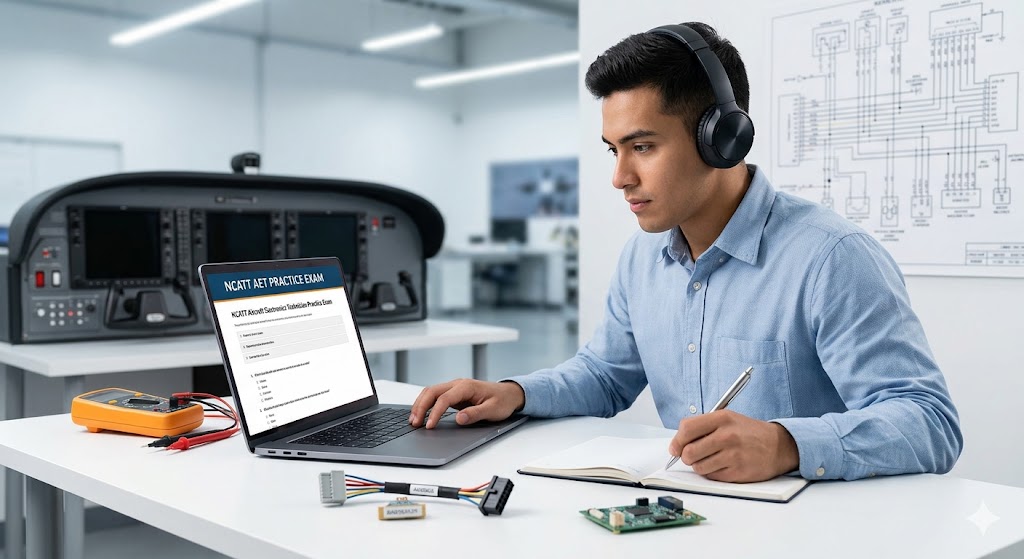
Additional Information
What the Course
Entails and Exam Details
This comprehensive certification covers a wide spectrum of
essential topics for an avionics technician. Students should prepare to be
tested on their knowledge of maintenance procedures and regulatory
requirements, including FAA and industry standards. Core electrical theory for
both DC (Direct Current) and AC (Alternating Current) circuits is fundamental,
alongside the systems that utilize them. The exam delves into Communication,
Navigation, and Surveillance (CNS) systems, flight instrument and pitot-static
systems, and the increasingly vital field of digital databus systems.
Furthermore, candidates must be proficient in aircraft wiring, proper hardware,
installation techniques, and the use of tools, test equipment, and measurement
methods. The certification identifies a technician's core competency to work
with the advanced electronics that make modern flight possible.
What to Expect in the Final Exam
The final NCATT AET exam is a rigorous test of a
technician’s knowledge. It consists of approximately 100 multiple-choice
questions designed to assess an individual’s understanding across all critical
domains. Candidates are given a time limit of 90 minutes to complete the exam.
While the passing score can vary slightly, it is typically in the range of 70%
to 73%; students should confirm the current requirement from their test
provider or the SPI website. The exam is delivered electronically, primarily through
a remote proctored online format, which allows candidates to take the test from
their own location. Some authorized testing centers or schools may also provide
on-site administration. The AET is a written knowledge exam; hands-on practical
elements are often separate endorsements, such as the CAET-Advanced, which
builds upon this foundational core. Retakes are possible, generally with a
waiting period between attempts.
How to Study and
Exam Centers
Effective preparation is key to success on the AET exam.
Actionable study strategies include utilizing official NCATT AET study guides,
which can often be found in volumes that detail specific knowledge areas.
Accessing online practice tests with verified questions and detailed
explanations, such as those provided by training platforms or organizations
like the Aircraft Electronics Association (AEA), is highly recommended to
become familiar with the exam format and identify areas for further review. Specialized
training courses, available through some community colleges, Part 147 aviation
maintenance schools, or online academies, can provide a structured curriculum
to build your knowledge from the ground up.
Taking the exam is designed to be convenient. It is
primarily delivered and proctored online, enabling candidates to take it using
a computer with a webcam and microphone. Before the exam, you will undergo an
identity verification process, and the remote proctor will monitor you to
ensure academic integrity. For those who prefer a more traditional setting,
some specialized physical testing centers, authorized schools, or industry
training facilities may be available. To find an authorized testing location or
register for the online remote exam, you should visit the official website of
SpaceTEC Partners Inc. (SPI).
Job Opportunities
from the Course
A certification as an NCATT Aircraft Electronics Technician
opens a wide array of career paths within the aviation and aerospace sectors.
Individuals holding this credential are often the first to be considered for
employment by military branches, major air carriers, air cargo companies, FAA
repair stations, fixed-based operators (FBOs), corporate flight departments,
and even aircraft manufacturers. Here is a list of specific job titles and
career paths this certification can unlock:
- Aircraft
Avionics (Electronics) Technician
- Aviation
Mechanic Component Technician
- Electromechanical
Aircraft Component Technician
- Aircraft
Electrical Assembler
- Electronics
Bench Technician/Inspector
- Avionics
Mobile Service Technician
- Cable
and Harness Technician
- Wire
Harness Assembler
- Avionics
Technician – Simulator Maintenance
- Aerospace
Assembly Technician
- Electronics
Repair Technician for Non-Aviation Applications
By successfully completing this certification, you can
enhance your earning potential and establish a solid foundation for a
successful, high-demand career in the dynamic and essential field of aircraft
electronics.
Now, I will generate an image that can be used for the study
guide, featuring the optimized title.
Image Prompt: A professional, inviting photograph of
a person, perhaps an aircraft maintenance student or early-career technician,
sitting at a clean desk. They are focused, with a determined expression, using
a modern laptop that clearly shows a practice exam for the 'NCATT Aircraft
Electronics Technician Practice Exam' on the screen. The top of the screen
displays the text "NCATT AET PRACTICE EXAM" in a distinct header.
They have headphones on and are making notes with a pen in a notebook. On the
desk are also some tools and small, labeled electronic components common to
avionics, such as a multimeter, a wire harness connector, and a small circuit
board. The background, softly blurred, is a modern workshop or classroom with a
partial view of an aircraft cockpit panel and some large, detailed wiring
diagrams on the wall. The image conveys dedication and educational advancement
in the field of aircraft electronics. The text is clear and integrated into the
scene.
Frequently Asked Questions
Reviews
5.0
Based on 0 reviews
Leave a Review
No reviews yet. Be the first to review!