
NCATT Radio Communication Systems Practice Test
$69.00
- Buy to unlock unlimited access to all Quiz questions and Answers in this Quiz.
- After purchase you can print a PDF of the whole quiz at any point. The PDF will contain the questions and the correct answers.
About this Exam
The ASTM NCATT Radio Communication Systems (RCS) is an industry-recognized endorsement certification designed to validate the specific knowledge and technical skills required for avionics professionals who maintain and install advanced radio communication systems in the aerospace sector. This credential is an essential step for entry-level and experienced technicians aiming to specialize in aircraft communications, ensuring they meet the standard performance guidelines established by the National Center for Aerospace & Transportation Technologies (NCATT) and ASTM International. While often pursued alongside the foundational Aircraft Electronics Technician (AET) certification, the RCS endorsement independently proves your proficiency in the complex world of aerospace communications.
Ready to test your knowledge?
Buy Now to Access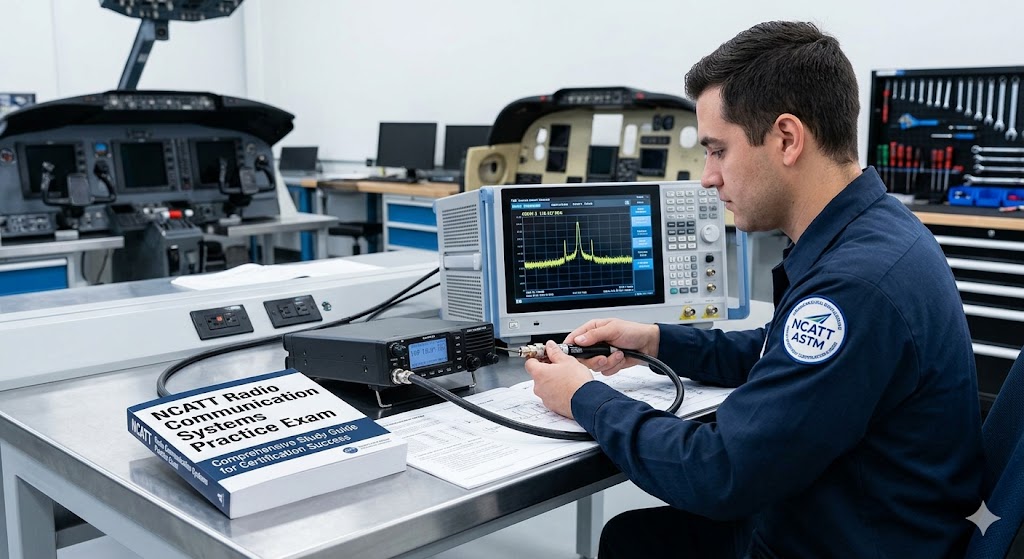
Additional Information
What the Course Entails and Exam Details
This endorsement focuses heavily on the practical
application of theoretical communication principles within a complex aviation
maintenance environment.
Core Study Domains:
The study standard focuses on four main subject areas
crucial for the communication technician:
Safety: Understanding
Radio Frequency (RF) and Electromagnetic Field (EMF) radiation hazards,
including protection protocols for personnel working near high-power antennas.
Radio Transmitters and
Receivers: Delving into the theory, installation, and fault isolation of
typical aircraft transceiver systems.
Communication Systems:
Covering a broad range of aviation communication types across multiple bands,
including HF, VHF, UHF, and their respective operational ranges, signal
characteristics (such as AM, FM, and Single-Sideband), and regulatory
requirements (FCC/FAA).
Satellite Communication
(SATCOM): Providing foundational knowledge of satellite communication
systems used in modern aerospace, such as Inmarsat and Iridium systems.
Specific Skills:
You will learn to work with complex block diagrams,
interpret technical terminology used by flight crews and technicians,
understand wave propagation (ground, sky, and space waves), and manage issues
such as RF interference and precipitation static. The course also addresses
transmission line theory, connector fabrication, proper antenna installation
practices, and the use of diagnostic test equipment, including RF wattmeters to
measure VSWR (Voltage Standing Wave Ratio).
What to Expect in the Final Exam
The NCATT Radio Communication Systems endorsement exam is a
rigorous test of your proficiency. Candidates should prepare for a professional
examination structure.
Exam Structure:
The final examination typically consists of approximately 50
multiple-choice questions. This format is designed to efficiently test your
theoretical understanding and your ability to apply the standard guidelines to
real-world troubleshooting and installation scenarios.
Passing Requirements:
To achieve certification, you must secure a minimum passing
score of 70%.
Delivery Method:
Candidates can typically choose between two standard
delivery methods:
Remote Proctored Online:
Take the exam from a secure, private location using your own computer equipped
with standard proctoring software.
In-Person Testing Centers:
Test at approved ASTM NCATT/SpaceTEC Partners testing locations, which are
often educational institutions, authorized repair stations, or specialized
training facilities.
Validity:
The certification is valid for a period of five years,
after which renewal is required to demonstrate continued competency and
familiarity with evolving aerospace communication technologies.
How to Study and Exam Centers
Achieving success requires a structured study plan that
mixes theoretical knowledge with practical test familiarization.
Actionable Study Strategies:
Master the Standard: Your
primary study resource must be the official ASTM NCATT Radio Communication
Systems Standard. Every question on the final exam is derived from the domains
outlined in this document.
Official Practice Tests:
Leverage available online NCATT Radio Communication Systems practice tests.
These are the single best method to familiarize yourself with the question
style, difficulty level, and required time management. Use them to benchmark
your progress and identify weak areas.
Reference Materials: Use
technical textbooks and industry training materials to provide context to the
standard. Textbooks like "Principles of Avionics" are often
recommended for their depth on RF theory and system architecture.
Hands-On Practice: Where
possible, work with test equipment such as a VSWR/wattmeter, spectrum analyzer,
or antenna analyzer. Visualizing concepts like wave reflection or modulation
will solidify your understanding.
Exam Centers:
Registration and testing are facilitated by ASTM
International and its authorized partners.
Remote Testing:
Registration and scheduling are managed directly through the SpaceTEC
Partners, Inc. (SPI) or ASTM International online portals, which
support remote proctoring options.
Physical Testing Centers:
To locate a physical facility, you can search the database of ASTM
NCATT-approved testing centers. These are often established technical colleges,
military training centers, or aerospace corporations that have met the strict
curriculum, facility, and faculty requirements necessary to administer the
certification exams.
Job Opportunities from the Course
Achieving the NCATT Radio Communication Systems endorsement
distinguishes you as a communication specialist within the wider avionics
field. The validated skills are highly sought after by aviation and aerospace
employers who require technicians who can ensure the reliability and integrity
of critical air-to-ground and satellite links.
Career paths unlocked by this certification include:
- Certified
Avionics Technician (with a communications focus)
- Aviation
Installation Technician (Communications and SATCOM)
- Aircraft
Electronics Repair Technician
- Field
Service Communication Specialist (Aerospace)
- Aviation
Communications Systems Integrator
- Avionics
Maintenance Lead (focusing on RF systems)
- Technician
for specialized repair stations specializing in RF components
Frequently Asked Questions
Reviews
5.0
Based on 0 reviews
Leave a Review
No reviews yet. Be the first to review!