
NCCCO Rigger Level 1 Practice Exam
$69.00
- Buy to unlock unlimited access to all Quiz questions and Answers in this Quiz.
- After purchase you can print a PDF of the whole quiz at any point. The PDF will contain the questions and the correct answers.
About this Exam
The NCCCO Rigger Level 1 certification is the essential foundational credential for construction and industrial professionals who are responsible for preparing a load for lifting. This certification, awarded by the National Commission for the Certification of Crane Operators (NCCCO), validates a candidate's competency in performing simple, repetitive rigging tasks where the load weight, center of gravity, and rigging configuration are known. It is designed specifically for rigger trainees, existing riggers looking to formalize their skills, ironworkers, millwrights, and any ground crew member working directly within the fall zone of a crane or assisting with crane assembly and disassembly. Achieving this certification demonstrates your commitment to safety and proficiency in one of the most critical aspects of hoisting operations.
Ready to test your knowledge?
Buy Now to Access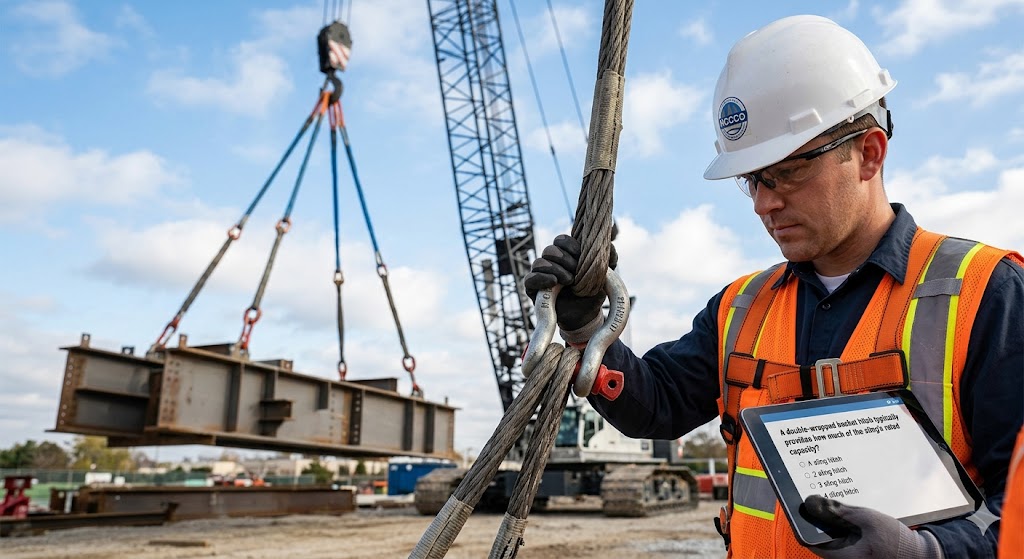
Additional Information
What the Course Entails and Exam Details
Preparing for the NCCCO Rigger Level 1 exam requires mastering several key domains of knowledge and practical skill. The core syllabus covers the thorough pre-use inspection of rigging components, ensuring all gear is safe and meets regulatory standards before a lift begins. You will learn the technical aspects of selecting and using various types of rigging equipment, including synthetic slings, wire rope, and chain slings, as well as essential rigging hardware like shackles, hooks, and eyebolts. A fundamental understanding of load dynamics is crucial, including basic methods for estimating load weight and identifying the center of gravity.
Additionally, the course demands proficiency in standard communication methods, specifically Mastering OSHA-approved hand signals and voice commands for clear coordination with the crane operator. Recognizing associated hazards—such as the fall zone, power line proximity, and unstable ground—is a major focus to prevent accidents.
What to Expect in the Final Exam
The full NCCCO Rigger Level 1 certification process consists of two distinct components: a written examination and a practical examination. Candidates must pass both to become certified.
Written Examination: The written test is designed to evaluate your theoretical knowledge. It consists of 60 multiple-choice questions that cover the four main domains: the scope of rigging activity, technical knowledge, inspection, and execution of the rigging activity. You are allowed 60 minutes to complete this section.
Practical Examination:The hands-on practical exam demonstrates your real-world proficiency. Candidates typically have approximately 60 minutes to complete four main tasks which progressively increase in complexity. These tasks generally test your ability to perform a dynamic pre-use rigging inspection, correctly identify and apply various rigging hitches (such as choker, basket, and vertical), make proper rigging connections, and tie basic knots.
The NCCCO establishes the minimum passing scores required for both portions of the exam to ensure standardized competency across the industry.
How to Study and Exam Centers
Effective preparation is the key to success. Your first step should be taking advantage of an NCCCO Rigger Level 1 practice test to familiarize yourself with the format and identify your knowledge gaps.
Actionable Study Strategies:Review official reference materials, specifically OSHA §1926 Subpart CC and ASME B30 standards (especially B30.9 for Slings and B30.26 for Rigging Hardware). Invest in a comprehensive study guide that breaks down the technical details of gear inspection and load dynamics. Attend a dedicated NCCCO exam prep course offered by authorized training organizations; these often provide hands-on practice that is invaluable for the practical exam. Watch candidate videos to visualize the flow of the practical tasks and practice essential knots until you can tie them quickly and correctly.
Exam Centers: You can locate authorized examination centers and scheduled test dates through the NCCCO website. Written exams are often administered through online portals or computer-based testing networks such as Pearson VUE. The practical exam must be conducted in person at an authorized facility with a CCO Certified Practical Examiner. Many specialized heavy equipment training schools and technical colleges serve as permanent test sites, while some larger employers also offer on-demand testing at their locations.
Job Opportunities from the Course
A certified Rigger Level 1 has unlocked multiple career paths in construction, manufacturing, and heavy industry. This credential is often a baseline requirement for safety-sensitive roles, providing a clear path for advancement.
Specific job titles and career paths enabled by this certification include:
Industrial Rigger
Construction Rigger
Millwright
Ironworker
Machinery Mover
Field Service Technician
Trades Apprentice (Rigging or Millwright)
Heavy Equipment Operator Apprentice
Signalperson/Rigger
Stage Rigger (Entertainment Industry)
Frequently Asked Questions
Reviews
5.0
Based on 0 reviews
Leave a Review
No reviews yet. Be the first to review!