
NCCER Grounding and Bonding Practice Test
$69.00
- Buy to unlock unlimited access to all Quiz questions and Answers in this Quiz.
- After purchase you can print a PDF of the whole quiz at any point. The PDF will contain the questions and the correct answers.
About this Exam
The NCCER Grounding and Bonding certification validates a craft professional's essential knowledge and skill in electrical safety systems, specifically focusing on the critical practices of grounding and bonding as defined by the National Electrical Code® (NEC®).
This exam is designed for journey-level electricians, electrical apprentices, industrial maintenance technicians, and any safety-conscious personnel responsible for installing, maintaining, or inspecting electrical systems where proper grounding and bonding are paramount for personnel protection and equipment safety.
Achieving this NCCER credential demonstrates that an individual possesses a standardized, verified level of competence in these fundamental electrical safety practices, which are recognized across the construction and industrial sectors.
Ready to test your knowledge?
Buy Now to Access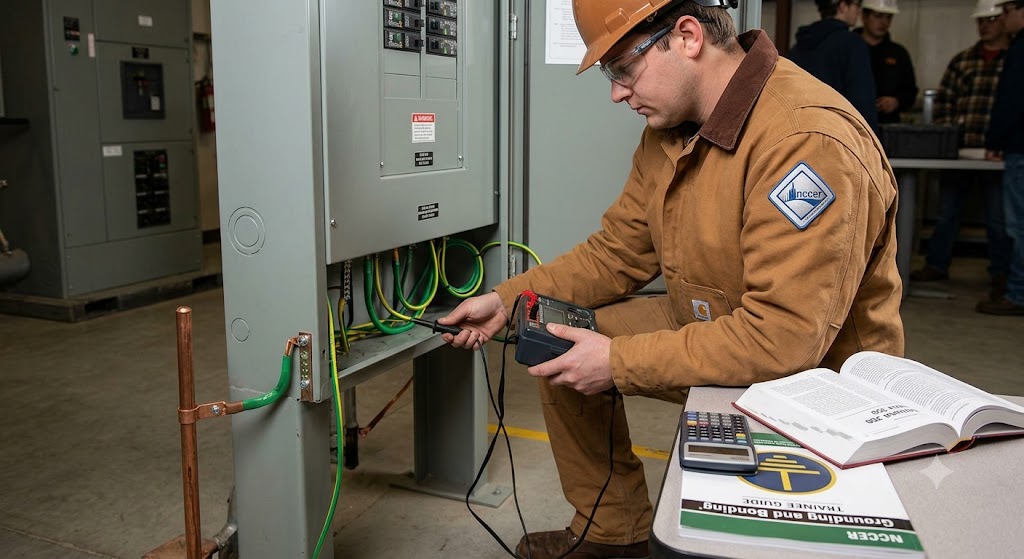
Additional Information
What the Course Entails and Exam Details
The study material and subsequent exam cover a range of
critical topics derived from NCCER’s comprehensive Electrical curriculum and
relevant sections of the NFPA 70®, National Electrical Code® (NEC®).
Core focus areas often include:
Safety Fundamentals:
Understanding the purpose of grounding and bonding in preventing electric
shock, arc flash hazards, and equipment damage.
NEC® Article 250: In-depth
application of the code requirements governing grounding and bonding.
Grounding Systems:
Installation, sizing, and testing of grounding electrode systems, including
rod, pipe, plate electrodes, and concrete-encased electrodes.
Bonding: Techniques and
requirements for ensuring electrical continuity and the safe conduction of
fault current, including bonding service equipment, piping systems, and
structural steel.
Equipment Grounding
Conductors: Proper selection, installation, and sizing of conductors used
to connect non-current-carrying metal parts of equipment to the system
grounding conductor.
Ground-Fault Protection:
Concepts and hardware related to ground-fault circuit interrupters (GFCIs) and
ground-fault protection of equipment (GFPE).
Testing and Maintenance:
Procedures for inspecting and testing grounding and bonding systems to ensure
ongoing effectiveness and code compliance.
What to Expect in the Final Exam
While specific details can vary by testing location and
version, candidates can generally expect the following format for an NCCER
knowledge-based exam:
- Format:
The primary component is a multiple-choice, computer-based exam.
- Time
Limit: Exams typically have a generous but specific time limit, often
ranging from 60 to 90 minutes.
- Passing
Score: NCCER exams require a minimum passing score, often 70% or
higher, to achieve certification.
- Open
Book Policy: Candidates are usually permitted to reference the
specified edition of the National Electrical Code® (NEC®) during the exam,
as proficiency in navigating and applying the code is a core skill being
evaluated. No other reference materials or personal notes are typically
allowed.
- Security:
Proctored environment, whether at a physical testing center or through an
authorized online proctoring service.
How to Study and Exam Centers
Effective preparation is key to success on the NCCER
Grounding and Bonding exam.
Study Strategies:
- Utilize
NCCER Curriculum: Focus your study on the relevant NCCER Electrical
trainee guides, specifically the modules covering grounding and bonding.
- Master
the NEC®: Spend significant time reading and understanding NEC®
Article 250. Practice locating specific requirements quickly using the
code book's index and table of contents.
- Take
Practice Tests: Actively use practice exams, like the one associated
with this guide, to familiarize yourself with the question format, time
constraints, and the types of concepts tested.
- Hands-on
Experience: Reinforce theoretical knowledge with practical application
on the job or in a lab setting under the guidance of a qualified mentor.
- Focus
on 'Why' and 'How': Don't just memorize rules; understand why
specific grounding and bonding practices are required (safety) and how
to apply them correctly in various scenarios.
Exam Centers:
NCCER exams are administered through a network of Authorized
Assessment Sites.
NCCER Accredited Training
Sponsors (ATS): Many community colleges, trade schools, unions (IBEW/JATC),
and large employers are accredited NCCER training providers and assessment
sites.
Online Proctoring: NCCER
also offers secure online proctoring options (like through the NCCER Testing
System), allowing you to take the exam from a convenient location, provided you
meet technical and environmental requirements.
Check the NCCER Website:
The most reliable method to find an approved assessment site near you is to use
the facility locator on the official NCCER website (nccer.org).
Job Opportunities from the Course
Earning the NCCER Grounding and Bonding credential opens
doors to various career paths and can significantly enhance job security and
earning potential in the electrical and industrial sectors. Specific job titles
this certification unlocks or advances include:
- Journey-Level
Electrician
- Industrial
Maintenance Electrician
- Electrical
Inspector
- Control
Systems Technician
- Solar/Photovoltaic
(PV) Installer
- Substation
Technician
- Electrical
Safety Officer
- Wind
Turbine Technician
- Data
Center Technician
- Project
Foreman (Electrical)
- Lead
Electrician
Frequently Asked Questions
Reviews
5.0
Based on 0 reviews
Leave a Review
No reviews yet. Be the first to review!