
NCCER Instrument Technician Practice Test
$69.00
- Buy to unlock unlimited access to all Quiz questions and Answers in this Quiz.
- After purchase you can print a PDF of the whole quiz at any point. The PDF will contain the questions and the correct answers.
About this Exam
The NCCER Instrument Technician certification represents the gold standard for professionals specializing in industrial process control. This credential is designed for individuals who install, maintain, troubleshoot, and repair sophisticated instrumentation systems that measure and control variables such as pressure, temperature, level, and flow in industrial settings. Earning this certification demonstrates to employers that you possess the rigorous knowledge and hands-on skills required to operate safely and effectively within complex environments, including refineries, chemical plants, manufacturing facilities, and power generation sites.
Ready to test your knowledge?
Buy Now to Access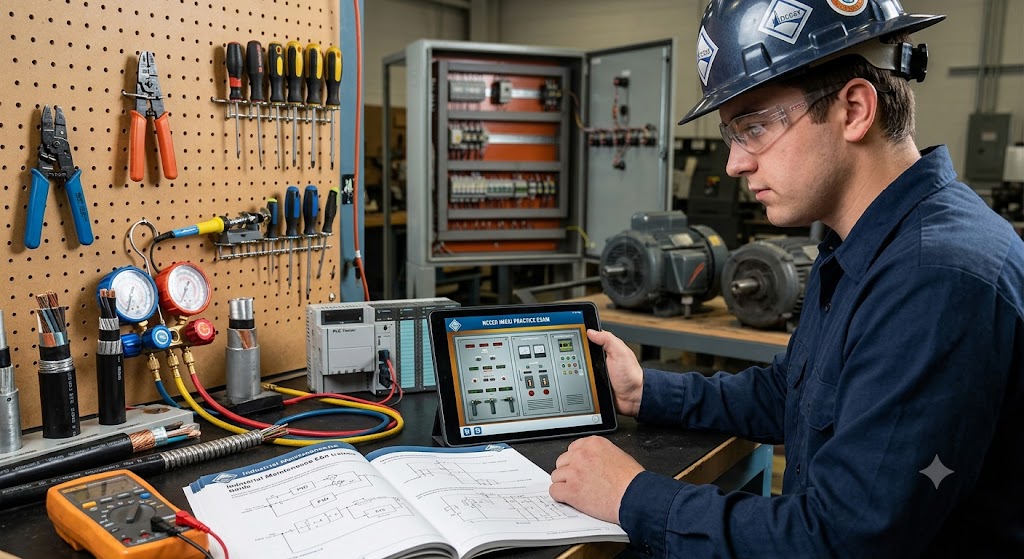
Additional Information
What the Course Entails and Exam Details
The path to becoming a certified NCCER Instrument Technician
involves mastering a comprehensive curriculum that spans four distinct levels.
A student preparing for the practice exam should be familiar with the core
competencies covered in this multi-level syllabus.
The core areas of focus include:
- Safety
and Craft Mathematics: You must have a strong foundation in industrial
safety practices and the ability to apply craft-specific math for precise
measurements and conversions.
- Tools
of the Trade: Technicians must be expert in the selection, use, and
care of specialized hand and power tools used specifically for
instrumentation installation and maintenance.
- Electrical
Systems: A significant portion of the course covers electrical theory,
alternating current (AC), grounding and shielding, circuitry, and the
proper termination of conductors.
- Instrumentation
Drawings and Documents: You will learn to read and interpret complex
Process and Instrument Diagrams (P&IDs), loop sheets, flow diagrams,
and installation detail drawings.
- Process
Control Theory and Elements: This includes understanding the
principles of flow, pressure, level, and temperature measurement, as well
as the operation of detectors, transducers, transmitters, control valves,
actuators, and positioners.
- Calibration
and Troubleshooting: A key skill is the ability to calibrate,
configure, prove, commission, and troubleshoot control loops, alongside
mastering the tuning of control loops.
- Advanced
Systems: The curriculum introduces sophisticated digital logic
circuits, Programmable Logic Controllers (PLCs), and Distributed Control
Systems (DCS).
What to Expect in the Final Exam
The final NCCER assessment is a rigorous validation of your
proficiency. Students should understand the standard procedure of NCCER testing
to avoid surprises on exam day.
Typically, the knowledge verification part of the final exam
is a written test, often administered in a multiple-choice format. You can
expect questions that test both theoretical understanding and practical
application scenarios.
NCCER utilizes a standardization that usually requires a
minimum passing score of 70% for the written portion. It is important to note
that many NCCER craft certifications also require a Performance Verification.
This is a separate, hands-on demonstration where a certified proctor evaluates
your ability to perform specific trade tasks in a real or simulated
environment.
Testing is usually timed, so part of your preparation with a
practice test should be improving your speed and decision-making under
pressure. You must bring valid identification to the testing center.
How to Study and Exam Centers
Preparation is the single most important factor in your
success. To prepare effectively, start by thoroughly reviewing the standard
NCCER Instrumentation Trainee Guides for all relevant levels. These guides are
the primary source of information for exam questions.
Use the NCCER Instrument Technician Practice Test not just
to test your knowledge, but to identify specific weak points. When you answer a
question incorrectly, go back to the source material to understand why
the correct answer is correct. Practice makes permanent, so repeatedly taking
simulated tests will build both your knowledge base and your test-taking
confidence.
Formulas and conversion factors are critical; dedicate time
to memorizing them using flashcards or visualization techniques. Finally, never
neglect the hands-on aspect—if possible, practice the performance tasks
required for performance verification in a workshop or on-site under a mentor's
guidance.
Where to Take the Exam
You cannot take the official final assessment through an
open online portal at home. All NCCER assessments must be proctored and
supervised by a certified NCCER Craft Instructor or Proctor at an accredited
Training Facility. These often include community colleges, vocational schools,
unions, or specific industrial employers that have obtained NCCER
accreditation. You can search for accredited facilities near you directly on
the official NCCER website.
Job Opportunities from the Course
A certified NCCER Instrument Technician is in high demand
across a broad spectrum of capital-intensive industries. Employers actively
seek out this specific credential because it standardizes skills and verifies
quality training.
Successfully completing this course and exam can unlock the
following job titles and career paths:
- Instrument
Technician
- Electrical
and Instrumentation (I&E) Technician
- Analyzer
Technician
- Process
Control Technician
- Instrumentation
Fitter
- Maintenance
Journeyman (E&I Focus)
- DCS/PLC
Technician
- Instrumentation
Foreman/Supervisor
Frequently Asked Questions
Reviews
5.0
Based on 0 reviews
Leave a Review
No reviews yet. Be the first to review!