
NCCER Instrumentation Certification Practice Test
$69.00
- Buy to unlock unlimited access to all Quiz questions and Answers in this Quiz.
- After purchase you can print a PDF of the whole quiz at any point. The PDF will contain the questions and the correct answers.
About this Exam
The NCCER Instrumentation Certification is an industry-recognized program designed to assess the competency of technicians and mechanics working with industrial instrumentation and control systems. The certification covers various aspects of the trade, including safety, tools, piping systems, electricity, process control, measurement devices, and troubleshooting. Earning this certification demonstrates a high level of proficiency and commitment to the profession, making individuals more competitive in the job market and opening doors to advanced career paths.
Ready to test your knowledge?
Buy Now to Access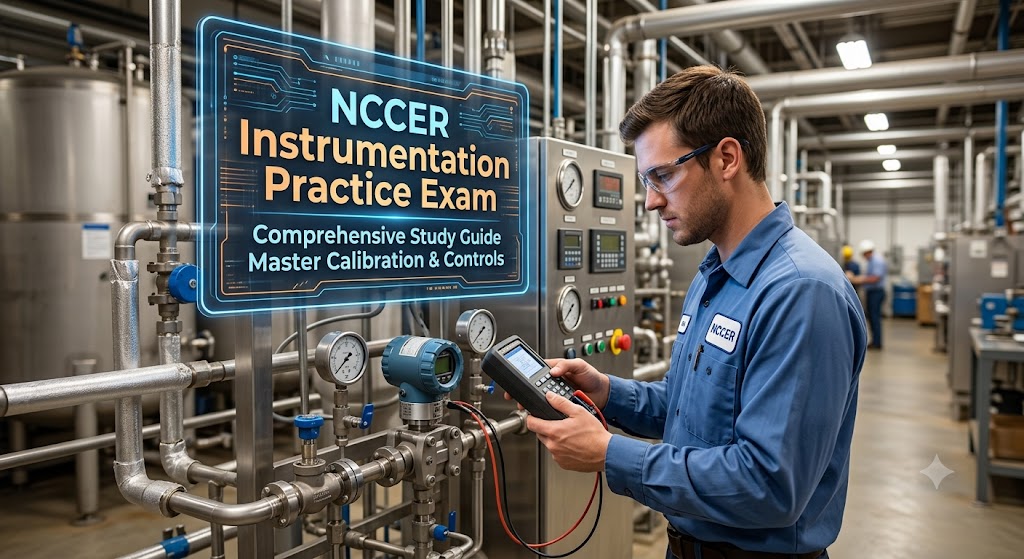
Additional Information
What the Course Entails and Exam Details
The NCCER Instrumentation curriculum is typically structured
into distinct levels (e.g., Level 1, Level 2, etc.), with each level building
on the knowledge gained in the previous one. While the specific course content
can vary slightly, here are the core topics commonly covered:
Core Topics
- Instrumentation
Safety: Adhering to safety standards (e.g., OSHA), understanding
hazardous locations, and utilizing personal protective equipment (PPE).
- Hand
and Power Tools: Identifying and safely operating specialized tools
used in the instrumentation trade.
- Piping
Systems and Process Controls: Reading process and instrumentation
diagrams (P&IDs), understanding piping systems, and the fundamentals
of process control loops.
- Electricity
and Electronics: Grasping basic electrical theory, DC circuits,
reading electrical schematics, and using test equipment (e.g.,
multimeters).
- Pressure,
Temperature, Level, and Flow Measurement: The theory and operation of
devices used to measure these process variables, such as transmitters,
sensors, and gauges.
- Analyzers
and Analytical Systems: Understanding analytical instrumentation and
sampling systems.
- Controllers
and Control Systems: Function and application of controllers,
including Distributed Control Systems (DCS) and Programmable Logic
Controllers (PLCs).
- Calibration
and Troubleshooting: Principles and methods for calibrating
measurement devices and diagnosing common instrumentation issues.
It's crucial to understand that a practice test is
designed to mimic the content and format of the official NCCER cognitive exam.
It helps candidates identify their strengths and weaknesses in these core
areas.
What to Expect in the Final Exam
While a practice test is a valuable tool, it's important to
know the specifications of the official NCCER certification exam you are
preparing for. Here’s what you can typically expect from the actual assessment:
- Format:
The primary cognitive assessment consists of multiple-choice questions.
- Passing
Score: NCCER generally sets a passing score of 70% or higher for the
cognitive assessment.
- Time
Limit: The final exam is timed (often around 3 hours), and you must
manage your time effectively to answer all questions.
- Proctored
Setting: The exam is administered in a controlled, proctored
environment to maintain integrity and prevent cheating.
Using a practice test helps you become familiar with this
format, identify challenging areas, and practice managing your time, directly
preparing you for the demands of the final proctored exam.
How to Study and Exam Centers
Preparation is the cornerstone of success for any
certification exam. Here are proven study methods:
Actionable Study Strategies
Use Official NCCER Materials:
Study from the official NCCER Instrumentation curricula, textbooks, and
resources. These are the most direct source of exam content.
Focus on Weaknesses:
Analyze your performance on practice tests to identify topics where you
struggle, then dedicate extra study time to those areas.
Hands-on Practice:
Instrumentation is a hands-on trade. Practice using relevant tools, test
equipment, and calibration devices in a practical setting (workshop, lab, or
under supervision). This reinforces theoretical knowledge.
Simulate Exam Conditions:
Take practice tests in a quiet environment, free from distractions, and
strictly adhere to a time limit to get used to the final exam's pressure.
Form a Study Group:
Collaborating with peers can provide different perspectives and help explain
complex concepts.
Locating Exam Centers
The final NCCER Instrumentation certification exams are not
typically administered in standard public test centers like some other
standardized tests. Instead, they are taken at authorized, accredited
facilities. You can usually find these through:
- Accredited
Training Sponsors (ATS): Employers, schools, or organizations that are
authorized by NCCER.
- Community
and Technical Colleges: Many institutions offer NCCER training and
assessment services.
- Vocational
Schools: Dedicated trade schools often have testing capabilities.
- Large
Employers: Companies in industrial sectors often administer
assessments in-house for their employees.
To locate the nearest authorized assessment center or
arrange your testing, use the "Find a Training or Assessment Center"
locator on the official NCCER website, or contact your employer/training
provider.
Job Opportunities
from the Course
Earning the NCCER Instrumentation Certification opens up
diverse career opportunities across many essential industrial sectors. Below
are common job titles that this certification unlocks or advances:
- Instrumentation
Technician: The core role of maintaining, calibrating, and
troubleshooting instrumentation systems.
- E&I
(Electrical and Instrumentation) Technician: Combined role with
expertise in both electrical and instrumentation systems.
- Controls
Technician: Focuses on the operation, maintenance, and troubleshooting
of process control systems.
- Maintenance
Technician (Industrial): Broad role with specialized skills in
instrumentation.
- Instrument
Fitter: Involved in the physical installation of piping, tubing, and
instruments.
- Calibration
Technician: Specializes in calibrating measurement devices to ensure
accuracy.
- Process
Control Specialist: Advanced role managing and optimizing large-scale
control systems.
- Field
Service Technician: Provides technical support and service for
equipment at various customer locations.
- Plant
Operator: Operators benefit from a deep understanding of
instrumentation and control logic.
Frequently Asked Questions
Reviews
5.0
Based on 0 reviews
Leave a Review
No reviews yet. Be the first to review!