
NCCER Pipeline Corrosion Control Practice Test
$69.00
- Buy to unlock unlimited access to all Quiz questions and Answers in this Quiz.
- After purchase you can print a PDF of the whole quiz at any point. The PDF will contain the questions and the correct answers.
About this Exam
The NCCER Pipeline Corrosion Control certification is a cornerstone credential for professionals working in the energy and pipeline sectors. It validates an individual's knowledge and skill in identifying, monitoring, and mitigating corrosion – a critical factor in ensuring pipeline integrity, environmental safety, and operational reliability. This certification is specifically designed for pipeline technicians, maintenance crews, corrosion control personnel, and inspectors seeking to demonstrate their expertise in preventing pipeline degradation. Acquiring this credential through a practice test is a proactive step towards ensuring the long-term sustainability and safety of essential pipeline infrastructure.
Ready to test your knowledge?
Buy Now to Access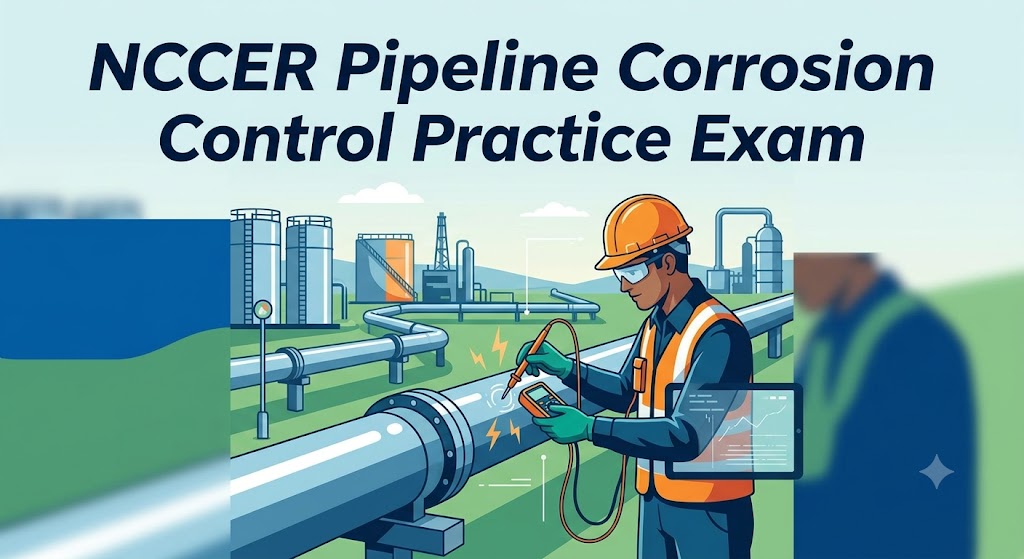
Additional Information
What the Course Entails and Exam Details
The training leading to this certification covers a broad
range of essential topics. Students can expect to delve into areas such as:
- Fundamental
concepts of corrosion and its varied types affecting pipelines.
- The
principles of cathodic protection, including sacrificial anodes and
impressed current systems.
- Application
techniques for different pipeline coatings and liners.
- Methods
for detecting and measuring corrosion through various inspection
technologies.
- Relevant
safety procedures and regulatory compliance standards for corrosion
control.
- Interpreting
data from corrosion monitoring and testing programs.
The NCCER Pipeline Corrosion Control course typically
consists of a combination of instructional learning and sometimes hands-on
practice, preparing candidates for both the knowledge-based assessment and
potential practical applications in the field.
What to Expect in the Final Exam
The final NCCER Pipeline Corrosion Control exam is
structured to evaluate your comprehension of the core concepts covered in the
training. It typically features a multiple-choice format, designed to assess
your ability to recall information, apply principles, and make sound decisions
related to corrosion prevention and control on pipelines. Candidates are
generally required to achieve a passing score, often around 70%, to earn the
certification. The time limit for completing the exam is usually specified but
is designed to allow sufficient time for thoughtful responses to all questions.
The test is administered in a proctored environment, ensuring integrity, and
candidates usually cannot refer to external materials. Practice tests, similar
to what this title suggests, are excellent tools to familiarize yourself with
the question types and overall structure before attempting the final exam.
How to Study and
Exam Centers
Effectively preparing for the NCCER Pipeline Corrosion
Control exam requires a structured study plan. Start by thoroughly reviewing
the official NCCER training modules and any supplementary study guides.
Utilizing practice tests can be exceptionally beneficial, as they mimic the
exam format and help you identify areas where further study is needed. Focus on
understanding key principles and their practical applications, and test your
knowledge of definitions and procedures frequently. Forming study groups with
colleagues can also offer valuable insights and peer support.
To take the NCCER Pipeline Corrosion Control exam, you must
typically do so through an NCCER Accredited Training Sponsor (ATS) or an
Accredited Assessment Center (AAC). These centers provide authorized testing
facilities, often within training organizations or specific industrial
companies. You can usually find a list of authorized providers in your area
through the official NCCER website or by contacting local pipeline operating
companies or training centers. Some components might offer online testing options
under proctored conditions, though physical centers remain the most common
method.
Job Opportunities from the Course
Obtaining the NCCER Pipeline Corrosion Control certification
opens the door to numerous valuable career opportunities within the oil and gas
industry and related sectors. Key job titles and career paths often pursue by
certified individuals include:
- Pipeline
Corrosion Control Technician
- Pipeline
Integrity Specialist
- Corrosion
Control Inspector
- Pipeline
Maintenance Technician
- Asset
Integrity Coordinator
- Pipeline
Operator (with a corrosion control focus)
- Coating
Inspector
- Quality
Control Technician (Pipelines)
- Field
Corrosion Engineer (potentially after gaining experience or advanced
degrees)
This certification demonstrates your commitment to safety,
adherence to industry standards, and expertise in preventing pipeline
degradation, making you a highly desirable candidate for roles critical to
infrastructure protection.
Frequently Asked Questions
Reviews
5.0
Based on 0 reviews
Leave a Review
No reviews yet. Be the first to review!