
NCCER Power Tools Practice Exam
$69.00
- Buy to unlock unlimited access to all Quiz questions and Answers in this Quiz.
- After purchase you can print a PDF of the whole quiz at any point. The PDF will contain the questions and the correct answers.
About this Exam
The NCCER Power Tools certification, primarily housed within the Introduction to Power Tools (Module 00104) of the NCCER Core Curriculum, serves as a critical entry point for individuals entering the construction and skilled trades. This course is designed for apprentices, craft professionals, and high school students in technical education pathways. It ensures that every worker on a job site possesses a standard, recognized level of knowledge regarding the safe operation, identification, and maintenance of common power tools. Passing this exam is often a mandatory prerequisite for advancing to specialized trade training.
Ready to test your knowledge?
Buy Now to Access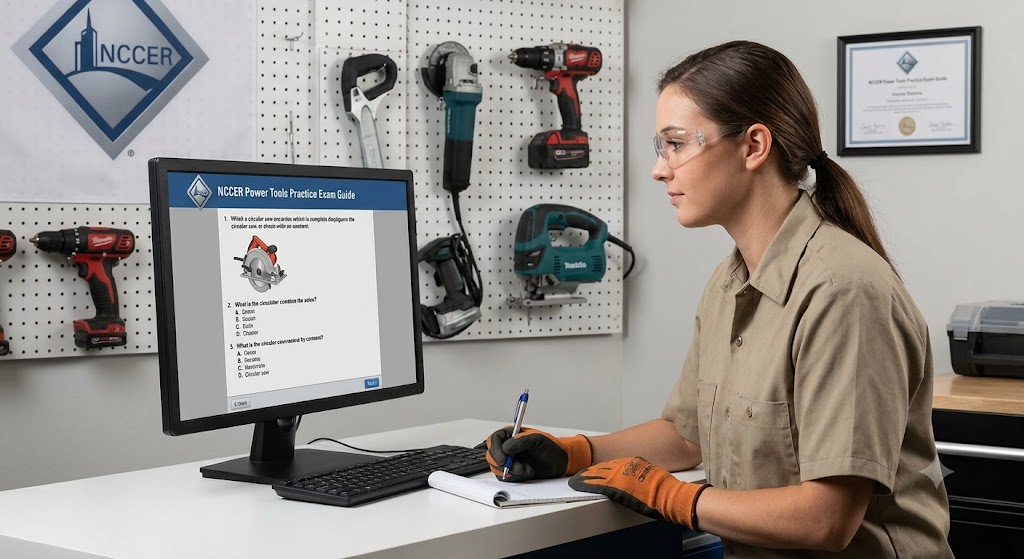
Additional Information
What the Course Entails and Exam Details
This module focuses on the three primary types of power
tools encountered in construction: electric, pneumatic (air-powered), and
hydraulic. Students are taught to identify a wide array of tools and,
crucially, to understand their specific applications and limitations. The
course covers the standard operating procedures for core tools, including
various drills (hammer drills, impact wrenches), saws (circular, reciprocating,
band saws), grinders (angle, bench), and miscellaneous tools such as pneumatic
nailers and hydraulic jacks. The curriculum places paramount importance on
identifying potential hazards, conducting thorough pre-operation inspections,
and mastering safety protocols unique to each power source.
What to Expect in the Final Exam
The full NCCER Power Tools assessment consists of two
distinct components that must be successfully completed. First, you will take a
written knowledge test. This portion is typically composed of
multiple-choice questions focusing heavily on safety regulations, tool-specific
terminology (like 'kerf' or 'chuck'), and identifying the correct tool for a
given task. You can expect a closed-book format, and the minimum passing score
is generally 70%. Second, you must pass a hands-on performance
profile. An evaluator will observe you to ensure you can safely and
correctly inspect, set up, and operate a minimum number of designated power
tools according to standardized criteria.
How to Study and
Exam Centers
Effective studying begins with a thorough review of the
official NCCER Module 00104 trainee guide. Take advantage of practice quizzes
to familiarize yourself with the phrasing of multiple-choice questions. Your
priority should be internalizing the why behind safety rules, not just
memorizing the steps. For the performance profile, there is no substitute for
supervised, hands-on experience in a workshop setting. The written and
practical exams must be administered by an NCCER-certified instructor or evaluator
at an Accredited Assessment Center (AAC) or an Accredited Training Sponsor
(ATS). These are commonly located at trade schools, community colleges, or
within approved construction companies. You can locate official centers using
the "Find a Center" tool on the NCCER website.
Job Opportunities from the Course
Earning your NCCER Introduction to Power Tools credential is
a foundational requirement that unlocks countless career paths within the
industrial and construction sectors. This certification proves to employers
that you are "site-ready" and possess a standard baseline of safety
knowledge. It is a necessary step for virtually any apprentice or trainee
position in the specialized crafts.
Potential job titles and career paths include:
- General
Construction Laborer
- Carpenter
Apprentice
- Electrician
Apprentice
- Plumber
or Pipefitter Trainee
- HVAC
Technician Assistant
- Maintenance
Technician
- Welder
Assistant
- Facilities
Maintenance Worker
Frequently Asked Questions
Reviews
5.0
Based on 0 reviews
Leave a Review
No reviews yet. Be the first to review!