
NCCPA Recertification Practice Exam
$69.00
- Buy to unlock unlimited access to all Quiz questions and Answers in this Quiz.
- After purchase you can print a PDF of the whole quiz at any point. The PDF will contain the questions and the correct answers.
About this Exam
Welcome to your essential resource for the PANRE practice exam! Maintaining your certification as a Physician Assistant (PA-C) is a mark of professional excellence, and the National Commission on Certification of Physician Assistants (NCCPA) requires a rigorous assessment to ensure ongoing medical competence. This guide is designed for practicing PAs like you who are approaching their recertification window and are seeking a reliable method to evaluate their knowledge base before taking the formal test. Whether you choose the traditional Physician Assistant National Recertifying Examination (PANRE) or the newer PANRE Longitudinal Assessment (PANRE-LA), utilizing a targeted practice exam is a crucial step in your preparation strategy. This article will break down how to effectively use a PANRE practice exam to identify knowledge gaps, familiarize yourself with the question format, and boost your confidence for test day.
Ready to test your knowledge?
Buy Now to Access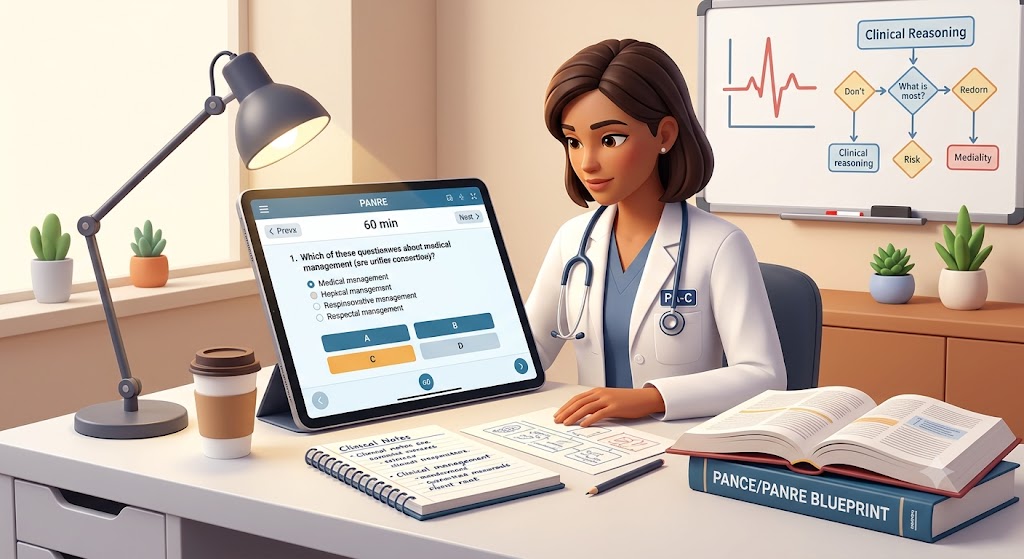
Additional Information
What the Course Entails and Exam Details
A high-quality NCCPA recertification practice exam
closely mimics the actual assessment content, which is based entirely on the NCCPA
Content Blueprint. The blueprint outlines the medical specialties and
knowledge categories you are expected to master. You should expect questions
covering a wide spectrum of primary care and general medicine. Core clinical
areas usually include high-yield systems such as Cardiovascular, Pulmonary,
and Endocrinology, alongside essential fields like Emergency Medicine,
Surgery, Pediatrics, and Women’s Health. Within these medical domains, the
exam tests your proficiency in different "tasks," ranging from taking
a comprehensive history and conducting physical exams to formulating diagnoses
and developing pharmaceutical management plans. By reviewing your performance
on a PANRE practice exam, you will get a clear picture of exactly which
systemic or task-based areas require more of your limited study time.
What to Expect in the Final Exam
Knowing what to expect when you take the final NCCPA
recertification assessment can dramatically reduce anxiety and improve
performance. Currently, PAs have two primary paths: the traditional PANRE and
the PANRE-LA. The traditional PANRE is a standard, single-day proctored
event consisting of 240 multiple-choice questions, which are divided into four
60-question blocks. Candidates have a total of four hours to complete the
questions, with additional time provided for tutorials and breaks. The official
passing scaled score is 379. Alternatively, the PANRE-LA (Longitudinal
Assessment) is an at-home, multi-year process where PAs answer a set number of
questions each quarter on their own device. PAs receive feedback immediately
after each question. Using a timed PANRE practice exam is particularly
helpful for simulating the pacing required for the traditional single-day exam,
ensuring you can manage your time effectively during the actual five-hour
testing window.
How to Study and Exam Centers
The most effective PA exam study guide involves a
combination of targeted content review and repeated practice. Start by
referencing the official PANRE blueprint from the NCCPA website to
ensure you are prioritizing high-weight content areas. Your primary studying
tool should be a comprehensive PA practice question bank that offers timed
PANRE practice exams. Do not just focus on whether you got a question right
or wrong; spend time thoroughly reading the rationales for every answer choice
to reinforce your clinical reasoning. We recommend completing at least one
full-length, timed PANRE practice exam to build stamina and identify
remaining weaknesses. To take the actual exam, you must first log into your NCCPA
online account within your eligibility window to submit your application
and pay the required fee. Once your application is approved, you will receive
an Authorization to Test (ATT) letter, allowing you to schedule your
appointment at a Pearson VUE testing center, which are located
throughout the United States and internationally.
Job Opportunities
from the Course
Maintaining your PA-C through successful NCCPA
recertification is mandatory for continued medical licensure in all 50
states and guarantees your versatility in the healthcare marketplace. It
unlocks a near-limitless variety of career paths across all medical and
surgical disciplines. Whether you are seeking a career change or looking to
advance in your current specialty, holding an active PA-C certification
makes you highly competitive for roles such as:
- Family
Medicine Physician Assistant
- Emergency
Medicine Physician Assistant
- Internal
Medicine Specialist PA
- General
Surgery PA-C
- Cardiothoracic
Surgery Physician Assistant
- Dermatology
PA
- Oncology
and Palliative Care PA-C
- Pediatric
Medicine Physician Assistant
- Women’s
Health/OB-GYN PA
Frequently Asked Questions
Reviews
5.0
Based on 0 reviews
Leave a Review
No reviews yet. Be the first to review!