
NCEA Level 2 Mechanics Practice Test
$69.00
- Buy to unlock unlimited access to all Quiz questions and Answers in this Quiz.
- After purchase you can print a PDF of the whole quiz at any point. The PDF will contain the questions and the correct answers.
About this Exam
This practice exam is designed for New Zealand secondary school students preparing for the NCEA Level 2 Mechanics external assessment, which is worth 6 credits.
This qualification assesses a fundamental understanding of physical principles, and achieving well in Level 2 Physics, particularly Mechanics, is a crucial stepping stone for students aiming for Level 3 Physics and tertiary study in science, engineering, or related fields.
The practice test aims to familiarize students with the structure, style, and complexity of the questions they will encounter in the final examination, helping them gauge their readiness and identify areas for improvement.
Ready to test your knowledge?
Buy Now to Access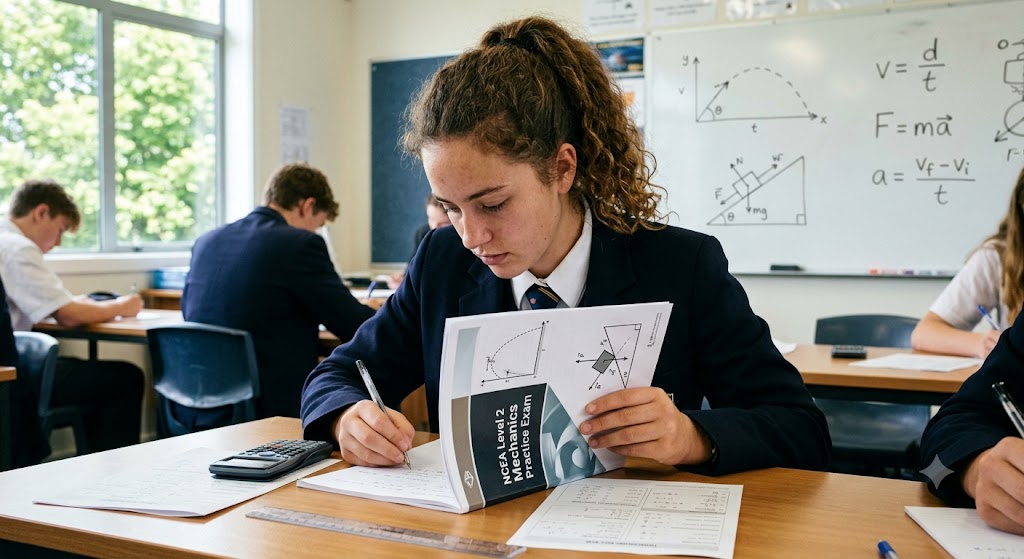
Additional Information
What the Course Entails and Exam Details
The NCEA Level 2 Mechanics course covers four main topics in
physics:
Motion:
Students explore concepts like displacement, velocity, acceleration, freefall,
and projectile motion. They learn to interpret and analyze motion graphs and
apply kinematic equations.
Forces and
Newton's Laws: This section covers vectors, net forces, friction, and
Newton's three laws of motion. Students apply these concepts to understand the
effects of forces on objects.
Momentum and
Impulse: Learners understand the relationship between force, time, and
changes in momentum, and apply the principle of conservation of momentum to
collisions and explosions.
Energy and Work: This topic focuses on work, kinetic
energy, gravitational potential energy, elastic potential energy, and the
principle of conservation of energy, along with power.
What to Expect in the Final Exam
The final NCEA Level 2 Mechanics exam (91171) is a written
paper assessment.
Students are typically given 3 hours to complete three
external standards in Physics, including Mechanics, though the time allocated
can vary. A specific, recommended time is often suggested for each standard
within the total exam session.
The exam usually consists of three to four main questions,
each with multiple parts, requiring a mix of short answers, calculations
showing working, and explanations.
Students should be prepared to use a calculator and refer to
a provided formula sheet. While there isn't a single 'passing score',
achievement levels are categorized as Not Achieved, Achieved, Merit, or
Excellence. Achieving a high grade reflects a robust understanding and is often
beneficial for university entrance.
How to Study and
Exam Centers
Effective preparation for the NCEA Level 2 Mechanics exam
involves several key strategies.
Firstly, thoroughly review the course content, ensuring you
understand the core concepts and can confidently use the kinematic equations
and formula sheets. Practice rearranging equations, which is a critical skill
for success in physics problems.
Utilize past exam papers and the practice test as essential
study tools. This helps you get used to the types of questions asked and the
language used in the exam. Work through problems under timed conditions to
simulate the exam environment and improve your speed and accuracy.
Examine the assessment schedules for past papers to
understand what is required for Achieved, Merit, or Excellence. This gives
insight into how questions are marked and where you need to focus. Consider
forming a study group to discuss challenging concepts or seek help from your
teacher.
The final external exams are held annually, usually in
November. They are taken in formal examination centers, which are typically the
secondary schools where students are enrolled, under the supervision of NZQA
(New Zealand Qualifications Authority) supervisors.
Job Opportunities
from the Course
While Level 2 Mechanics is just one component of a broader
physics curriculum, it provides essential skills for a wide array of technical
and scientific career paths, particularly when combined with further education.
Careers that utilize these fundamental principles include:
- Engineering
(Civil, Mechanical, Electrical, Aerospace)
- Physics
Research and Academia
- Data
Analyst
- Architect
- Pilot
- Geophysicist
- Materials
Scientist
- Renewable
Energy Specialist
- Medical
Physicist
- Software
Engineer (particularly in game design or simulations)
- Technical
Writer
Frequently Asked Questions
Reviews
5.0
Based on 0 reviews
Leave a Review
No reviews yet. Be the first to review!