
NCEA Level 2 Music Practice Exam
$69.00
- Buy to unlock unlimited access to all Quiz questions and Answers in this Quiz.
- After purchase you can print a PDF of the whole quiz at any point. The PDF will contain the questions and the correct answers.
About this Exam
The NCEA Level 2 Music assessment is a critical component of the National Certificate of Educational Achievement in New Zealand, designed for Year 12 students or those studying equivalent curriculums. It acts as a significant stepping stone between foundational music concepts and advanced music study at Level 3. This qualification validates your growth as a musician, showing your commitment to performance, composition, and theoretical understanding. Taking a practice exam is an essential step in this journey, allowing you to gauge your readiness and build confidence.
Ready to test your knowledge?
Buy Now to Access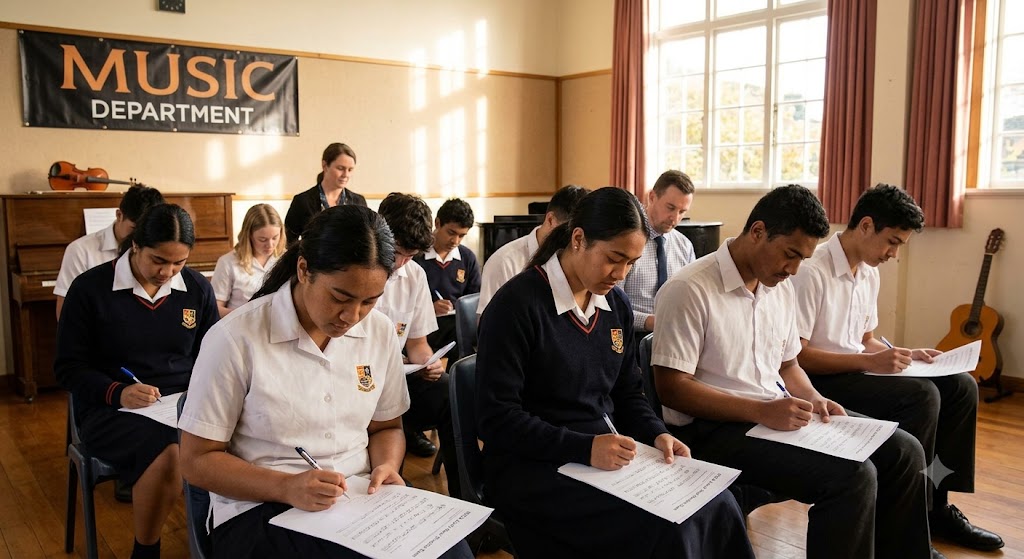
Additional Information
What the Course Entails and Exam Details
This course covers a broad spectrum of musical skills and
knowledge. At Level 2, you are expected to move beyond simple recall and
demonstrate a deeper understanding of musical mechanics and context. The
curriculum is split into internal (practical) and external (written) standards.
The practice exam specifically replicates the external standards, which focus
on theoretical and analytical skills. The key areas covered in this course
include:
- Solo
Performance: Presenting two substantial pieces of music on your chosen
instrument or voice.
- Group
Performance: Demonstrating ensemble skills by performing as part of a
musical group.
- Instrumentation/Arranging:
Learning how different instruments function and how to arrange music for
varied ensembles.
- Composition:
Creating original musical works, demonstrating an understanding of
structure, melody, and harmony.
- Sonic
Arts/Music Technology: (Optional standard) Utilizing digital tools and
software for sound creation and recording.
- Theory
(Exam Focus):
- Aural
Skills: Developing the ability to write down melodies, rhythms, and
chords by ear.
- Score
Analysis: Critically analyzing music scores to identify structures,
harmonic progressions, and instrumentation techniques.
- Contextual
Knowledge: Understanding the historical, social, and cultural
contexts of various musical styles and genres.
What to Expect in the Final Exam
The final (external) exam is a written paper administered by
NZQA at the end of the school year. The NCEA Level 2 Music practice exam is
designed to mimic this format exactly, providing a realistic test of your
knowledge and exam technique. It is composed of two to three main standards,
depending on what your school selects, but typically includes Aural Skills
(Standard 91275) and Knowledge of Conventions in Music Scores (Standard 91276).
- Aural
Skills (91275): This section is highly practical despite being a
written exam. You will be in a room where recorded music is played
multiple times. You are required to:
- Transcribe
short melodic and rhythmic phrases.
- Identify
chord progressions (often in a specified key).
- Describe
musical elements such as dynamics, texture, and instrumentation.
- Music
Scores (91276): This section presents you with physical music scores.
You will need to answer questions related to:
- Identifying
keys, cadences, and harmonic progressions (Roman numerals).
- Identifying
musical devices (e.g., sequence, imitation, pedal point).
- Answering
questions about orchestration, transposition, and stylistic conventions.
Time Limit and Passing Scores: The external exam
session usually allows for 3 hours to complete all required papers. Each
standard is graded separately on the NCEA scale: Not Achieved (N), Achievement
(A), Merit (M), or Excellence (E).
How to Study and Exam Centers
Effective Study Strategies:
Past Papers: This is the
single most effective way to prepare. NZQA makes previous years' external exam
papers available on their website. Complete them under timed conditions to
practice your speed and recall.
Develop Your Aural Ear:
Use tools like websites (e.g., tonesavvy.com, musictheory.net) or apps to
practice dictation and interval recognition. Practice writing down simple tunes
you know by ear.
Flashcards for Harmony:
Create flashcards for Roman numeral analysis in different keys (e.g.,
identifying chord IV in E Major). Memorize common harmonic progressions.
Practice Score Reading:
Get scores of pieces you enjoy and analyze them. Identify the key, the
different instrumental parts, and the structural sections.
Simulate the Practice Exam:
The practice exam should be treated like the real thing. Sit in a quiet room,
time yourself, and don’t look at your notes. This identifies weak spots in a
low-stakes environment.
Exam Centers:
- Practice
Exams: These are almost always organized and administered internally
by your high school or educational institution. They are typically held
during a dedicated 'exam week' mid-year (Term 3).
- Final
Exams: The final NZQA external exams are held at your registered high
school. If you are a distance learning or correspondence student, NZQA
will assign you to an authorized exam center, usually a local high school,
where you will sit the exam alongside their students.
Job Opportunities from the Course
A qualification in NCEA Level 2 Music demonstrates
creativity, dedication, teamwork, and analytical thinking—skills that are
valued in any profession. However, for those looking to continue in the arts,
this qualification opens the door to numerous exciting career paths:
- Sound
Engineer
- Music
Producer
- Professional
Musician (Soloist or Session)
- Secondary
School Music Teacher
- Instrumental
Music Tutor
- Composer
for Film, Gaming, or Advertising
- Music
Journalist
- Arts
Administrator
- Concert
Promoter
- Radio
Presenter/DJ
- Music
Therapist
- Booking
Agent
Frequently Asked Questions
Reviews
5.0
Based on 0 reviews
Leave a Review
No reviews yet. Be the first to review!