
NCEA Level 3 Biology – Plant and Animal Responses (AS91602) Practice Exam
$69.00
- Buy to unlock unlimited access to all Quiz questions and Answers in this Quiz.
- After purchase you can print a PDF of the whole quiz at any point. The PDF will contain the questions and the correct answers.
About this Exam
The NCEA Level 3 Biology – Plant and Animal Responses external assessment (Achievement Standard 91602) is a critical gateway exam for New Zealand secondary students who wish to pursue higher education in life sciences, ecology, medicine, or veterinary studies. This external exam, worth three credits, focuses on how organisms interact with their external environment. It is designed for Year 13 students who have already established a foundation in biology and are ready to tackle complex, interrelated ecological concepts. Understanding these processes is essential for grasping the fundamental mechanisms of survival and reproductive success in the natural world. This practice guide is engineered to help students streamline their revision, identify key knowledge gaps, and perform at an Excellence level.
Ready to test your knowledge?
Buy Now to Access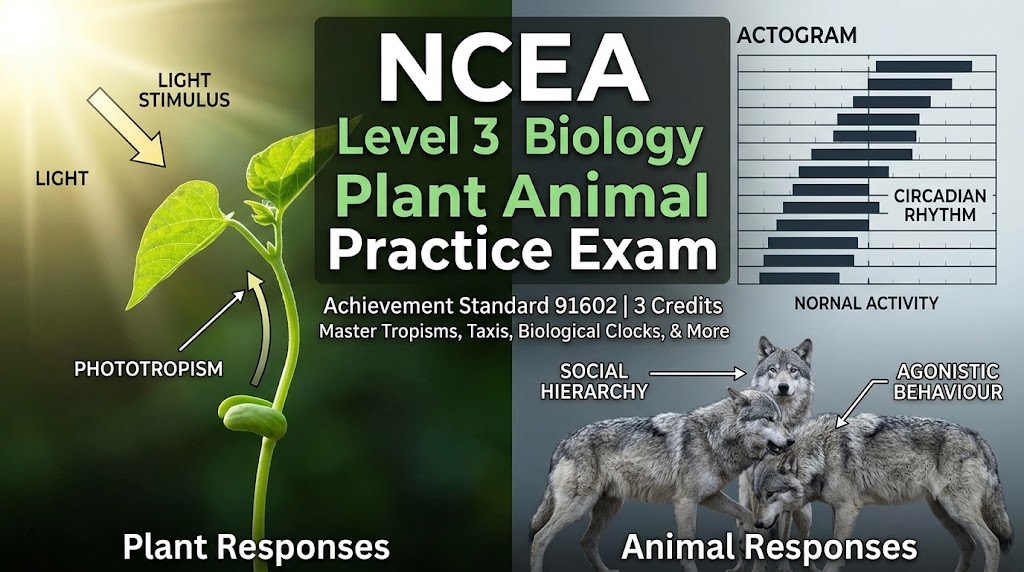
Additional Information
What the Course Entails and Exam Details
To succeed in AS91602, students must demonstrate a
comprehensive understanding of the distinct ways plants and animals respond to
external stimuli. The course requires more than simple memorization; students
must analyze the mechanisms of these responses and evaluate their adaptive
advantages.
The core syllabus topics cover both biological kingdoms. In
the Plant Responses section, you will study:
- Tropisms:
The growth responses of plants in relation to the direction of stimuli,
including phototropism, gravitropism, and thigmotropism.
- Nastic
Responses: Rapid, non-directional movements of plant parts, such as
the folding of Mimosa pudica leaves.
- Photoperiodism:
How plants use the phytochrome system to detect critical day length and
control flowering.
In the Animal Responses section, you will explore
orientation and relationship behaviors:
- Orientation:
Mechanisms animals use to find their way, including taxes (directional
movement), kineses (non-directional changes in activity rate), homing, and
migration.
- Biological
Clocks: Understanding endogenous rhythms, including circadian,
circatidal, and circannual cycles, and how they are reset by environmental
cues (zeitgebers) like actograms.
- Interspecific
Relationships: Interaction between different species, including
competition, predation, and various forms of symbiosis (mutualism,
commensalism, parasitism).
- Intraspecific
Relationships: Interactions within the same species, such as social
behavior, hierarchical structures, territoriality, and agonistic behavior,
including reproductive strategies.
What to Expect in the Final Exam
The AS91602 examination is an external written test
administered by NZQA during the end-of-year exam period. Students typically
receive a written booklet containing three main questions, with each question
consisting of several parts of increasing difficulty. You should expect to
spend roughly one hour on this paper within your three-hour Level 3 Biology
exam session.
The exam questions are designed to challenge your
understanding of core concepts. You will not find multiple-choice sections;
rather, you must provide written explanations that integrate specific
biological examples. To achieve an Excellence grade, you must do more than just
describe or explain a process. You must comprehensively justify the response,
linking it back to the organism's adaptive advantage. For example, if
discussing grey wolf hierarchies, you must not only describe the dominance
structure but also analyze how this system benefits the group as a whole
regarding resource allocation, energy conservation, and reproductive success.
The quality of your biological examples and your ability to connect mechanisms
to their functional benefits are the keys to a high score.
How to Study and Exam Centers
Preparation for this exam requires a strategic approach that
blends content knowledge with practical application. You can supercharge your
revision using these actionable strategies.
First, master the specialized biological vocabulary.
Creating digital flashcards using tools like Quizlet is essential for quickly
defining and recalling terms such as endogenous, actogram, phytochrome, nastic,
and agonistic behavior. Second, the single best way to prepare is by utilizing
past NZQA exam papers and assessment schedules. Set a timer and practice
writing full, integrated responses to previous questions. Third, always review
the "Assessment Schedules" (exemplar answers) for past papers.
Analyze what constitutes an "Achieved," "Merit," and
"Excellence" response so you know exactly how to structure your
arguments and what depth of analysis is required. Fourth, create visual aids.
Draw tropism diagrams, actograms, and hierarchy charts, and practice explaining
aloud how each response provides an adaptive advantage. Fifth, memorize complex
case studies. Choose several diverse examples of tropisms, animal navigation,
or social structures and know their mechanisms inside out.
The AS91602 exam is not taken online or at third-party
portals like Pearson VUE. It is part of the national NCEA examination system.
Students take this exam in authorized physical testing centers, which are
almost exclusively the schools they attend or other registered educational
institutions. You will receive your definitive exam timetable and location
directly from your school's NCEA coordinator well in advance of the examination
date.
Job Opportunities from the Course
Mastering Level 3 Biology, including the concepts in
AS91602, serves as the foundation for diverse and rewarding career paths in the
sciences. Understanding biological responses to the environment is essential
for professionals in the field, lab, and clinic. This certification unlocks
further study leading to these specific roles:
- Biologist
- Ecologist
- Zoologist
- Botanist
- Veterinarian
- Marine
Biologist
- Conservation
Officer
- Biotechnologist
- Medical
Doctor
- Biomedical
Scientist
- Science
Educator
- Environmental
Consultant
- Wildlife
Manager
- Agricultural
Scientist
Frequently Asked Questions
Reviews
5.0
Based on 0 reviews
Leave a Review
No reviews yet. Be the first to review!