
NCEA Level 3 Chemistry – Aqueous Chemistry (AS91393) Practice Exam
$69.00
- Buy to unlock unlimited access to all Quiz questions and Answers in this Quiz.
- After purchase you can print a PDF of the whole quiz at any point. The PDF will contain the questions and the correct answers.
About this Exam
This study guide is designed for high school students in New Zealand preparing for the NCEA Level 3 Chemistry external assessment: Aqueous Chemistry (AS91393). This standard is a critical component of Year 13 Chemistry and is aimed at students seeking to demonstrate a sophisticated understanding of chemical equilibrium principles within aqueous systems. Success in this exam signifies a student's readiness for university-level chemistry and related scientific disciplines, showcasing their ability to apply complex mathematical reasoning to chemical problems. This guide serves as a comprehensive roadmap, offering strategic advice, key topic breakdowns, and actionable study methods to help you achieve Excellence.
Ready to test your knowledge?
Buy Now to Access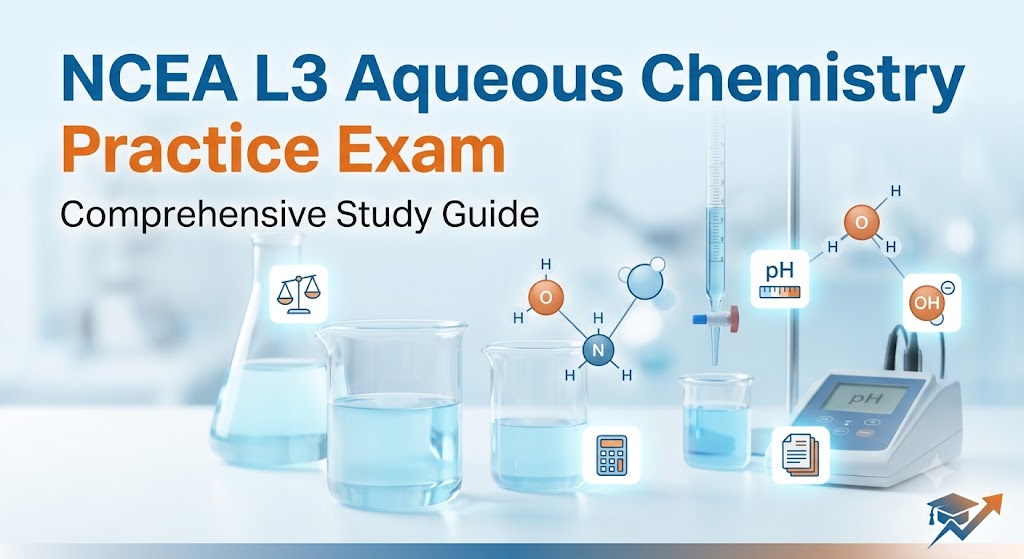
Additional Information
What the Course Entails and Exam Details
The Aqueous Chemistry standard requires you to apply
knowledge of equilibrium principles to describe and solve problems in
diverse aqueous scenarios. This is one of the most mathematically demanding
standards in NCEA Level 3 Chemistry. You will need to master both qualitative
and quantitative analysis of the following core topics:
- Solubility
Equilibria: Understanding sparingly soluble ionic solids. This
involves writing $K_s$ expressions, calculating solubility ($s$) from
$K_s$ and vice versa, and predicting precipitation using the reaction
quotient ($Q_s$). You must also explain the common ion effect and the
formation of complex ions on a substance's solubility.
- Acid-Base
Equilibria: Distinguishing between strong and weak acids and bases.
You will master pH, pKa, Ka, and $K_w$ calculations for single species.
This includes understanding the dynamic equilibrium of weak acids/bases
and their conjugate pairs.
- Buffer
Systems: Explaining how buffers resist changes in pH. This requires
analyzing the composition of buffer solutions and calculating the pH of a
buffer before and after the addition of small amounts of strong acid or
base.
- Titration
Curves: Interpreting titration curves for acid-base reactions
(specifically strong acid/weak base or weak acid/strong base). You will
need to explain the shape of the curve, identify key points (initial pH,
half-equivalence point, equivalence point), select appropriate indicators,
and perform pH calculations at any point on the curve.
- Species
in Solution: Identifying and comparing the relative concentrations and
conductivity of all species present in weak acidic, weak basic, and buffer
solutions.
What to Expect in the Final Exam
The NCEA Level 3 Aqueous Chemistry exam is an external,
written assessment. You can expect:
- Format:
The exam paper usually consists of three large, multi-part questions, each
worth one third of the total marks (5 credits). The questions require a
mix of mathematical calculations, short written answers to describe
processes, and comprehensive paragraph-style responses to
"justify" or "explain" chemical phenomena.
- Time
Limit: You will have three hours in total for the examination session.
Since there are typically three external chemistry papers to sit (e.g.,
Organic, Thermochemistry, and Aqueous), it is crucial to manage your time,
dedicating roughly 60 minutes to this standard.
- Materials
Provided: You will be provided with a Resource Booklet
containing a Periodic Table and standard data, such as $K_s$, $K_a$, and
$K_w$ values relevant to the questions.
- Required
Skills: You must bring a calculator capable of performing logarithmic
functions. The exam assesses your ability to apply chemical vocabulary,
symbols, and conventions accurately. Higher marks (Merit and Excellence)
require you to link calculations to qualitative descriptions, for
instance, by connecting Le Chatelier’s principle to complex ion formation.
- Passing
Score Requirements: To gain the 5 credits for this standard, you need
to achieve 'Achieved' (A), 'Merit' (M), or 'Excellence' (E).
How to Study and
Exam Centers
Preparation for the Aqueous Chemistry exam must be active
and structured. Here are proven strategies:
- Practice
with Past Papers: This is the most effective study tool. Complete at
least five years of past NCEA external exam papers. Don't just do the
math; write out the full explanations. After completing a paper, use the
official Assessment Schedules (marking schemes) on the NZQA website
to grade your work. This helps you understand exactly what examiners are
looking for to award Achievement, Merit, or Excellence.
- Master
the Math from First Principles: Don't just memorize formulas.
Understand why you use c = n/v and n=m/M. Practice rearranging
these to solve for concentration, mass, or volume. For solubility, always
start by writing the dissociation equation; for acid-base, write the
proton transfer equation. This groundwork prevents errors when NZQA
introduces a non-standard scenario.
- Focus
on 'Justify' Questions: Excellence often depends on your ability to justify
a calculation. For example, after calculating a solubility, you might need
to use Le Chatelier’s principle to explain why adding HCl would dissolve
more lead(II) hydroxide. Practice creating logical, step-by-step written
arguments.
- Create
a Formula Sheet and Flashcards: Write down all key equations (e.g.,
Henderson-Hasselbalch, $pH = -log[H_3O^+]$) and definitions on a master
sheet. Use flashcards for key terms, definitions of buffers, and
recognizing strong vs. weak species.
- Exam
Centers: The final NCEA external exams are taken at authorized
secondary schools throughout New Zealand, which serve as physical testing
centers. They are not taken online. As a current secondary student,
your own school will coordinate your exam entries and the logistics of
where and when you will sit the test. If you are an extracurricular or
home-schooled student, you must register through a local school to sit the
exam as a private candidate.
Job Opportunities
from the Course
A strong performance in NCEA Level 3 Chemistry, particularly
in a demanding standard like Aqueous Chemistry, opens the door to numerous
science-based career paths. This qualification serves as a primary foundation
for entry into university degrees required for the following job titles:
- Chemical
Engineer
- Medical
Doctor (GP or Specialist)
- Pharmacist/Pharmacologist
- Analytical
or Forensic Chemist
- Environmental
Scientist
- Biochemist
- Biomedical
Scientist/Medical Laboratory Scientist
- Toxicologist
- Veterinarian
- Dentist
- Geochemist
- Science
Teacher
- Food
Scientist/Technologist
- Laboratory
Technician
Frequently Asked Questions
Reviews
5.0
Based on 0 reviews
Leave a Review
No reviews yet. Be the first to review!