
NCEES FE Other Disciplines Practice Exam
$69.00
- Buy to unlock unlimited access to all Quiz questions and Answers in this Quiz.
- After purchase you can print a PDF of the whole quiz at any point. The PDF will contain the questions and the correct answers.
About this Exam
The Fundamentals of Engineering (FE) exam is a crucial first step for engineers pursuing their Professional Engineer (PE) license.
This particular FE exam, titled 'Other Disciplines', is designed for examinees whose undergraduate engineering programs are not clearly defined by one of the specific discipline exams, or for those with an interdisciplinary background.
It serves as a comprehensive assessment, validating your foundational knowledge in core engineering principles and preparing you for a diverse range of engineering career paths.
Taking this exam demonstrates a serious commitment to the engineering profession and is a mandatory requirement in the process of becoming a Licensed Professional Engineer.
Ready to test your knowledge?
Buy Now to Access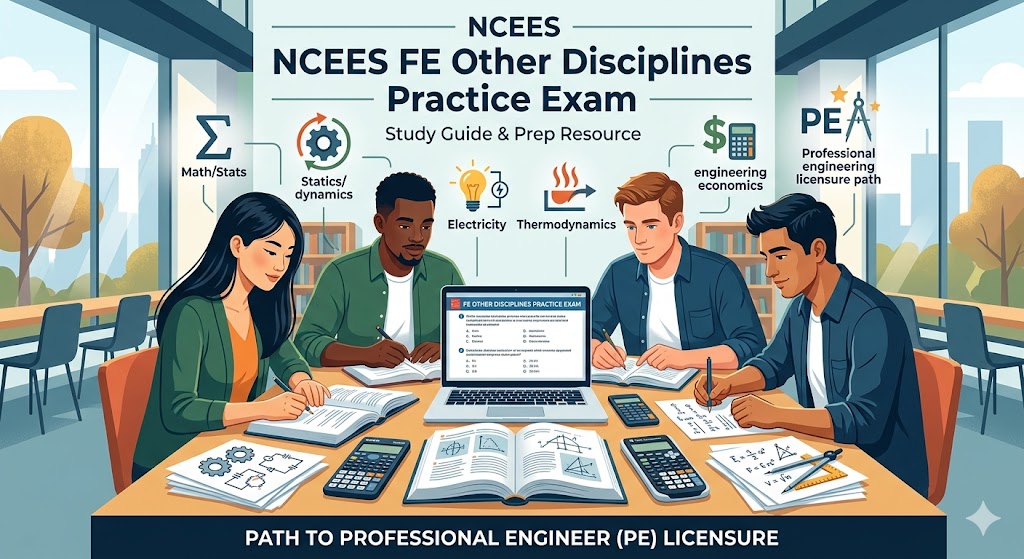
Additional Information
What the Course Entails and Exam Details
This examination does not have a formal 'course' structure, but it covers a vast range of engineering subjects you likely studied during your university years.
The official NCEES FE Other Disciplines exam specifications outline the exact knowledge areas and the approximate number of questions in each topic, which include: Mathematics, Probability and Statistics, Computational Tools, Ethics and Professional Practice, Engineering Economics, Statics, Dynamics, Mechanics of Materials, Material Properties, Fluid Mechanics, Thermodynamics, Heat Transfer, Electricity, Sensors and Data Acquisition, Industrial Engineering, and other critical concepts.
The exam itself is a computer-based test (CBT), providing a modern and efficient testing experience.
You are not allowed outside materials and must use the provided electronic version of the NCEES FE Reference Handbook, which is the sole reference source available during the test.
What to Expect in the Final Exam
You should expect to face 110 multiple-choice questions throughout the exam, which are often structured to test both your conceptual understanding and problem-solving abilities.
The total appointment time is 6 hours, which includes a brief tutorial, a non-disclosure agreement, a 25-minute scheduled break, and approximately 5 hours and 20 minutes of actual testing time.
The exam is scored using a scaled method, based on the number of correct answers you provide, and there are no penalties for incorrect answers.
While NCEES does not release the exact passing score, your performance is compared against a minimum competency standard determined by subject-matter experts.
The results are reported as either a pass or a fail, and they are typically available within 7–10 days after your exam date through your MyNCEES account.
Approved calculators are essential, and only specific models from brands like Casio, Hewlett Packard, and Texas Instruments are permitted within the test center.
How to Study and Exam Centers
Effective preparation is key to success on the FE Other Disciplines exam, and a good strategy includes starting your study well in advance of your desired test date.
You should acquire and study the official NCEES FE Other Disciplines Reference Handbook, as it is the critical resource you will have access to during the actual exam.
Make sure to utilize the official NCEES FE Other Disciplines Practice Exam and other high-quality prep materials to understand the exam format and practice solving various types of engineering problems in a timed environment.
Identify your weaker areas among the tested subjects and dedicate sufficient time to reinforcing your understanding and improving your performance in those topics.
Practice using your approved calculator efficiently, ensuring you are familiar with all its relevant functions before the exam day.
The FE exam is administered year-round at approved Pearson VUE test centers across the United States and internationally.
You can register for the exam and schedule your testing appointment directly through the official NCEES website, where you can select your preferred location, date, and time based on availability.
Job Opportunities from the Course
Passing the FE Other Disciplines exam marks you as an Engineer-in-Training (EIT) and unlocks numerous entry-level engineering positions across a broad range of industries.
The diverse nature of the 'Other Disciplines' specification makes you suitable for interdisciplinary roles and fields that value a solid, general engineering foundation.
Furthermore, this certification is the prerequisite step towards achieving the prestigious Licensed Professional Engineer (PE) status, a credential that significantly enhances your career progression, earning potential, and authority in the engineering field.
Here are specific job opportunities and career paths that passing this exam can facilitate:
Entry-Level Engineer in various disciplines
Project Engineer
Design Engineer
Systems Engineer
Operations Engineer
Technical Sales Engineer
Industrial Engineer
Test and Quality Engineer
Consulting Engineer (starting roles)
Roles within government, manufacturing, consulting, and technology sectors
Unlocking the path to PE Licensure, which is vital for significant career advancement and specialized roles.
Frequently Asked Questions
Reviews
5.0
Based on 0 reviews
Leave a Review
No reviews yet. Be the first to review!