
NCFSA Officers Training Practice Test
$69.00
- Buy to unlock unlimited access to all Quiz questions and Answers in this Quiz.
- After purchase you can print a PDF of the whole quiz at any point. The PDF will contain the questions and the correct answers.
About this Exam
The NCFSA Officers Training certification is a premier designation designed for ambitious fire service professionals seeking to ascend the ranks into leadership and command positions. This comprehensive program is specifically tailored for current firefighters, lieutenants, and captains who desire to validate their mastery of advanced supervisory concepts, administrative duties, and operational command strategies. Achieving this certification demonstrates a candidate's readiness to shoulder the significant responsibilities of a fire officer, ensuring the safety of their crew and the community through proven competency and educated decision-making. It represents the crucial transition from task-oriented performance to strategic leadership within the fire service hierarchy.
Ready to test your knowledge?
Buy Now to Access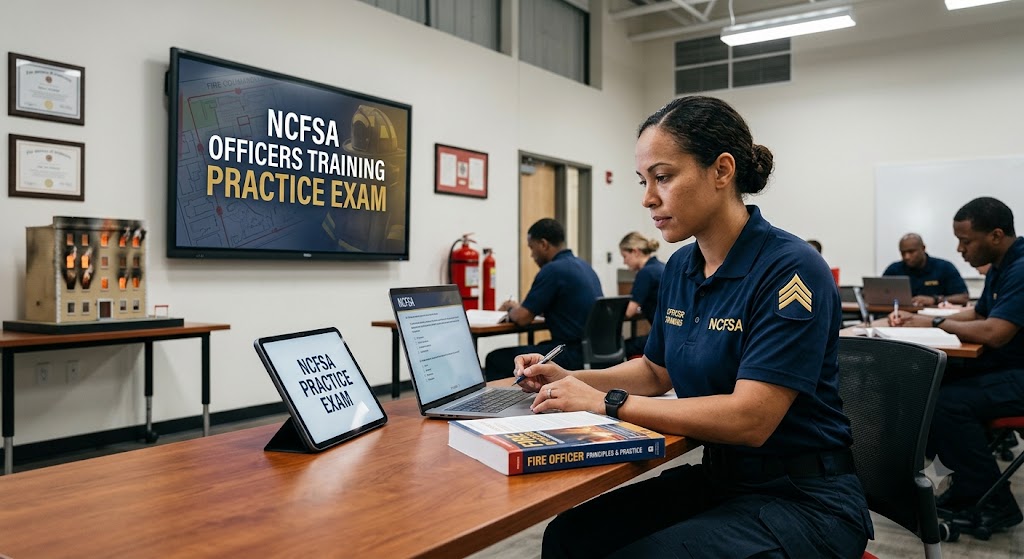
Additional Information
What the Course Entails and Exam Details
The preparatory course for the NCFSA Officers Training exam
is rigorous and wide-ranging, reflecting the complex nature of modern fire
department leadership. The syllabus typically covers several core domains
essential for officer competency. Candidates will delve deeply into Human
Resource Management, covering leadership styles, personnel evaluation, conflict
resolution, and health and safety regulations. Another critical area is
Administrative Duties, which includes managing budgets, writing effective reports,
and understanding the legal framework surrounding fire service operations. The
Community Risk Reduction section focuses on fire prevention, public education,
and disaster planning. The most operationally critical domain is Emergency
Service Delivery, where candidates are tested on the Incident Command System
(ICS), strategic and tactical deployment of resources at various emergency
scenes, and post-incident analysis. Understanding standard operating procedures
(SOPs) and safety management protocols is woven throughout every topic.
What to Expect in
the Final Exam
The final certification exam is a comprehensive assessment
of the candidate's cognitive understanding of the training material. It is a
formal, proctored evaluation. Candidates should expect a significant
multiple-choice examination, which is designed to test knowledge recall,
situational judgment, and the application of leadership principles. A high
degree of critical thinking is required, as many questions present real-world
scenarios that an officer would encounter on the fireground or in the station.
While the exact number of questions and time limits can vary slightly by
jurisdiction, a typical exam might consist of 100 questions to be completed
within a strict two-hour window. A minimum passing score, often 70% or higher,
is required to demonstrate proficiency. In some integrated program structures,
a practical skills evaluation or portfolio review may also be required,
assessing the candidate's ability to complete administrative tasks or command a
simulated incident, though the core of the final testing event remains the
cognitive exam.
How to Study and Exam Centers
Preparation is the absolute key to success on the NCFSA
Officers Training exam. Candidates must first master the primary text, which is
typically based on current NFPA standards for Fire Officer professional
qualifications. Passive reading is insufficient; active study methods are
crucial. Utilize the NCFSA Officers Training Practice Test extensively;
this is the single best way to become familiar with the phrasing, difficulty
level, and format of the questions you will encounter. We highly recommend
creating comprehensive flashcards for definitions, legal statutes, and ICS
protocols. Group study sessions with other candidates allow you to discuss
complex scenarios and gain different perspectives on command decisions.
Once you are prepared, you must register for the examination
through the official NCFSA portal or your state's designated fire training
commission website. The cognitive exam is typically administered at authorized,
professional Exam Centers. These are often located within state fire
academies, regional emergency training facilities, or authorized community
colleges equipped with secure testing labs. In some regions, third-party
professional proctoring services may also be utilized to offer more flexible
testing dates. Ensure you possess the required prerequisites, such as current
Firefighter II and Instructor I certifications, before attempting to schedule
your test date.
Job Opportunities
from the Course
Earning the NCFSA Officers Training certification
significantly enhances a candidate's promotion potential and unlocks a defined
career path within the fire and emergency services sector. This certification
is often a mandatory prerequisite for advancing to supervisory and management
ranks.
Specific job titles and career paths this certification
unlocks include:
- Fire
Lieutenant
- Fire
Captain
- Company
Officer
- Incident
Commander (at the company level)
- Training
Officer
- Fire
Marshal (depending on accompanying specialized training)
- Station
Manager
- Safety
Officer
- Battalion
Chief (as a stepping stone for future promotion)
- Fire
Department Administrator
Frequently Asked Questions
Reviews
5.0
Based on 0 reviews
Leave a Review
No reviews yet. Be the first to review!