
NCHSE Standard 10 Technical Skills Practice Test
$69.00
- Buy to unlock unlimited access to all Quiz questions and Answers in this Quiz.
- After purchase you can print a PDF of the whole quiz at any point. The PDF will contain the questions and the correct answers.
About this Exam
The NCHSE Standard 10 Technical Skills assessment is a vital certification tool for students on a path to a career in the healthcare industry.
Developed by the National Consortium for Health Science Education, this standard specifically validates that a student has mastered the fundamental technical skills required for any entry-level healthcare role.
This certification is designed for high school or post-secondary students enrolled in health science programs.
It provides a recognized benchmark, proving that the student has both the conceptual understanding and the basic hand-on competencies necessary to enter the workforce or advance to specialized training.
Ready to test your knowledge?
Buy Now to Access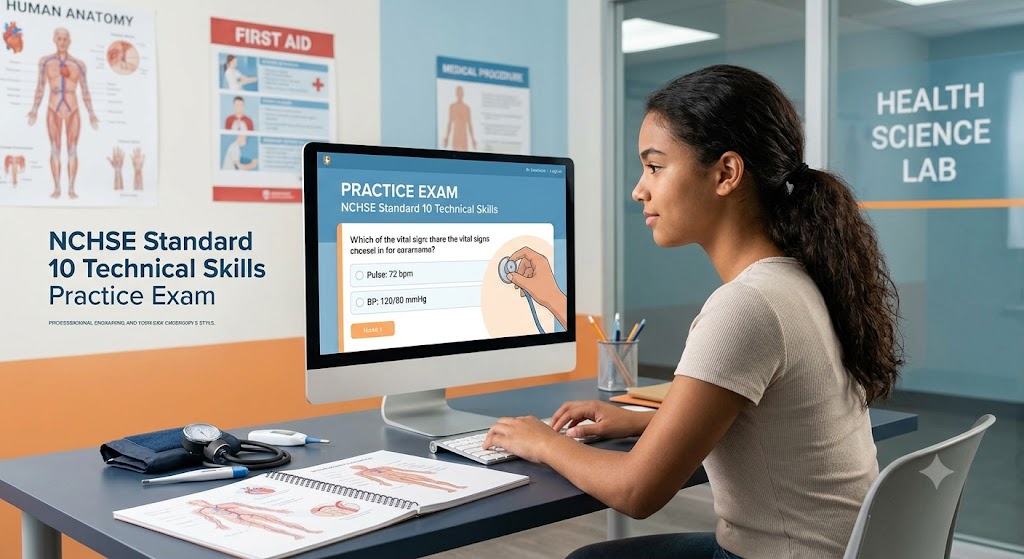
Additional Information
What the Course Entails and Exam Details
This technical skills assessment focuses on the overarching
foundation of practical medical knowledge, rather than a single specific job
title.
The core syllabus and skills covered within this standard
can be summarized in two main pillars:
- Measuring
and Recording Vital Signs:
- This
is the backbone of technical competence. You must be able to accurately
measure, record, and interpret temperature, pulse, respirations, blood
pressure, and pain assessment.
- A
student should understand the normal ranges for different demographics
(infants, children, adults, geriatrics) and identify abnormal readings
that require immediate action.
- It
covers the proper use of equipment, from blood pressure cuffs
(sphygmomanometers) to thermometers and stethoscopes.
- Emergency
Procedures and First Aid Knowledge:
- This
includes the knowledge necessary for obtaining or validating training or
certification in fundamental life-saving techniques.
- Topics
cover the principles of Cardiopulmonary Resuscitation (CPR), the use of
an Automated External Defibrillator (AED), understanding and assisting
with Foreign Body Airway Obstruction (FBAO), and general First Aid
concepts.
- It
tests the proper procedural steps in a medical emergency.
The study path for this certification includes both academic
instruction and structured practice of these hands-on skills in a controlled
lab or classroom setting.
What to Expect in the Final Exam
When you sit for the final exam for the NCHSE Standard 10
Technical Skills, you should prepare for a rigorous validation.
The format of the exam can vary slightly depending on how
the school or district administers the NCHSE National Health Science
Assessment, of which this standard is one part. However, a common format
includes:
- Exam
Format: Multiple-choice questions. It is important to note that many
comprehensive technical skills assessments from NCHSE may also include a
separate practical skill demonstration, especially if this is taken as a
end-of-program competency test. However, a dedicated "Standard 10
Practice Test" is usually focused on the theoretical and
scenario-based multiple-choice portion.
- Question
Types: You will encounter knowledge recall questions, situational
judgement scenarios where you must apply correct procedural steps, and
questions interpreting medical data.
- Time
Limit: When part of the full National Health Science Assessment (11
Standards, approx. 100 questions), the total time is often 90-120 minutes.
If administered as a standalone module for Standard 10, expect a
proportional time limit (e.g., 20-30 minutes for 15-20 questions).
- Passing
Score: The typical passing threshold is determined at the state or
local level, but generally falls between 70% and 80%.
You must enter the exam well-rested, with a deep
understanding of the protocols for measuring vital signs and the sequence of
steps for life-saving interventions.
How to Study and Exam Centers
Effective study strategies are key to conquering this exam.
Here is an actionable approach to ensure you are ready:
- Actionable
Study Strategies:
Repeat and Refine Practical
Skills: You cannot study for a technical skills exam by just reading. You
must practice. Spend consistent time in the lab taking real vital signs on
classmates. Practice using a stopwatch and standard equipment until the process
is instinctual.
Master the Normal Ranges:
Create flashcards for the normal parametersof every vital sign and memorizing
them is non-negotiable.
Learn the Steps In Order:
For CPR, AED use, and first aid procedures, the specific order of actions is
crucial. Practice the steps as scenarios, saying them out loud (e.g.,
"Check the scene, check for response, call 911, check for
breathing...").
Use Practice Tests:
Utilize authorized online test banks, NCHSE-aligned curriculum study guides,
and previous practice exams to get comfortable with the types of situational
questions you will encounter.
Study Scenario-Based
Questions: Many questions place you in a situation (e.g., "You are
measuring blood pressure on a patient who has just exercised. The reading
is..."). Practice analyzing these situations and choosing the correct
course of action, which may include waiting or alerting a supervisor.
- Exam
Administration: The NCHSE Standard 10 exam is typically administered
in your school's authorized testing center, computer lab, or classroom.
It is usually delivered through a secure online testing portal. Talk to
your health science instructor to understand how and when the exam is
scheduled in your specific program.
Job Opportunities
from the Course
Passing the NCHSE Standard 10 Technical Skills exam
validates a strong core of practical competence. Combined with a comprehensive
health science curriculum, it prepares you for immediate entry into several
career paths or provides a critical foundation for advanced study.
Below are specific job titles and career paths this
certification helps to unlock:
- Direct
Entry Roles:
- Medical
Assistant (Entry Level): Performing vital sign measurements is a
daily task.
- Nurse
Aide (Entry Level / Pre-Certification): Essential in long-term care
settings.
- Patient
Care Technician (PCT): Working under the direction of a nurse.
- Home
Health Aide: Vital signs are a core requirement for patient
monitoring in the home.
- EKG
Technician (Knowledge Base): Often a combined pathway, understanding
heart rhythm and basic vital signs is foundational.
- Healthcare
Support Staff: Providing varied administrative and patient-facing
assistance.
- Foundation
for Advanced Careers (Critical Step):
- Registered
Nurse (RN) / Licensed Practical Nurse (LPN): The initial clinical
skills mastery.
- Emergency
Medical Technician (EMT): Standard 10 knowledge is the prerequisite.
- Physical
Therapist Assistant (PTA): Monitoring patient responses to therapy.
- Surgical
Technologist: Fundamental technical and safety skills.
- Veterinary
Assistant: Technical skills transferable to other species.
This certification is your passport into the healthcare
workforce. Use this study guide, commit to rigorous practice, and take that
first confident step toward your healthcare career. Good luck!
Frequently Asked Questions
Reviews
5.0
Based on 0 reviews
Leave a Review
No reviews yet. Be the first to review!