
NCIC Certification Practice Exam
$69.00
- Buy to unlock unlimited access to all Quiz questions and Answers in this Quiz.
- After purchase you can print a PDF of the whole quiz at any point. The PDF will contain the questions and the correct answers.
About this Exam
The National Crime Information Center (NCIC) Certification is a critical credential required for criminal justice professionals who need access to the FBI’s sprawling NCIC database.
This database serves as the backbone of United States law enforcement intelligence, housing millions of records related to wanted persons, missing individuals, stolen property, and criminal histories.
The certification exam is meticulously designed to ensure that every user authorized to access this sensitive information understands how to utilize the system effectively, accurately, and, most importantly, legally.
It is typically mandatory for personnel working within police departments, sheriff’s offices, dispatch centers, correctional facilities, and other authorized governmental agencies.
By verifying the competence of operators, the NCIC Certification safeguards the integrity of the data and ensures that the system remains a reliable tool for public safety and officer survival across the country.
Ready to test your knowledge?
Buy Now to Access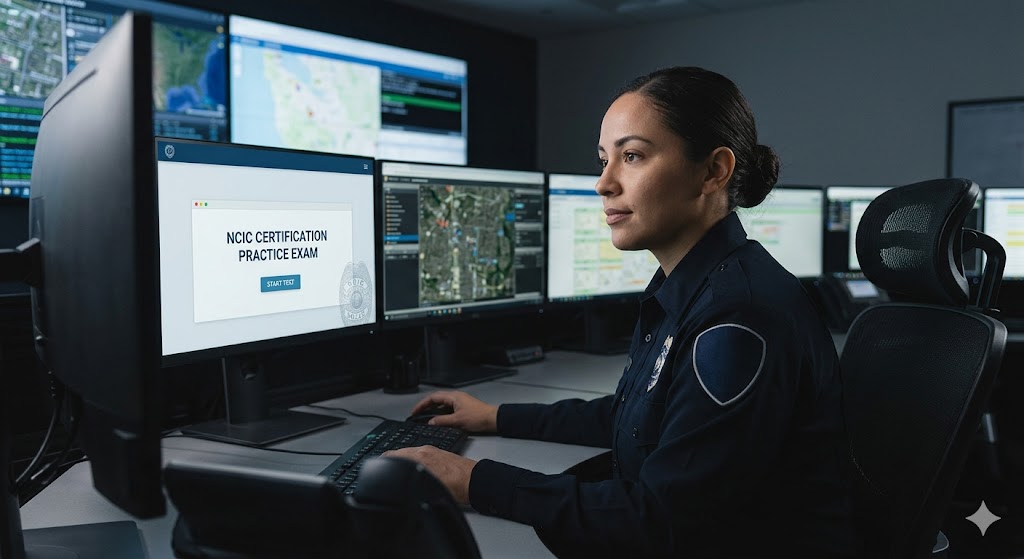
Additional Information
What the Course Entails and Exam Details
Preparing for the NCIC Certification requires a deep dive into the official NCIC Operating Manual and related CJIS (Criminal Justice Information Services) security policies.
Candidates will cover the fundamental principles of the database, learning about the various file categories such as Vehicle, License Plate, Missing Person, Wanted Person, and Stolen Article files.
The training emphasizes the rigorous data quality standards, highlighting the mandatory fields required for a record to be accepted into the system.
A significant portion of the curriculum focuses on system operations, including terminal requirements, security procedures, and proper message keys (MKEs) for inquiry, entry, modification, and cancellation of records.
Furthermore, students are trained in valid code formats and must grasp the strict policies governing the dissemination and use of Criminal History Record Information (CHRI) accessed through the Interstate Identification Index (III).
Accuracy and validation are constant themes throughout the course, mirroring their importance in real-world applications.
What to Expect in the Final Exam
The structure and format of the final NCIC Certification exam are largely determined by the specific State Criminal Justice Information Services (CJIS) Systems Agency (CSA), but they share common characteristics.
Candidates should prepare for a comprehensive exam that often includes a substantial multiple-choice component, focusing on regulations, policy compliance, security requirements, and data entry rules.
In many states, the examination also incorporates a practical application section or hands-on scenario-based questioning.
This requires the operator to demonstrate proficiency by correctly formulating queries, interpreting complex NCIC responses, and determining the appropriate actions based on the system's output.
Due to the critical nature of the information handled, the passing score threshold is generally very high, frequently requiring candidates to achieve a minimum score between 80% and 100%.
The exam is typically timed to simulate the fast-paced environment of law enforcement operations.
It is crucial for candidates to review their specific state guidelines regarding allowed materials, retake policies, and the frequency of necessary recertification, which is commonly required every two years.
How to Study and Exam Centers
The cornerstone of effective studying for the NCIC Certification exam is a thorough review of the NCIC Operating Manual and the state’s specific supplement.
These resources contain all the essential procedures, codes, and policy requirements covered on the test.
Active learning strategies, such as creating flashcards for common codes, message keys, and validation regulations, can significantly improve retention.
Many agencies offer official study guides, practice quizzes, and internal training sessions that closely mimic the exam format.
Hands-on practice is arguably the most valuable study method; if permitted, trainees should practice forming inquiries and reviewing records on a training terminal under the guidance of a supervisor.
This practical exposure helps bridge the gap between abstract policy and operational reality.
Regarding exam logistics, the NCIC Certification test is not available to the general public and cannot be taken at standard commercial testing centers like Pearson VUE.
Because access to the NCIC database is restricted, the exam must be proctored within a secure, authorized criminal justice facility.
Typically, the test is administered internally at the candidate's employing agency (such as a police department or dispatch center) by a designated Terminal Agency Coordinator (TAC) or a CJIS-authorized trainer.
Candidates should coordinate with their agency’s training department to schedule the exam and confirm the specific testing protocols in their jurisdiction.
Job Opportunities from the Course
A broad range of crucial roles within the law enforcement and criminal justice sectors require or heavily prioritize NCIC Certification.
This qualification is often a non-negotiable prerequisite for employment in these positions.
Police Officer
Deputy Sheriff
Public Safety Dispatcher / 911 Operator
Police Records Clerk / Technician
Correctional Officer
Crime Analyst
Probation and Parole Officer
Terminal Agency Coordinator (TAC)
Evidence Technician
Court Clerk (with access to criminal records)
Criminal Justice Information System (CJIS) Trainer
Investigative Assistant
Frequently Asked Questions
Reviews
5.0
Based on 0 reviews
Leave a Review
No reviews yet. Be the first to review!